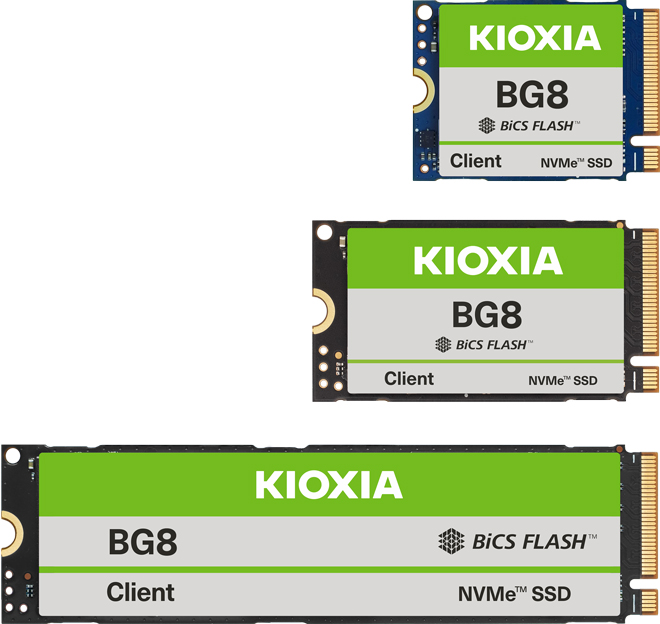
IN Brief:
- Kioxia has introduced the BG8 SSD series for OEM client systems using eighth-generation BiCS FLASH 3D NAND.
- The PCIe 5.0 drives are offered in M.2 2230, 2242, and 2280 form factors, with capacities up to 2TB.
- Client storage is absorbing higher performance demands as AI workloads, compact system design, and platform refresh cycles reshape memory planning.
Kioxia has introduced the BG8 series of solid-state drives for PC OEMs, bringing PCIe 5.0 performance to compact M.2 storage modules for mainstream client systems.
The new SSD family uses Kioxia’s eighth-generation BiCS FLASH 3D TLC NAND and is intended for slim notebooks, commercial PCs, consumer notebooks, desktops, and other OEM platforms where storage performance, board space, and power efficiency have to be balanced inside increasingly compact designs.
The drives support PCIe 5.0 Gen5 x4 and NVMe 2.0d, with M.2 2230, 2242, and 2280 form factors available. Capacities include 512GB, 1TB, and 2TB options, giving OEMs a spread of configurations across small-footprint mobile platforms and larger desktop or commercial systems.
Kioxia lists sequential read performance of up to 10,300MB/s and sequential write performance of up to 10,000MB/s. Random performance reaches up to 1.4 million IOPS for read operations and up to 1.3 million IOPS for writes. Compared with the previous BG7 generation, the BG8 series delivers up to 47% higher sequential read, 67% higher sequential write, 44% higher random read, and 30% higher random write performance.
The BG8 family uses a DRAM-less architecture with Host Memory Buffer support, allowing the SSD to use host system memory while avoiding a discrete DRAM package on the module. That approach helps preserve board space and manage cost in compact systems, while still enabling stronger performance than earlier mainstream client SSD generations.
Security support includes self-encrypting drive options based on TCG Opal 2.02, giving OEMs a hardware-based route for managed commercial systems and business client platforms. Sampling is underway for selected PC OEM customers, with systems using the drives expected from the second quarter of 2026 onwards.
Storage planning is being pulled into broader platform design decisions as client devices handle more local AI inference, heavier content workloads, larger application data sets, and faster wake-and-resume behaviour. The move to PCIe 5.0 improves bandwidth, but it also tightens requirements around signal integrity, power delivery, thermal spreading, firmware validation, and host platform compatibility.
That supply-side pressure has already been visible in AI inference pushing NAND supply into constraint, where embedded and client device makers are increasingly exposed to demand from data centre and AI infrastructure markets. BG8 gives OEMs a faster client storage option, but the broader memory market is becoming harder to treat as a stable commodity layer.
The small M.2 formats are especially important. PCIe 5.0 performance in 2230 and 2242 layouts creates greater thermal and layout discipline, because compact boards leave less copper area and fewer mechanical options for heat spreading. Host designers also need to account for the behaviour of DRAM-less drives under mixed workloads, where system memory use, firmware efficiency, and power-state transitions all influence real-world performance.
With BG8, PCIe 5.0 storage moves further into mainstream OEM design rather than remaining confined to premium modules. The shift narrows the performance gap between high-end and volume client platforms, while making NAND, interface validation, and storage thermal design more prominent in the overall system architecture.