IN Brief:
- Bioelectronics is moving from planar arrays to 3D, shape-matched interfaces.
- A porous “pop-up” mesh delivers 240 electrodes across 91% organoid coverage.
- The platform supports network-wide mapping, stimulation, and drug-response readouts.
A Northwestern University-led team has developed a soft, three-dimensional electronic mesh that wraps around human neural organoids, pushing electrophysiology tooling beyond the planar constraints that have limited how much of a spherical tissue model can be observed at once.
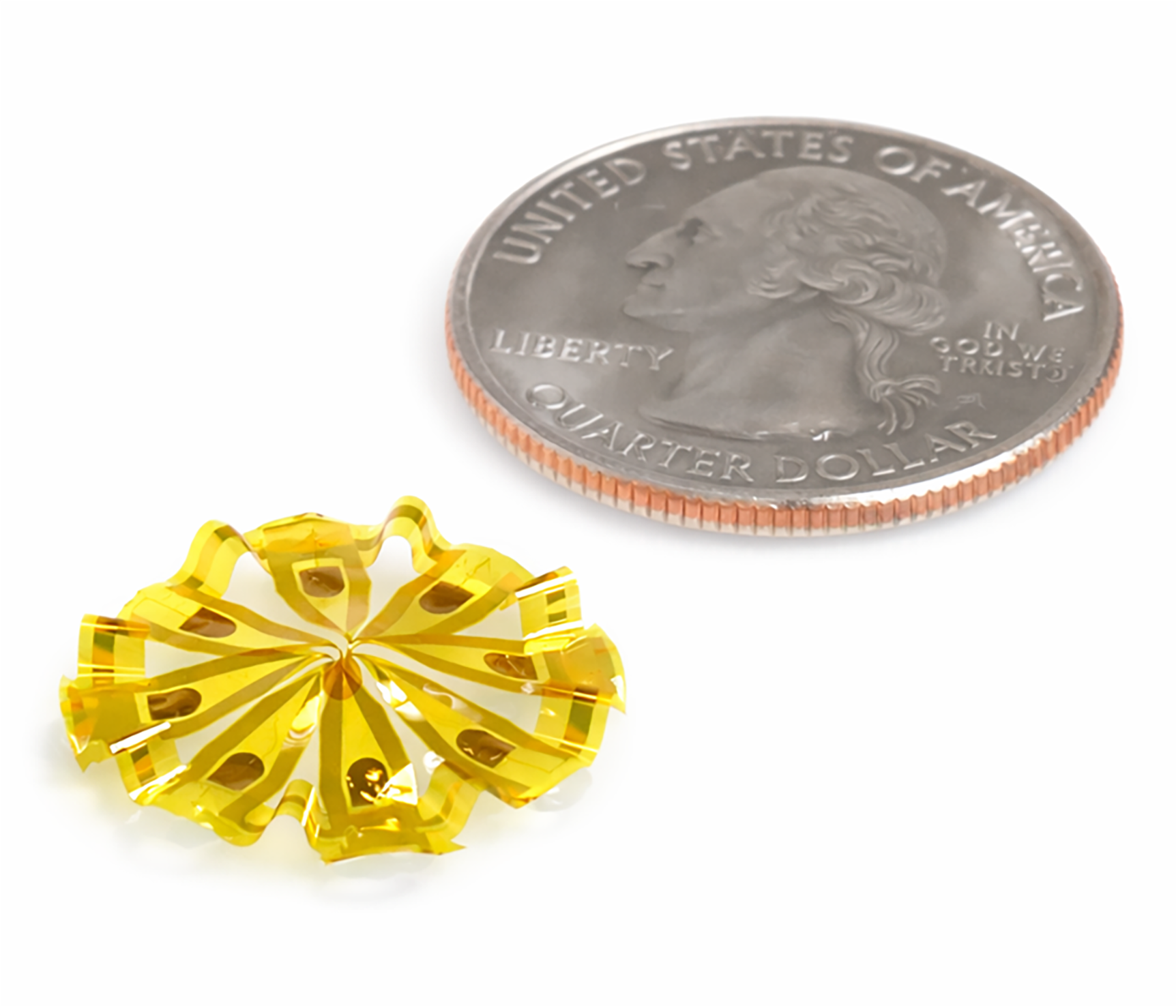
The device starts as a flat, rubbery lattice and then transforms into a 3D structure through controlled mechanical buckling — the same basic concept as a pop-up book — producing a shape-conformal framework that can envelope an organoid without blocking its metabolism. The mesh is porous, allowing oxygen and nutrients in, and waste products out, while carrying hundreds of miniature electrodes that maintain contact across the tissue surface.
In one demonstrated configuration, the framework covered 91% of an organoid’s surface and integrated 240 individually addressable microelectrodes. The electrodes are reported at around 10 microns in diameter — roughly cell-scale — enabling dense sampling across the organoid rather than sparse probing at a handful of points. The study was published on 18 February in Nature Biomedical Engineering.
The practical outcome is a shift from localised recordings to network-level measurement. When the team compared lower-channel-count systems with eight or 32 electrodes against the full 240-channel mesh, the higher-density interface captured synchronised oscillatory waves spanning the organoid, with the electrode geometry enabling a 3D map of activity and observable timing differences as signals propagated across the tissue.
John A. Rogers, Louis Simpson and Kimberly Querrey Professor of Materials Science and Engineering, Biomedical Engineering and Neurological Surgery at Northwestern University, said, “Human stem cell-derived organoids have become a major focus of biomedical research because they enable patient-specific studies of how tissues respond to drugs and emerging therapies. A key missing component is hardware technology that can interrogate, stimulate and manipulate these tiny analogs to organs in the human body.”
The platform is designed to do more than record. It can also stimulate, delivering electrical pulses to provoke responses at specific locations, and it is intended to combine with imaging and optogenetics for richer experiments. In drug response work, the team reported that exposure to 4-aminopyridine increased neural signalling, while botulinum toxin disrupted coordinated activity, supporting use in pharmacology workflows where functional network changes matter as much as single-neuron events.
Colin Franz, physician-scientist at Shirley Ryan AbilityLab and Associate Professor at Northwestern University Feinberg School of Medicine, said, “This advance is really about building the right tools for a new class of biological models.”
The mechanical nature of the scaffold also creates an additional lever: the mesh can shape how organoids grow. By modifying the microlattice design, the researchers report non-spherical geometries — including cubic and hexagonal forms — with organoids growing into the imposed structure. That suggests a route to more repeatable tissue shapes for experiments and, potentially, modular assembly approaches where differently patterned organoids are combined into more complex systems.
The work sits at a boundary between materials, microfabrication, and high-channel-count interfacing — an area where packaging choices, electrode stability, and biocompatible mechanics decide whether dense sensing remains reliable over the longer experimental windows that organoid research increasingly demands.