IN Brief:
- Q5D and Kyocera AVX are developing custom IDC connectors for robotic wire-harness assembly.
- The work builds on three years of testing across wire gauges, current levels, and harsh-environment performance.
- Automated harness production could reduce manual assembly constraints in aerospace, automotive, and industrial equipment.
Q5D Technologies and Kyocera AVX have expanded a three-year collaboration to develop custom insulation displacement connectors for automated wire-harness assembly.
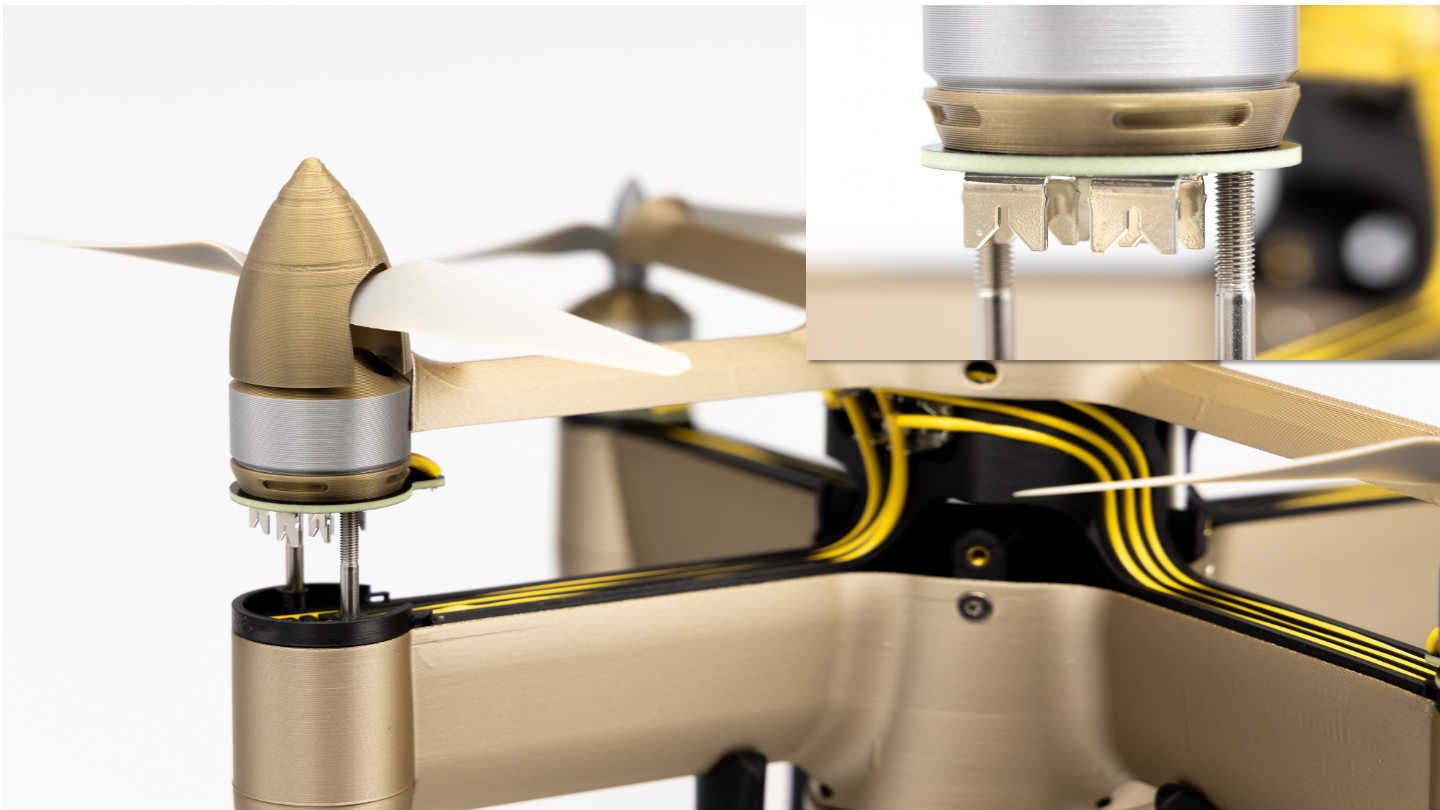
The connectors are being optimised for termination by Q5D’s robotic wiring platforms, which use five-axis manufacturing systems to automate wire placement and termination on complex assemblies. The work addresses one of the most labour-intensive operations in electronics and electromechanical manufacturing: producing wiring harnesses for systems that must fit tight spaces, withstand movement, and maintain repeatable electrical performance.
Insulation displacement contacts differ from conventional crimp contacts by allowing a wire to be terminated without stripping. The contact pierces the insulation and forms an electrical connection directly with the conductor. That makes the method attractive for robotic assembly, where a machine can lay the wire, hold it in place, and press it into a controlled termination in a repeatable motion.
Q5D and Kyocera AVX have carried out joint test programmes using established IDC product families with customer-specified wires. The evaluations have covered harness conductors from around 12 to 32 AWG, with current levels ranging from small-signal connections to approximately 20A. The work has focused on cold-weld terminations and robust performance under shock and vibration.
The companies are now moving from standard IDC parts towards custom connector designs. Those concepts are being developed to support automated placement and termination while allowing contact count and layout to scale with the application. Once qualified with early adopters, the technology is intended to support more repeatable approaches to automated harness production across several industrial sectors.
Wire harnesses have become a constraint in advanced manufacturing. Electronic content has increased across aircraft, vehicles, industrial machinery, appliances, and connected equipment, while harness production still relies heavily on skilled manual work. That creates cost pressure, introduces variability, and makes production scaling more difficult without expanding labour-intensive assembly cells.
The issue is sharper where wiring is no longer confined to separate looms added late in the build. More products require conductors to be integrated into structural parts, housings, and three-dimensional assemblies. Robotic wiring systems can address part of that requirement, but only when the connector and termination process are designed for automated handling from the outset.
IDC technology gives robotic systems a direct route because the wire can be terminated without stripping, crimping, or feeding separate contacts through a conventional harness workflow. The design work then centres on contact geometry, material selection, conductor compatibility, tolerance control, and validation under mechanical stress.
Aerospace and industrial equipment also bring long qualification cycles. A robotic harness process still has to meet electrical, vibration, shock, thermal cycling, and service-life requirements. Treating the connector as part of the automation system, rather than a passive component added to a manual workflow, gives the process a stronger route into demanding applications.
If the approach scales, wiring could move closer to the automated assembly methods already used for PCBs, modules, and mechanical subassemblies. Harness production has remained one of the more stubborn gaps between electronics design and physical system integration; connector designs built around robotic assembly are a practical step towards closing it.