IN Brief:
- QinetiQ and Additive Manufacturing Solutions flew a laser-built titanium bracket at Boscombe Down.
- The component was produced from recycled titanium powder derived from retired airframes.
- The work targets domestic feedstock qualification to reduce reliance on imported aerospace titanium.
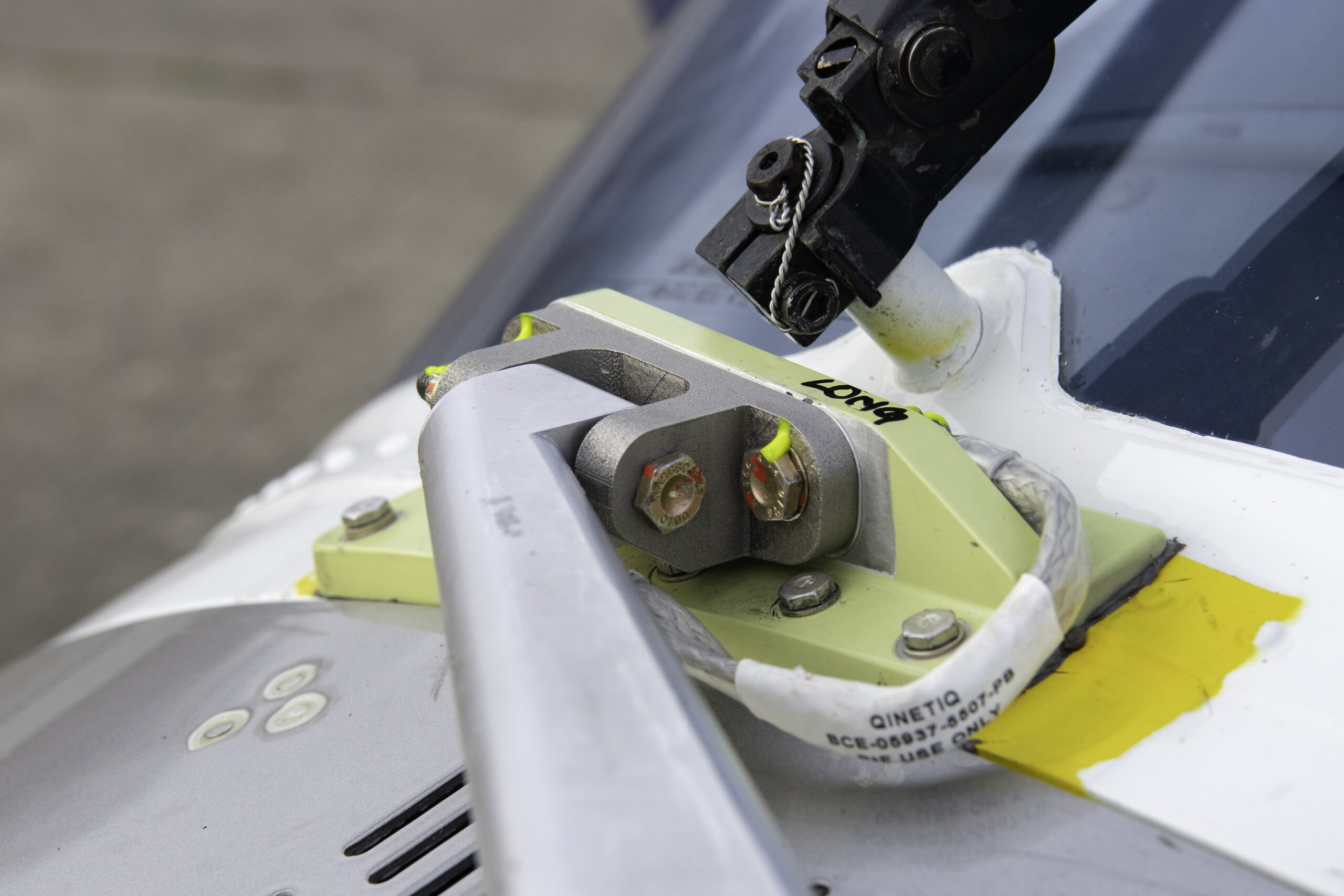
A bracket manufactured from recycled titanium using laser powder bed fusion has completed its first flight on a QinetiQ helicopter at the Ministry of Defence’s Boscombe Down test site, marking a rare milestone for circular-economy feedstock in a safety-critical aerospace application.
The part — described as a bracket manufactured from recycled titanium powder — was built via laser powder bed fusion (LPBF), a process whose qualification burden is rarely about geometry and almost always about powder pedigree, process stability, and post-build verification. Titanium’s sensitivity to interstitial pickup, batch-to-batch chemistry variation, and powder handling contamination makes it an unforgiving candidate for “recycled” narratives unless the supply chain can demonstrate traceability back to source material, plus repeatable powder morphology and flow characteristics after atomisation.
In this case, the project team set out to repurpose scrap aircraft metal into an aerospace-grade powder feedstock, rather than treating scrap titanium as a one-way route into lower-value products. That matters operationally because titanium supply for aerospace programmes is constrained by long qualification cycles and a limited set of approved producers, and it matters politically because defence aviation supply chains remain exposed to imported titanium routes that are difficult to diversify quickly.
The flight activity is being positioned as an engineering proof-point that recycled titanium can be brought back into service in an airborne component without compromising mechanical performance, inspection requirements, or build consistency. For LPBF components in titanium alloys, that typically implies a chain of controls that extends beyond powder chemistry to include particle size distribution, oxygen and nitrogen limits, build parameter windows, heat treatment and, where required, hot isostatic pressing, plus non-destructive evaluation aligned to the component’s criticality.
While the bracket itself is a modest part, the real payload is the process evidence: demonstrating that a closed-loop route from decommissioned airframes to qualified powder can be engineered, audited, and repeated within the UK. If that pathway scales, it offers a lever for reducing dependency on imported aerospace-grade titanium while turning retired metal into a strategic resource rather than a disposal problem.
The next hurdles are predictable, and mostly bureaucratic: establishing broader material allowables, ensuring multi-lot repeatability, and expanding the scope from a single bracket to components that sit closer to primary structure or higher thermal and fatigue loads. The Boscombe Down flight, however, gives the programme something that materials test coupons never will — an operational data point in a real aircraft environment.