IN Brief:
- EV charging and inverter platforms continue to push higher switching frequencies and tighter thermal budgets.
- RIR’s 1,200V SiC MPS diodes focus on low forward drop and fast, temperature-stable switching behaviour.
- Packaging and surge capability point to use in PFC stages and freewheel paths in compact power designs.
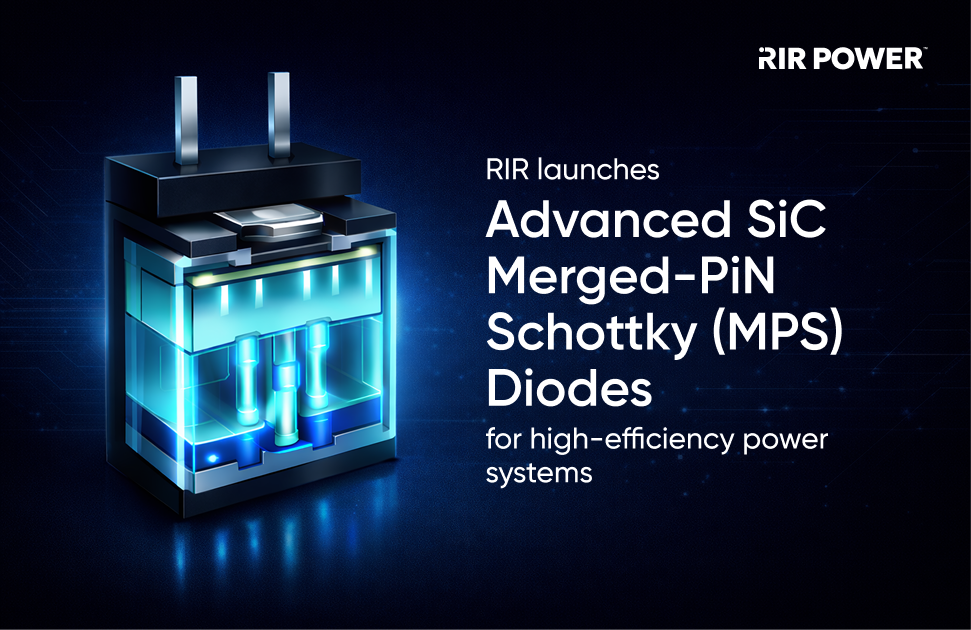
RIR Power Electronics has expanded its silicon carbide discrete portfolio with a set of 1,200V Merged PiN Schottky (MPS) diodes aimed at EV and industrial power conversion, targeting applications where switching behaviour, surge robustness, and thermal management are as important as headline voltage rating. The range is positioned in the familiar space between “it works on paper” and “it survives in the field” — fast chargers, on-board chargers, solar inverters, motor drives, and other systems that punish rectifiers with repetitive transients.
In technical terms, the company is leaning on the MPS structure’s appeal to power designers: Schottky-like switching without reverse recovery current, combined with characteristics intended to handle real surge and fault conditions. Across the published device set, RIR lists a maximum repetitive peak reverse voltage of 1,200V and maximum junction temperature of 175°C, with parts offered at forward-current ratings of 10A, 20A, and 40A in TO-247-2L packaging.
The datasheets emphasise “no reverse recovery current” and “fast switching independent of temperature,” alongside a low forward-voltage profile. For example, the 10A part lists a typical forward voltage of 1.39V at rated current (25°C), with a maximum of 1.70V, while the 20A and 40A variants show the same typical 1.39V at their respective rated currents under the stated conditions. That consistency is useful in platform design, where engineering teams often want a predictable electrical signature as they scale power stages up and down.
Surge handling and thermal resistance figures are included with an eye to applications such as power factor correction and inverter freewheeling, where abnormal events are a design expectation rather than a remote possibility. The 20A device, for instance, lists non-repetitive surge current at 135A (10 ms half-sine, 25°C case temperature) and junction-to-case thermal resistance of 0.55°C/W max. The 40A part lists 225A surge current under comparable conditions, with junction-to-case thermal resistance reduced to 0.27°C/W max, reflecting the typical scaling effect of die size and package utilisation.
From a system perspective, the value proposition is largely about the knock-on effects. Cutting reverse recovery losses reduces heat, which can translate into smaller heatsinks, reduced airflow demands, and more compact mechanical packaging. It also supports higher switching frequencies in topologies that benefit from it, helping shrink magnetics and improve transient response, albeit with the usual caveat that EMI performance must be engineered, not wished for.
For EV platforms, the target use-cases are clear: rectification and freewheel paths in traction inverters, high-power DC fast-charger stages, and on-board chargers where efficiency points are hard-won and thermal headroom is scarce. In industrial settings, similar constraints show up in high-frequency motor drives, welding inverters, and induction heating systems. In each case, the diode is rarely the headline component, but it is often the part that makes a thermal design either feasible or miserable.