IN Brief:
- SDR01 delivers 0.33W rated power in a 1005 metric, or 0402-inch, thick-film resistor package.
- Full rated power is guaranteed up to a terminal temperature of 125°C, with operation specified from -55°C to +155°C.
- AEC-Q200-qualified parts target high-density power, control, and interface circuits exposed to surge and ESD events.
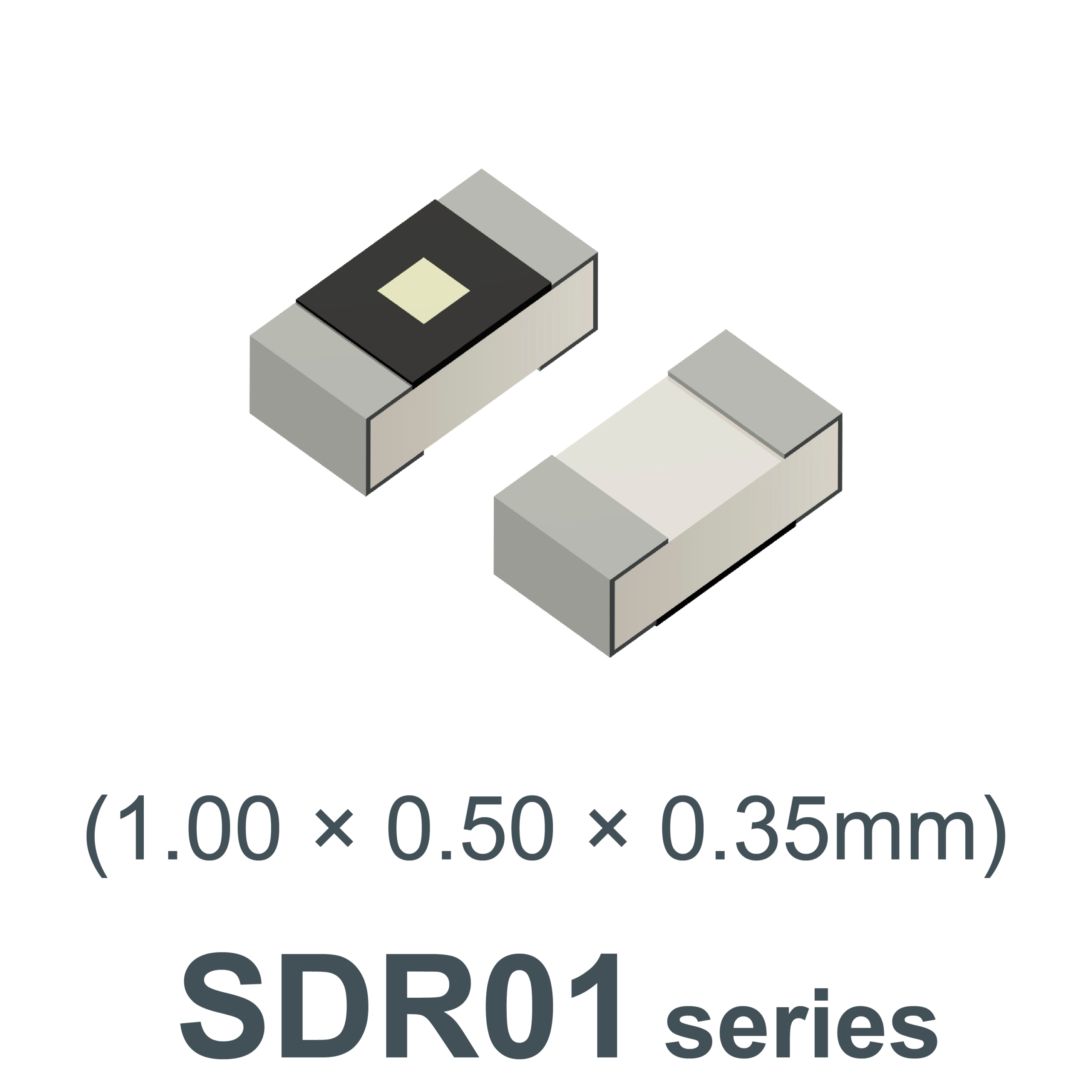
ROHM has introduced the SDR01 series of high anti-surge thick-film chip resistors, delivering a 0.33W rated power in the 0402-inch, or 1005 metric, package.
The components are intended for circuits where board density is increasing without a corresponding reduction in electrical or thermal stress. ROHM is targeting automotive, industrial, consumer, and AI-server equipment, particularly power supplies, control circuits, and interfaces that must accommodate surge events or electrostatic discharge.
A 0402 resistor occupies only around 1.0mm by 0.5mm of board area, making sustained dissipation increasingly difficult as power density rises. Heat has to leave the resistive element through the terminations, solder joints, and PCB while neighbouring semiconductors and passives may be adding to the local temperature.
ROHM has revised the resistive-element and electrode structures to raise the available power without moving to a larger footprint. SDR01 is rated at 0.33W, with the full rating guaranteed up to a terminal temperature of 125°C.
Using terminal temperature rather than enclosure air temperature is significant in compact electronics. A resistor mounted close to a converter, processor, or switching device can have considerably hotter solder joints than the surrounding air, so the temperature at the electrical connection can provide a more useful limit when assessing real board conditions.
The product family operates from -55°C to +155°C and includes AEC-Q200-qualified automotive versions. ROHM specifies resistance values from 1Ω to 10MΩ across the available tolerances, while ±1% parts between 10Ω and 2.2MΩ achieve a temperature coefficient of ±100ppm/°C.
The design is also intended to withstand transient stress rather than simply higher steady-state dissipation. Chip resistors around power rails and interfaces can be exposed to short-duration pulses caused by switching, capacitor charging, inductive loads, or ESD. Those events can damage the resistive film even when average operating power remains comfortably below the continuous rating.
ROHM says SDR01 provides greater surge resistance than its existing ESR series. Increasing that capability in the 0402 footprint gives designers another option where a larger resistor would otherwise be selected primarily to obtain greater pulse handling rather than because its physical size was required by the circuit layout.
The difference can become material across electronics containing large passive populations. Individual resistors are small and inexpensive, but moving repeated functions to larger footprints consumes routing area and can restrict the placement of connectors, magnetics, controllers, and thermal structures that are more difficult to relocate.
Higher rated power can also allow component consolidation where circuit requirements permit. ROHM is positioning SDR01 as a way to replace some larger resistors or reduce parallel component arrangements, although the usable reduction will depend on resistance value, pulse conditions, PCB construction, and the thermal environment of the finished product.
The 0.33W headline figure should therefore not be treated as a substitute for thermal validation. Copper area, board stack-up, adjacent heat sources, airflow, terminal temperature, and the shape and repetition rate of surge events all influence the stress experienced by the device in service.
Automotive electronics place those constraints particularly close together as control units become smaller while carrying more processing, networking, and power functions. Similar pressures exist in industrial controllers and AI-server power assemblies, where dense component placement raises local temperatures even when overall cooling capacity is substantial.
Mass production of SDR01 has already begun, with the parts available through ROHM and distributors including DigiKey and Farnell. The company has quoted a sample price of $0.04 per unit before tax.
The development is a relatively small component change with a straightforward engineering consequence: more continuous and transient power can now be handled in a footprint that previously forced designers towards larger passives. In increasingly crowded power and interface circuits, that can matter more than the dimensions of the resistor suggest.