IN Brief:
- Automotive power electronics continues to compress into smaller ECUs without relaxing mechanical reliability targets.
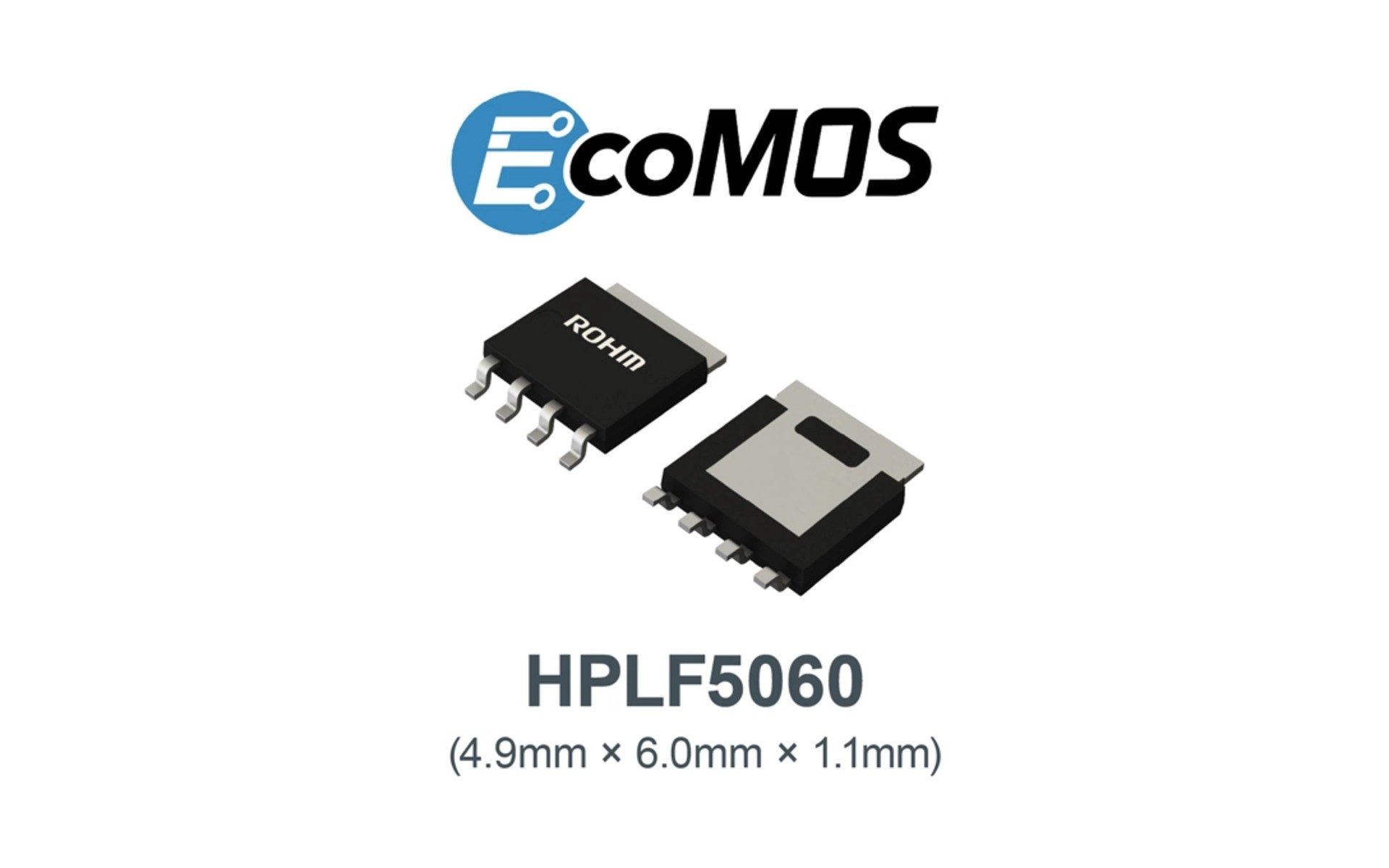
- ROHM is pushing 40 V and 60 V MOSFETs into a 4.9 mm × 6.0 mm gull-wing package with copper clip construction.
- Package-level choices are increasingly dictated by assembly robustness, inspection, and thermal cycling behaviour.
ROHM has expanded its automotive low-voltage MOSFET lineup with new 40 V and 60 V devices using its HPLF5060 surface-mount package, as vehicle designers continue to shrink power stages while demanding higher robustness under vibration and thermal cycling.
The company’s stated target applications include main inverter control circuits, electric pumps, and LED headlights — use cases that sit in the awkward middle ground of “low voltage” and “high consequence,” where failures are costly, and space is always at a premium. As these loads proliferate across vehicles, especially with more electrified auxiliaries, the pressure falls on MOSFET packaging as much as silicon performance.
ROHM is positioning HPLF5060 as a response to the reliability trade-offs that come with aggressive miniaturisation. As packages trend smaller — and often move toward leadless formats with tighter terminal spacing — mounting reliability can become the limiting factor. ROHM’s answer is a 4.9 mm × 6.0 mm package that adopts gull-wing leads, delivering a smaller footprint than the widely used TO-252 (6.6 mm × 10.0 mm) while aiming to improve board-mount robustness.
Gull-wing leads are not a novelty, but they remain useful in harsh environments because they provide a more forgiving mechanical interface at the solder joint and can make solder fillets easier to inspect. In automotive electronics manufacturing, that matters when yield control, automated optical inspection, and long-term field reliability intersect. A smaller package that still exposes lead geometry can be preferable to a compact leadless alternative if the assembly process needs margin against warpage, vibration, and board-level stress.
ROHM is also leaning on copper clip junction technology in the new package, replacing conventional wire bonding with a direct chip-to-leadframe connection via copper clips. The approach is commonly used to reduce electrical resistance and improve thermal and current handling, while also reducing wire-bond related reliability concerns in high-current operation. ROHM’s framing is that this enables high-current operation in demanding automotive environments, where thermal management and transient load response are everyday conditions rather than edge cases.
Commercially, ROHM says mass production for the new HPLF5060-packaged products began in November 2025, with a stated sample price of $3.50 per unit (excluding tax). The devices are also being made available through online distribution channels, including DigiKey and Farnell, which signals an intent to make the package broadly accessible beyond tightly controlled automotive supply agreements.
The move is consistent with the broader automotive power trend: as the bill of materials adds more electrified loads and local power conversion, the “space problem” shifts from PCB real estate to manufacturable, reliable interconnects. Silicon improvements still matter, but the packaging decision increasingly sets the boundary conditions for what a design can survive.