
IN Brief:
- ROHM’s TSC3PAK package brings top-side cooling to surface-mount SiC MOSFETs.
- The 14.00 × 18.58 × 3.50mm package supports automated mounting and a 6.66mm creepage distance.
- Target applications include xEV onboard chargers, electric compressors, server power supplies, and photovoltaic inverters.
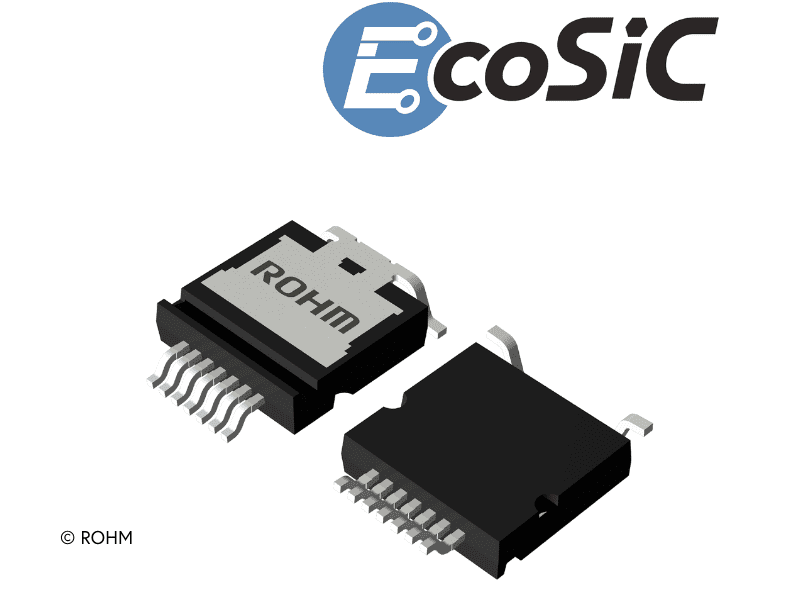
ROHM has developed TSC3PAK, a top-side cooling package for SiC MOSFETs that combines surface-mount assembly with thermal performance closer to conventional through-hole power packages.
The package measures 14.00 × 18.58 × 3.50mm and places the heat-dissipation surface on top of the device. ROHM is using the structure to support automated mounting while maintaining heat dissipation performance comparable with through-hole packages such as TO-247-4L. Mass production of products using the package began in June 2026.
Applications include onboard chargers and electric compressors in electric vehicles, as well as server power supplies and photovoltaic inverters. These systems are pushing SiC devices beyond traction inverters and into auxiliary and infrastructure power stages where switching losses, thermal density, and assembly consistency are all under pressure.
Conventional high-power SiC devices have often used through-hole packages because they provide strong thermal performance during sustained operation. That remains valuable, but through-hole devices can complicate automated assembly, add package height, and restrict layout flexibility. Surface-mount formats can improve manufacturing flow and profile, provided the package can handle heat extraction and high-voltage insulation.
TSC3PAK uses a top-side heat path so heat can be removed from above the package rather than being driven primarily into the PCB. ROHM has also incorporated a proprietary groove structure to secure a creepage distance of 6.66mm, allowing the package to accommodate an AC peak voltage of 1200V in a Pollution Degree 2 environment.
Creepage distance shapes real converter design. High-voltage power stages are constrained by insulation coordination, PCB geometry, certification requirements, and pollution-degree assumptions, all of which affect component spacing and board area. A package that preserves voltage margins while remaining compatible with automated surface mounting can simplify part of the trade-off between power density and production repeatability.
The initial products using TSC3PAK incorporate ROHM’s fourth-generation SiC MOSFETs, which are designed for low on-resistance and high-speed switching. The line-up spans 750V and 1200V variants, with typical on-resistance values ranging from 13mΩ to 90mΩ depending on voltage class and device selection. Simulation models are available to support circuit evaluation.
SiC’s spread into server power and energy infrastructure is already visible in adjacent designs. In AI server backup power, ROHM’s 750V SiC MOSFETs have been adopted for a battery backup unit as high-voltage DC rack architectures advance. TSC3PAK addresses the same density and efficiency pressure from the package side, where heat removal and assembly method can decide whether the device can be used at scale.
Wide-bandgap supply chains are also expanding around both SiC and GaN. ROHM and AIXTRON are scaling GaN production through in-house epitaxy work, while SiC continues to develop around wafer capacity, device structures, packaging, reliability data, and system-level reference designs. Although SiC and GaN serve different voltage and frequency windows, both technologies depend on the same industrial reality: transistor performance is only useful when it can be packaged, cooled, assembled, and qualified repeatedly.
Top-side cooling can support denser converter layouts by moving thermal extraction away from the circuit board and toward a heatsink or cooling plate above the device. That arrangement can reduce stress on the PCB and open new mechanical options, but it introduces its own design requirements around thermal interface materials, mounting pressure, isolation, coplanarity, and service conditions. Package data, mechanical guidance, and thermal modelling become part of the electrical design process.
Automated mounting also changes the manufacturing equation as SiC moves into higher-volume platforms. Manual assembly can be acceptable in specialist power systems, but electric vehicles, data centres, and solar inverters reward repeatability and throughput. A surface-mount SiC package that maintains high-voltage creepage and robust thermal performance gives manufacturers more room to align power density with production efficiency.
The next stage of SiC adoption will be shaped by packages as much as by die characteristics. Gate-drive layout, switching parasitics, protection, magnetics, cooling, insulation, and manufacturability all sit around the MOSFET. ROHM’s TSC3PAK package is therefore part of a wider move from proving wide-bandgap performance to making it easier to build into compact, qualified, and repeatable power-conversion hardware.

