IN Brief:
- High-frequency test requirements are spreading from specialist labs into broader engineering teams.
- FPL1044 extends the FPL range to 44GHz, with DC coupling and a 2.92mm input connector.
- A 40MHz RTSA option with 4.2µs POI aims at intermittent, hard-to-catch RF events.
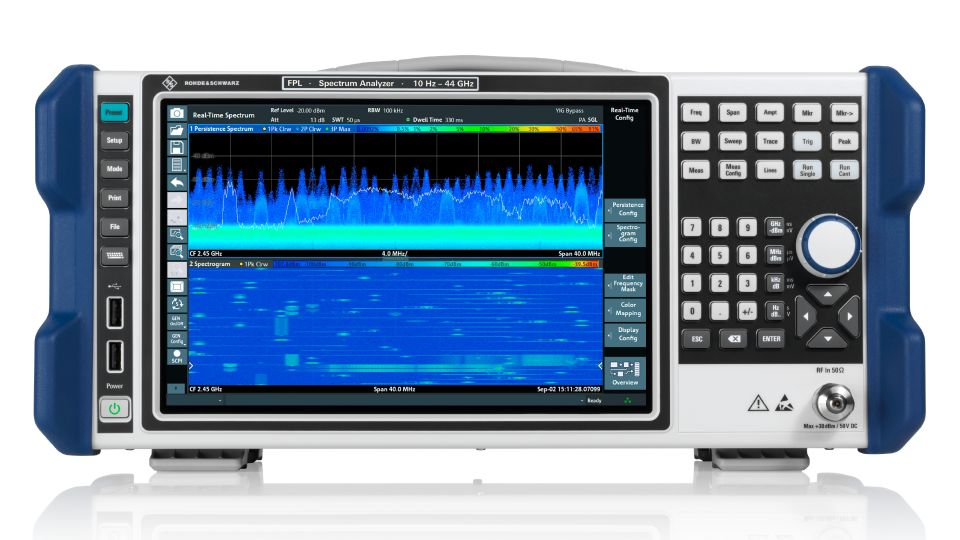
Rohde & Schwarz has launched the FPL1044 spectrum analyser, extending its mid-range FPL family to cover frequencies from 10Hz to 44GHz and pairing the instrument with a new 40MHz real-time spectrum analysis option available across the entire FPL line. The move targets engineers who need access to Ka-band and adjacent high-frequency work without stepping into the cost and complexity tier of high-end lab analysers.
The core specification is the expanded frequency range: the FPL1044 reaches 44GHz, and Rohde & Schwarz is positioning it as the first model in its price class to do so. Within the FPL family, the company also calls out a DC coupling option, allowing measurement from as low as 10Hz, which is relevant for users analysing very low-frequency components or modulation effects without switching instruments. A standard 2.92mm male input connector is included, reflecting the practicalities of maintaining measurement integrity as frequencies climb.
The second part of the launch is the RTSA upgrade. The R&S FPL1-K41R option provides 40MHz real-time spectrum analysis bandwidth, and the company states it can capture and analyse very short events with a Probability of Intercept time as low as 4.2µs. In practice, that speaks to modern RF realities: signals are often bursty, frequency agile, and intermittent by design, whether driven by radar modes, satellite links, hopping schemes, or simply the messy reality of real-world interference.
By combining 44GHz coverage with RTSA capability, Rohde & Schwarz is aiming at a wide set of use cases that increasingly overlap. Aerospace and defence remain obvious drivers — radar and electronic systems testing, satellite links, and navigation-related work all sit in the 26.5GHz to 44GHz region — but the same frequency bands are also central to component development and production QA for filters, amplifiers, and other microwave subsystems. The company also points to on-site maintenance and repair as a target, which is where portability and bench footprint stop being “nice to have” and become deciding factors.
The broader industry context is that high-frequency engineering is no longer confined to a small corner of the lab. More products incorporate microwave and millimetre-wave components, and more teams need at least occasional access to higher-frequency analysis to validate designs, troubleshoot failures, or qualify suppliers. That creates a market for instruments that are capable enough to be trusted, but accessible enough to be deployed beyond a single specialist group.
The immediate question for users will be less about the headline 44GHz figure and more about how the instrument behaves under everyday constraints: dynamic range in crowded spectral environments, usability for non-specialist operators, and the practical value of a 40MHz real-time window when chasing elusive bursts and transients. If the FPL1044 lands as intended, it gives engineering teams a more direct path into Ka-band work, without forcing them to rent time on the “serious” analyser.