IN Brief:
- Edge inference designs are consolidating CPU, GPU, and NPU resources on modules.
- ADLINK’s cExpress-R8 targets COM Express Type 6 carriers with AMD Ryzen Embedded 8000.
- Long lifecycle availability and security features are being built into standardised form factors.
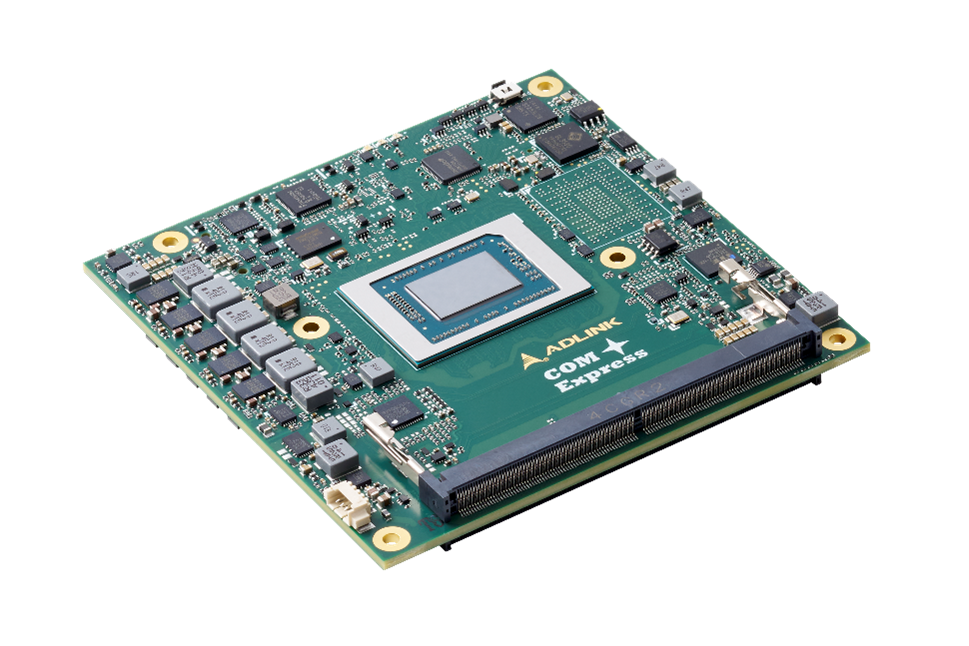
Rutronik has added ADLINK’s cExpress-R8 to its catalogue, expanding distribution for a COM Express R3.1 Type 6 Compact module built around AMD’s Ryzen Embedded 8000 series. The module targets edge compute platforms where inference workloads, video pipelines, and mixed I/O requirements need to be handled within a standardised carrier architecture.
The cExpress-R8 follows the COM Express COM.0 R3.1 mechanical and electrical framework, with a 95 mm × 95 mm footprint. ADLINK positions the module as a drop-in compute element for carrier boards that already support Type 6 pin-outs, keeping redesign effort focused on application I/O and certification rather than reworking the core CPU and memory layout each generation.
At the processor level, the module supports Ryzen Embedded 8000 parts including 8845HS, 8840U, 8645HS, and 8640U configurations, with up to eight Zen 4 CPU cores and integrated RDNA 3 graphics. ADLINK also specifies an integrated XDNA NPU, and quotes up to 39 TOPS combined performance across CPU, GPU, and NPU resources, a figure that is commonly rounded to 40 TOPS in distribution material.
Memory support is up to 96 GB of DDR5-5600, with ECC and non-ECC options. For multi-display systems, ADLINK lists four concurrent display combinations spanning DisplayPort, HDMI, LVDS, and eDP, with build options allowing eDP in place of LVDS, depending on the carrier and target panel interface.
On the expansion side, the module exposes up to 16 PCIe Gen4 lanes, split across an x8 link and multiple x1 links, aligning with accelerator cards, high-speed networking, and frame-grabber class peripherals typically used in vision-heavy edge systems. Storage and peripheral connectivity includes USB 3.x, additional USB 2.0 ports, and up to four SATA 6 Gb/s channels, with an alternative build option for on-board PCIe Gen4 NVMe storage.
Security and determinism are increasingly front-of-mind in edge deployments, and ADLINK includes TPM 2.0 support using an Infineon device, alongside 2.5 GbE networking based on Intel’s I226 series, with time-sensitive networking called out as a Linux build option. Operating system support listed by ADLINK includes Windows 11 22H2 and Ubuntu 22.04 LTS, keeping the module aligned with common industrial, and applied AI software stacks.
Rutronik has also highlighted a 10-year lifecycle expectation, reflecting the procurement realities of industrial and medical designs where platform churn creates cost, and regulatory headaches, long after the compute module is technically obsolete.