IN Brief:
- Samsung completed a commercial vRAN call on a live Tier 1 US operator network using Intel Xeon 6.
- The setup ran on a single COTS HPE server with a Wind River cloud platform.
- Samsung and Intel are pitching consolidation as the path to lower power, CAPEX, and OPEX, while preparing for AI-RAN and 6G.
Samsung Electronics and Intel say they have completed the industry’s first commercial call using Samsung’s virtualised RAN (vRAN) solution with Intel’s Xeon 6700P-B processor series on a Tier 1 US operator’s live network. The test ran on a single commercial off-the-shelf server from Hewlett Packard Enterprise, using a cloud platform from Wind River, in what demonstrates a practical route to single-server vRAN deployments.
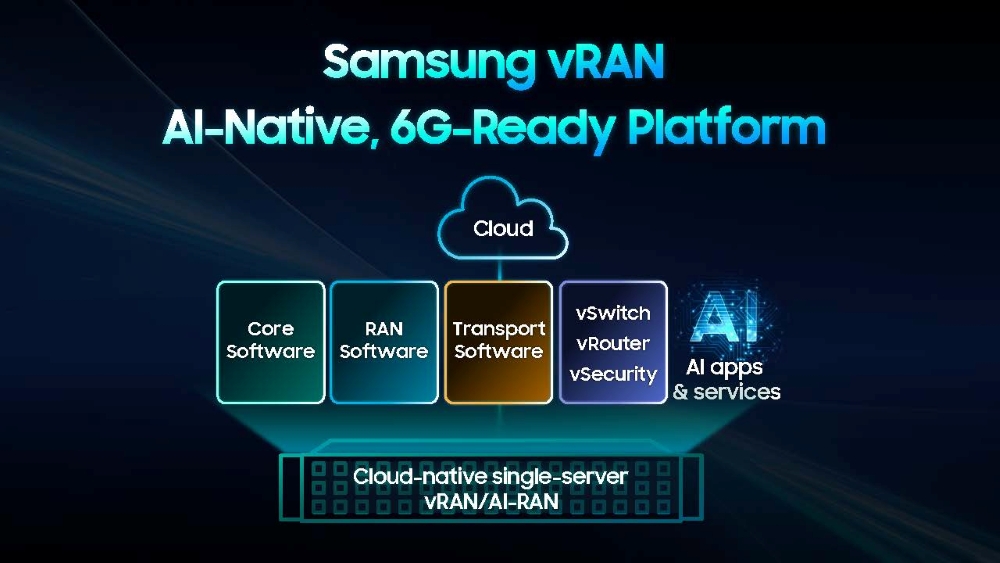
The technical claim is not merely “it worked”. Samsung is pushing the idea that operators can consolidate multiple software-driven network elements — mobile core, radio access, transport, and security — onto fewer, more powerful servers, reducing complexity and site footprint while improving power efficiency. That is the real fight in vRAN: the architecture is only compelling if it does not quietly multiply compute, cooling, and operational effort.
The milestone arrives only months after the first wave of Intel Xeon 6 SoCs became commercially available, and ties the work directly to “AI-native, 6G-ready networks”. The subtext is that operators want flexibility, but they also want fewer boxes, fewer truck rolls, and fewer line items on energy bills.
June Moon, Executive Vice President and Head of R&D for Samsung’s Networks Business, said the test confirms “real-world readiness” under live network conditions and that single-server vRAN deployments can meet “stringent performance and reliability standards”. Samsung’s stated outcome is reduced network power consumption, CAPEX, and OPEX, alongside smoother adoption of AI-RAN and AI services enabled by flexibility and automation.
Intel is selling the silicon story: higher core counts and built-in acceleration. Samsung says its vRAN leverages Intel Xeon 6 SoC capabilities including Intel Advanced Matrix Extensions, Intel vRAN Boost, and up to 72 cores, with “significant improvements” in AI processing, memory bandwidth, and energy efficiency compared with the prior generation. Cristina Rodriguez, Vice President and General Manager of Network & Edge at Intel, said Xeon 6 provides a compute foundation for “future ready networks”, enabling greater consolidation while lowering power and total cost.
There is also an ecosystem point that matters for deployment reality. The test ran on commercial hardware with named infrastructure partners, which is the minimum bar for operators that are tired of lab demos that collapse under operational constraints. If the industry wants vRAN to be more than an architectural preference, it needs repeatable configurations that can be procured, deployed, monitored, and upgraded without becoming a bespoke science project at every site.
Samsung also points to earlier milestones, including a 2024 end-to-end call in a lab environment using Intel Xeon 6, framing the live-network call as the step from controlled conditions to operational credibility. An analyst quote included in the release argues the achievement moves beyond “theoretical performance gains” and into “practical, deployable innovation”, which is exactly the line operators want to hear — and exactly the line vendors have to prove with sustained performance, not one successful call.
The hardware is ready. The commercial question is whether operators are ready to trust it at scale.