
IN Brief:
- SemiQ will show expanded SiC module technology at PCIM Europe 2026 in Nuremberg.
- The line-up includes QSiC Dual3 modules, AlN substrate options, S3 modules, SOT-227 modules, and full-bridge devices.
- Power-module design is being reshaped by AI infrastructure, EV charging, storage, solar, and industrial motor-drive requirements.
SemiQ will showcase expanded silicon carbide power-module technology at PCIM Europe 2026, with new module options targeting AI data centres, EV charging, energy storage, solar PV, and industrial power conversion.
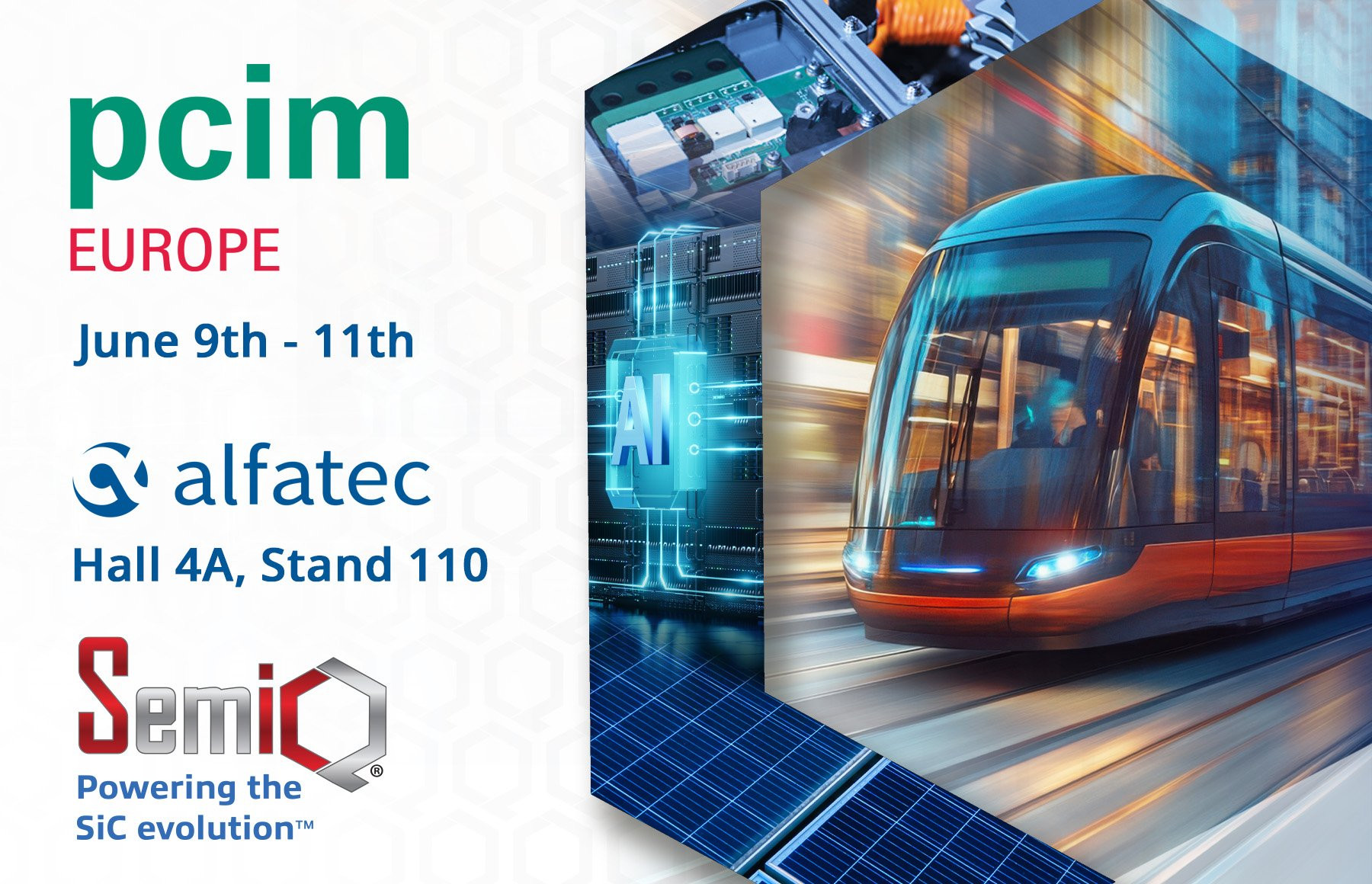
The company’s PCIM line-up includes additions to its QSiC Dual3 MOSFET family, including high-thermal-performance options with aluminium nitride substrates and pre-applied thermal interface material. The event runs from 9 to 11 June at Messe Nürnberg in Nuremberg, with SemiQ exhibiting through Alfatec’s stand.
The QSiC Dual3 modules are 1200V half-bridge MOSFET modules designed for high-efficiency, high-density power converters. SemiQ is also highlighting third-generation SiC module activity, with reduced specific on-resistance and lower turn-off energy losses compared with earlier generations. Those gains are intended to reduce cooling demands and switching losses in equipment such as EV charging stations, energy storage systems, and industrial motor drives.
Additional devices include S3 modules with a 608A half-bridge option, SOT-227 modules with RDS(on) values of 7.4mΩ, 14.5mΩ, and 34mΩ, B2T1 six-pack modules for motor drives and AC-DC converters, and B3 full-bridge modules delivering up to 120A with RDS(on) as low as 8.6mΩ. The range reflects the spread of SiC adoption across multiple power-conversion formats rather than a single flagship application.
Power-electronics design is increasingly being shaped by the full converter environment rather than by device switching performance alone. Faster switching is only useful when the module, substrate, thermal stack, busbar, gate-drive arrangement, and protection scheme can support it without adding unacceptable losses, ringing, heat, or system complexity.
That is why substrate and thermal-interface choices are becoming more prominent in SiC module selection. Aluminium nitride offers strong thermal conductivity and insulation properties, while pre-applied thermal interface material can reduce assembly variability and simplify integration. In higher-power systems, a few degrees of thermal margin can affect lifetime, enclosure design, and cooling-system cost.
The qualification environment is also tightening. JEDEC’s SiC reliability guidelines for power electronics have added more formal structure around short-circuit evaluation and stress procedures. As SiC moves into higher-volume and more safety-critical equipment, module suppliers must demonstrate reliability at the system level, not only attractive headline figures at the device level.
AI infrastructure adds another layer of pressure. Data-centre power systems are moving towards higher voltages, denser conversion stages, and more demanding backup-power architectures. SiC modules used in server power supplies, battery chargers, and high-voltage DC-DC converters sit inside an electrical system where conversion efficiency affects cooling load, rack density, and operating cost.
Industrial drives, storage, and solar systems bring different operating conditions, including repetitive switching stress, variable loads, outdoor environments, and long service lives. SemiQ’s expanded portfolio points to a SiC market now defined by packaging, thermal design, and application fit as much as by the semiconductor material itself.

