IN Brief:
- Amsterdam Drone Week runs 10–13 March 2026 at RAI Amsterdam alongside Intertraffic’s mobility and traffic technology programme.
- Sony’s focus is high-resolution aerial capture, compact depth sensing, and OEM-ready camera control for multi-drone operations.
- Sensor fusion and remote configuration are moving from “nice-to-have” to baseline capabilities in commercial UAV payload design.
Sony will exhibit at Amsterdam Drone Week 2026 in Amsterdam from 10–13 March, with its stand positioned around a familiar theme in industrial UAV payloads: higher-resolution imaging, tighter integration, and more repeatable workflows. The company’s Digital Imaging Solutions line-up for the show spans full-frame stills capture, zoomable block cameras intended for embedded platforms, and compact LiDAR depth sensing aimed at mid-range measurement.
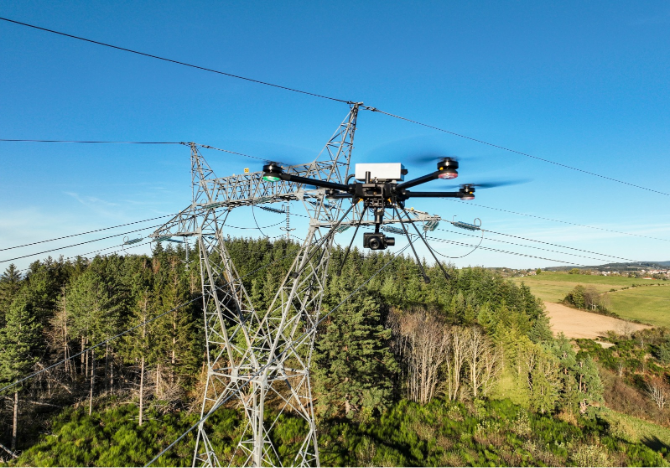
At the centre of Sony’s drone imaging pitch is the ILX-LR1 — a 61.0-megapixel, full-frame camera designed for industrial integration. The body strips back conventional camera features in favour of weight and mounting flexibility, supporting interchangeable E-mount lenses and remote operation. Sony positions the platform for surveying and mapping, photogrammetry, inspection, and surveillance, with the camera intended to sit inside purpose-built payloads rather than being flown as a consumer-style body on a gimbal.
Remote operation is backed by Sony’s Camera Remote Toolkit, which packages two approaches: Camera Remote SDK for deeper, Sony-only control via API functions, and Camera Remote Command for mixed-manufacturer environments using an industry-standard command interface. Sony highlights drone workflows specifically, including in-flight setting changes and post-processing alignment between GNSS data and captured images, as well as multi-camera control for more complex imaging rigs.
On the sensing side, Sony is pushing its AS-DT1 LiDAR depth sensor into the same conversation as aerial imaging payloads. The unit is built around direct time-of-flight (dToF) ranging with a SPAD (single photon avalanche diode) sensor and multi-point ranging, producing 24×24 (576) ranging points. Sony specifies a 30 fps frame rate, a 0.25 mm distance resolution, and ±5 cm measurement accuracy at 10 metres, with a maximum measurement range quoted at 40 metres indoors and 20 metres outdoors under bright conditions (assuming 100,000 lux). The form factor is designed to fit where conventional depth sensors struggle — roughly 29 × 29 × 31 mm, with weight at 50 g or less — supporting integration on drones where payload mass translates directly into endurance.
Sony’s stand plan also includes its FCB-ER9500 zoom camera block, aimed at embedded machine-vision and observation platforms. The model outputs 4K video at 60 fps, uses a STARVIS 2 4K image sensor, and pairs it with a 25× optical zoom lens. Sony highlights an inner-zoom drive design intended to reduce mechanical constraints in system packaging, while maintaining a wide-angle to long-distance transition in a compact block form.
Speaking ahead of the show, Michael Pisch, Senior Manager Sales & Business Development EMEA, Sony Europe, said: “We are excited to exhibit at Amsterdam Drone Week, which will provide the perfect platform to showcase our established range of digital imaging solutions to the industry. We will demonstrate our commitment to developing groundbreaking sensing technologies that enable safe, sustainable and efficient operations, helping our customers push the boundaries of innovation — now and in the future.”