IN Brief:
- STMicroelectronics has introduced Stellar P3E with an on-chip Neural-ART Accelerator.
- The MCU targets software-defined vehicle workloads, including “virtual sensor” functions.
- The architecture is aimed at consolidating real-time control and edge AI without a separate processor.
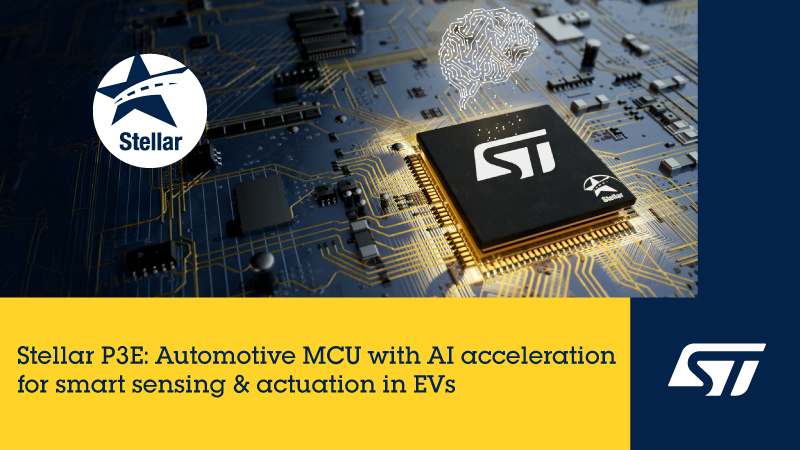
STMicroelectronics has introduced the Stellar P3E, an automotive microcontroller that integrates a dedicated Neural-ART Accelerator intended to run edge AI workloads directly on the MCU. The positioning is explicit: keep inference close to deterministic control, reduce latency, and avoid pushing every decision into a higher-power application processor when the workload is bounded and time-critical.
Automotive electronics teams have spent the past decade splitting compute between real-time controllers and increasingly capable domain processors. That division is now under pressure from software-defined vehicle architectures that expect faster iteration, richer diagnostics, and more adaptive functions across powertrain, chassis, body, and zonal control. The consequence is a growing set of “small AI” tasks — classification, anomaly detection, sensor plausibility, and learned estimators — that need to execute within tight control loops and under functional-safety constraints.
Stellar P3E is aimed at that middle ground. ST’s implementation couples a dual Arm Cortex-R52+ real-time subsystem with the Neural-ART accelerator so that neural workloads can run alongside safety- and security-focused control code, rather than being offloaded to a separate compute island. The company is also pushing the device as an enabler for “virtual sensors”, where models infer signals that would otherwise require additional physical sensing, or provide continuous plausibility checks against sensor drift and failures.
The move is as much about system partitioning as raw performance. Putting inference on the MCU changes how teams distribute software across ECUs, and it changes the cost model: fewer processors, fewer high-speed links between devices, and fewer failure modes introduced by moving fast data between compute domains. It also forces a harder conversation about toolchains, because the value of an embedded accelerator depends on how cleanly models move from training environments into production binaries, how they are versioned, and how they are verified under automotive safety processes.
ST is positioning Stellar P3E within its wider Stellar automotive MCU roadmap, which has been built around high-integration peripherals, high-speed comms options, and security features that reflect the reality of vehicles behaving like long-lived connected systems. The P3E announcement adds an AI acceleration block to that mix, making the MCU less of a peripheral orchestrator and more of a compute node capable of taking on selected perception and estimation tasks without leaving the real-time domain.
If the approach lands, the near-term impact will be architectural: more inference inside ECU-class silicon, fewer excuses for bolting on secondary processors for narrow workloads, and a tighter coupling between control engineering and model-based development in production vehicle software.