IN Brief:
- Sfera Labs has added cellular and positioning to its Strato Pi Max platform, extending the controller beyond wired-only edge deployments.
- The new X2-Series board is compatible with Telit LN920A LTE cards, bringing dual Nano SIM support, GNSS, modem control lines, and front-panel status LEDs.
- The move strengthens Strato Pi Max as a remote gateway platform for field assets, infrastructure monitoring, and distributed industrial IoT systems.
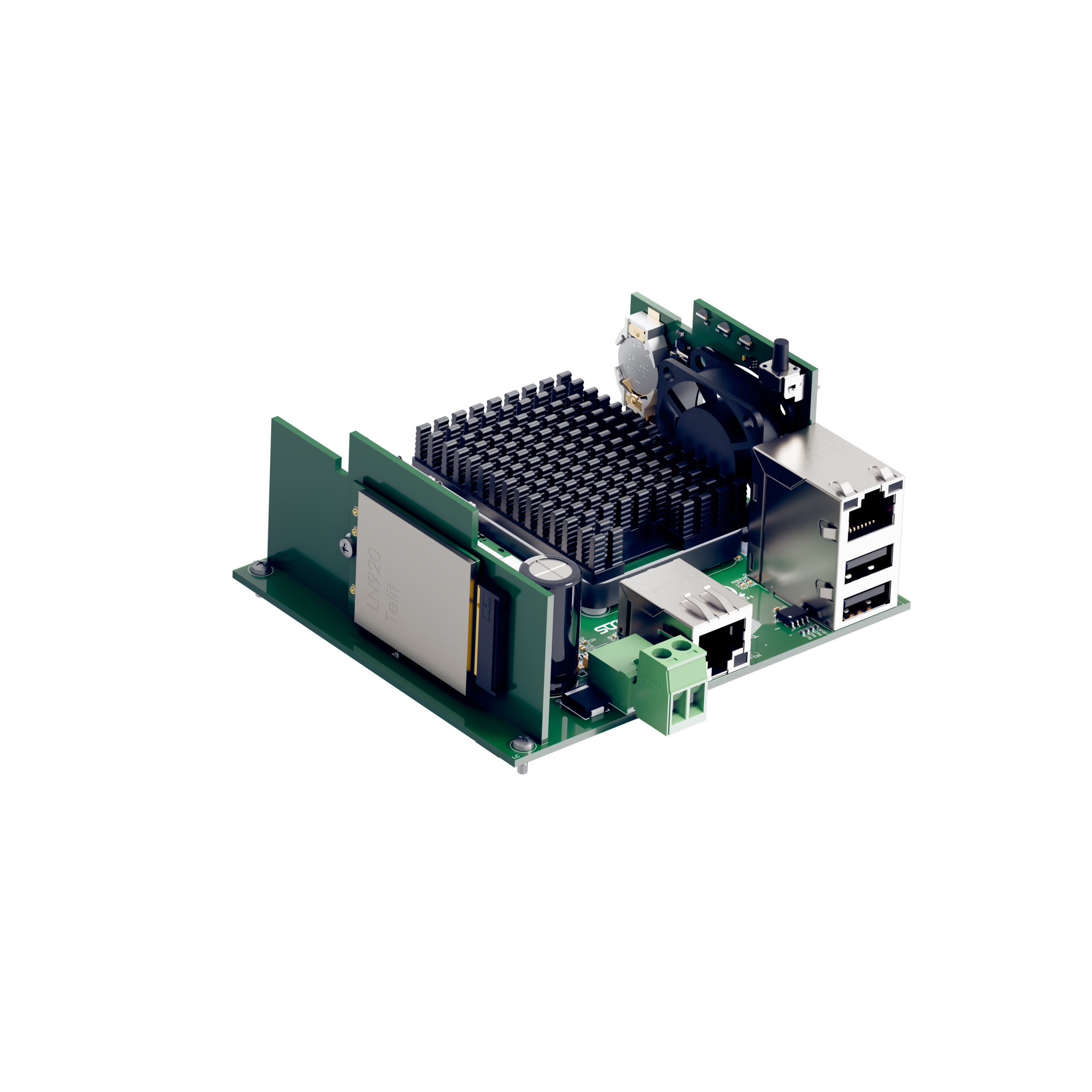
Sfera Labs has expanded its Strato Pi Max platform with an M.2 LTE Module X2-Series Expansion Board that adds LTE connectivity and GNSS positioning to the company’s modular industrial controller line. The new board is available for both Strato Pi Max XL and XS systems, giving the Raspberry Pi Compute Module-based platform a direct route into deployments where Ethernet is missing, Wi-Fi is unreliable, or location data is part of the application rather than an optional extra.
That matters because Strato Pi Max is not pitched as a bare Raspberry Pi carrier. The platform combines a Raspberry Pi Compute Module 4 or 5 with an RP2040 microcontroller, and Sfera Labs has built the surrounding hardware around fault tolerance and field use. The RP2040 handles housekeeping, supervises the Compute Module as a watchdog, manages storage boot options, and can trigger a full power cycle and recovery boot from redundant media. Around that, the controller brings dual Ethernet, Wi‑Fi, Bluetooth 5.0, USB, secure element support, and a DIN-rail form factor that can host up to four internal X2 expansion boards in the XL chassis.
The LTE board slots neatly into that architecture. It is compatible with the Telit LN920A family of M.2 data cards, supports two Nano SIMs for multi-operator or backup configurations, and exposes software control lines for modem power, reset, RF disable, GNSS disable, and GPIO. Front-panel LEDs show both power and network registration state, which is not glamorous, but is exactly the sort of detail that shortens commissioning time when a unit is being installed in a cabinet, a roadside enclosure, or a remote plant room.
On the modem side, the LN920 family brings more than a simple wireless uplink. Telit’s Cat 6 and Cat 12 variants pair LTE data rates up to 300Mbps and 600Mbps respectively with embedded GNSS, WCDMA fallback, broad band support from 600MHz to 3.7GHz, and operator pre-certification for worldwide deployments. That gives Sfera Labs a ready-made cellular building block that already looks familiar in IIoT gateways and routers, rather than asking integrators to stitch together an external modem, a USB interface, and a separate GNSS receiver.
The result is a more self-contained edge platform. Remote monitoring, fleet-connected equipment, smart infrastructure, mobile data acquisition, and geo-referenced sensor networks all tend to fail at the same point: the controller is capable enough, but the communications layer is an afterthought. By moving LTE and positioning inside the Strato Pi Max expansion framework, Sfera Labs is tightening that weak point and nudging the platform further from maker-adjacent hardware and closer to a modular industrial gateway with a clearer field role.