IN Brief:
- Synopsys has released its first Multiphysics Fusion solutions for customer deployment.
- The tools integrate physics-aware analysis into timing, design closure, multi-die, analogue, and photonic workflows.
- The release supports advanced-node and multi-die designs where electrical, thermal, and packaging effects converge.
Synopsys has made its first Multiphysics Fusion solutions available for customer deployment, bringing signoff-grade physics analysis deeper into advanced semiconductor design workflows.
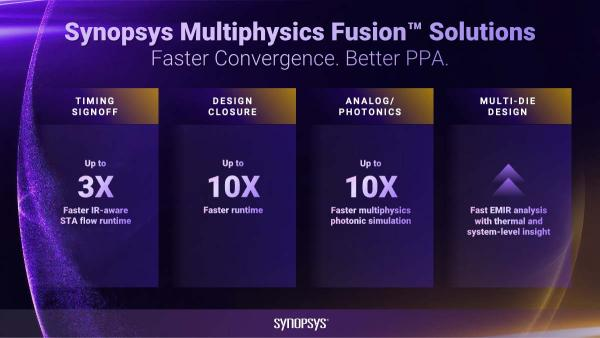
The portfolio integrates multiphysics analysis into timing signoff, design closure, multi-die design, analogue design, photonic IC design, and co-packaged optics workflows. It combines Synopsys AI-powered EDA tools with Ansys signoff analysis to address signal integrity, power integrity, thermal integrity, electromagnetic effects, stress, packaging interaction, and optical-domain constraints.
The first wave includes Multiphysics Fusion for Timing Signoff, Design Closure, Multi-die Designs, and Analog & Photonic Design. The timing signoff flow integrates PrimeTime with RedHawk-SC, RedHawk-SC Electrothermal, StarRC, and HFSS-IC, bringing IR drop, thermal behaviour, stress, extraction, and electromagnetic effects closer to timing analysis.
The design-closure flow combines PrimeClosure with RedHawk-SC to embed power integrity into signoff optimisation. Multi-die support links 3DIC Compiler with RedHawk-SC, RedHawk-SC Electrothermal, and HFSS-IC for concurrent power integrity, thermal, and electromagnetic analysis across dies and packages.
Analogue and photonic flows are also included. Custom Compiler is integrated with HFSS-IC for electromagnetic analysis, while OptoCompiler is linked with Lumerical for photonic IC and co-packaged optics systems. Synopsys is also using NVIDIA CUDA-X libraries, including cuDSS, to accelerate selected workloads, with reported gains across SPICE-accurate timing analysis, design closure, and GPU-accelerated simulations.
Advanced-node and heterogeneous chip design is now constrained by more than transistor density and logic synthesis. Timing paths can be affected by voltage drop, local heating, mechanical stress, parasitics, package geometry, and electromagnetic coupling. Multi-die systems add another level of interaction, where each die, interposer, substrate, and power-delivery structure can influence the behaviour of the whole device.
The foundry ecosystem is already moving in that direction. Synopsys and TSMC’s expanded AI silicon design flows brought IP, EDA, 3D packaging, photonics, and multiphysics analysis into a tighter development environment, reflecting the need to align design closure with manufacturable physical behaviour earlier in the process.
Component modelling is following a similar path at system level. Murata’s integration of simulation models into Ansys workflows brought passive component data closer to design simulation, reducing the gap between schematic assumptions and physical implementation. Synopsys’ Multiphysics Fusion release applies the same principle to chip and package design, where the cost of late discovery is far higher.
More integrated analysis can also reduce unnecessary overdesign. When electrical, thermal, and electromagnetic interactions are not visible early enough, engineering teams often add conservative margins in area, power, cooling, or package design. Those margins can protect the project, but they also increase cost and can limit performance. A more connected signoff flow allows margin to be placed where physical evidence supports it.
AI accelerators, high-performance computing devices, RF systems, and co-packaged optics are pushing EDA tools towards system-level convergence. The release of Multiphysics Fusion adds deployable flows to that trend, treating chip closure less as a sequence of isolated checks and more as a coupled physical design problem.