
IN Brief:
- Germany’s BAAINBw has ordered 60 Thales GO12 short-range battlefield radar systems.
- The mobile radar supports 360-degree detection of drones and vehicles, including in weather conditions that limit optical sensors.
- Deliveries are planned for 2026, with production based at Thales’ Ditzingen site in Baden-Württemberg.
Thales will deliver 60 GO12 short-range battlefield radar systems to the German Armed Forces under an order placed by Germany’s Federal Office of Bundeswehr Equipment, Information Technology and In-Service Support, BAAINBw.
The order covers radar systems, additional equipment, spare parts, and user training, with deliveries planned for 2026. The GO12 is developed in Germany and manufactured at Thales’ Ditzingen site in Baden-Württemberg, anchoring the programme within the country’s defence electronics and sensor manufacturing base.
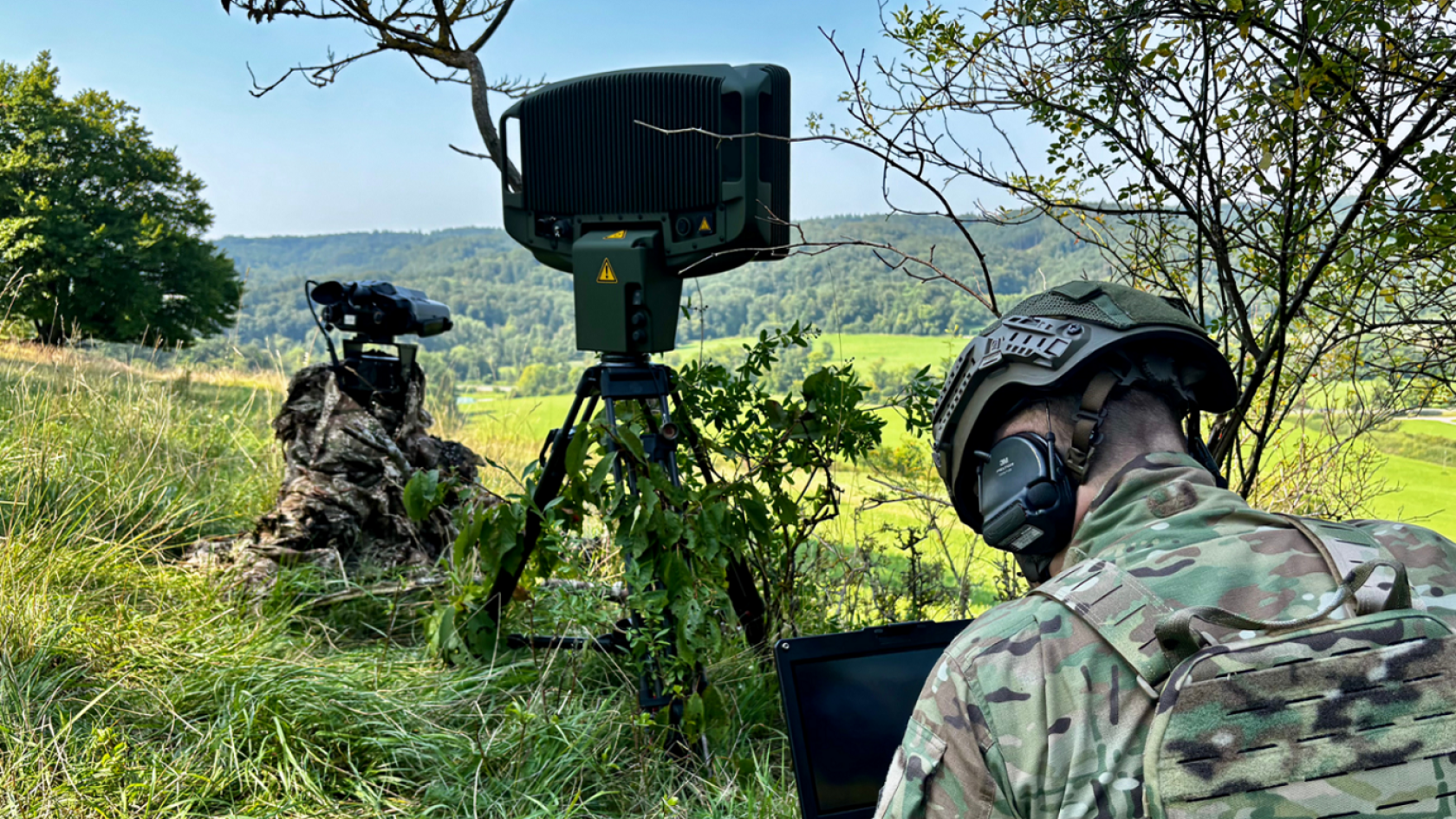
Designed for highly mobile forces, the GO12 is a tactical reconnaissance and artillery radar capable of detecting drones and vehicles with 360-degree coverage. The system is built to operate in rain, snow, and fog, supporting surveillance tasks when optical sensors are degraded by darkness, weather, obscurants, or terrain.
The radar has a sensor volume of 28 litres and can be transported with its supporting equipment by two soldiers. That scale places it well below large fixed or vehicle-mounted surveillance radars, while still giving forward units access to an RF sensing layer that can be deployed rapidly and repositioned as operations shift.
Small unmanned aircraft have changed the value of short-range radar. Low-cost drones can move slowly, fly close to the ground, and operate in numbers that make visual detection unreliable and continuous camera coverage difficult. Radar adds a complementary layer, particularly where ground clutter, poor visibility, and changing weather reduce the confidence of optical systems.
The electronics architecture behind a system such as GO12 has to balance RF sensitivity, signal processing, power consumption, mechanical ruggedness, environmental sealing, operator usability, and field support. Detection performance alone is not enough if the radar cannot be carried, powered, maintained, and trusted in conditions where larger infrastructure is unavailable.
Short-range ground surveillance is also becoming more closely tied to counter-UAS and mobile air-defence architectures. A radar that can detect drones and vehicles at tactical level can feed wider command systems, cue other sensors, or support effectors depending on the deployed configuration. As European forces strengthen low-level air and ground surveillance, sensor density is becoming a procurement requirement rather than an optional enhancement.
The German order sits within a wider move toward distributed sensing across European defence. In the UK, work on ground-based air-defence radar testing shows how validation methods are evolving as radar-led architectures become more numerous and more complex. Repeatable test environments, electronic confidence, and lifecycle support are now integral parts of radar deployment, rather than separate back-end engineering tasks.
Mobile air-defence developments are moving in the same direction. Diehl’s mobile IRIS-T SLS MK 4 system combines mobility, sensing, command functions, and missile effectors in a more deployable architecture. GO12 occupies a different point in the system chain, but both developments show European defence procurement moving toward layered, mobile, sensor-rich systems that can be fielded closer to operational units.
That direction places sustained pressure on RF and embedded electronics suppliers. Radar front ends, processors, displays, power systems, rugged enclosures, connectors, batteries, software updates, and diagnostic tools all have to support systems that may be deployed frequently rather than protected in fixed installations. Weight, electromagnetic compatibility, maintainability, and ease of training become engineering constraints alongside detection range and classification performance.
Sensor fusion will sharpen those constraints further. Ground surveillance radars are increasingly expected to work alongside cameras, electronic-warfare systems, acoustic sensors, command networks, and counter-UAS effectors. Clean interfaces, dependable data output, and robust update paths become essential when a portable radar is no longer a standalone observation tool but part of a wider operational picture.
Thales’ GO12 order gives Germany another mobile layer for detecting drones and vehicles, while reinforcing the role of short-range radar in contemporary force protection. The procurement is modest compared with large platform programmes, but its engineering character is highly current: compact RF sensing, rugged deployment, software-supported detection, and domestic production capacity are all moving up Europe’s defence electronics agenda.

