IN Brief:
- Toshiba Electronics Europe has started engineering sample shipments of the TB9M030FG SmartMCD motor-control device.
- The AEC-Q100-compliant IC integrates a 32-bit Arm Cortex-M0 MCU, gate driver, LIN transceiver, and automotive battery-level power system.
- The device targets low-speed sensorless field-oriented control of three-phase BLDC motors in pumps, fans, and blowers.
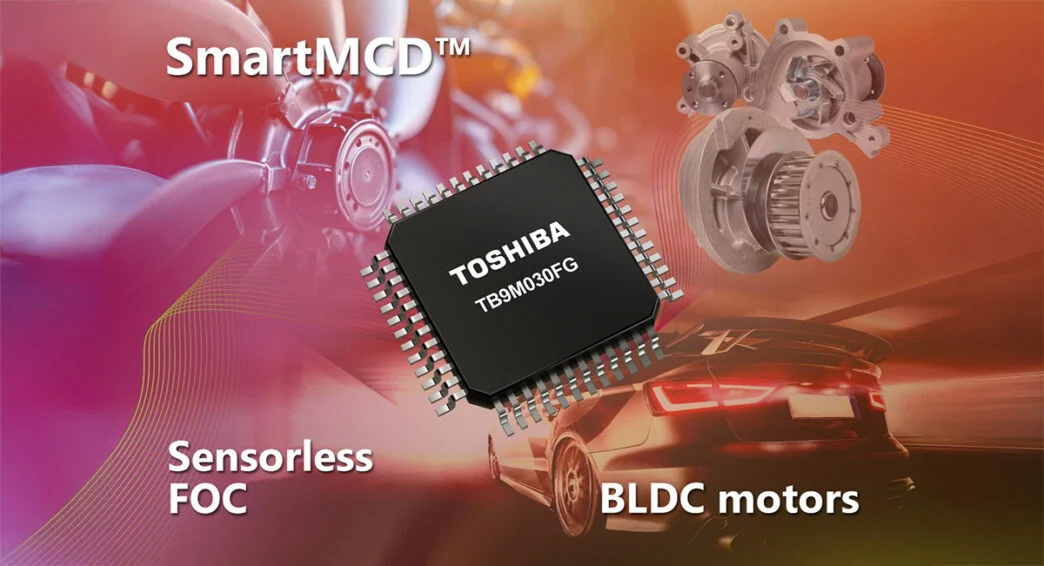
Toshiba Electronics Europe has begun engineering sample shipments of the TB9M030FG, an AEC-Q100-compliant addition to its SmartMCD series that integrates a microcontroller and motor driver for three-phase brushless DC motor control.
The device is designed for low-speed, sensorless field-oriented control of BLDC motors used in automotive systems, including electric water pumps, oil pumps, fans, and blowers. These auxiliary functions are increasingly controlled electronically as vehicle architectures move away from mechanically driven subsystems.
The TB9M030FG integrates a 32-bit Arm Cortex-M0 MCU, 64kB of flash memory, 12kB of ROM, and 4kB of RAM. Its gate driver controls N-channel power MOSFETs for three-phase BLDC operation, while the device also includes a LIN transceiver and a power system capable of operating at automotive battery levels. The IC is housed in a 9mm × 9mm QFP48 package.
Toshiba has included a vector engine co-processor to support shorter FOC cycle times, reduce CPU workload, and limit the size of the required motor-control software. The sensorless control technology enables position field-oriented control from zero speed through the low-speed range when used with optimised permanent-magnet synchronous motors.
Low-speed sensorless motor control remains a difficult part of BLDC design. Rotor position is harder to infer at standstill and very low speed because back-EMF information is limited. Conventional high-frequency injection methods can solve the measurement problem, but they can also introduce noise and unwanted harmonic effects. Toshiba’s approach uses magnetic anisotropy in the rotor to support position control while reducing noise associated with harmonic injection.
Vehicles now carry a growing number of small electric motors used for thermal management, lubrication, air movement, comfort systems, and auxiliary pumping. Each additional motor adds a control challenge, as designers have to balance efficiency, acoustic performance, board area, software complexity, and electromagnetic behaviour.
Highly integrated motor-control ICs reduce that burden by combining processing, gate drive, communication, and power functions in one device. That can reduce external component count, shrink PCB area, simplify software development, and support more consistent implementation across related motor applications.
Auxiliary motor control is becoming a more active design area as electrified vehicles place tighter demands on thermal systems and energy management. Battery packs, power electronics, cabin conditioning, and drivetrain components all require controlled fluid or air movement. Pumps and blowers that once had relatively simple control requirements now need smoother low-speed operation, lower noise, and more efficient response across variable operating conditions.
The TB9M030FG gives designers a compact route to implement sensorless BLDC control in automotive auxiliary systems. By integrating the MCU, driver, LIN interface, and power architecture, Toshiba is addressing one of the less visible but increasingly important areas of vehicle electrification: the distributed motor-control electronics that keep the larger electrical system operating within its required thermal, mechanical, and efficiency limits.