IN Brief:
- European research groups are pushing edge-AI silicon as sovereignty moves from policy to tape-out.
- TUM’s 7nm neuromorphic chip pairs RISC-V with local processing for low-latency, privacy-led deployments.
- The university is building a pipeline for multiple designs per year, with an ambition to link design training to European production.
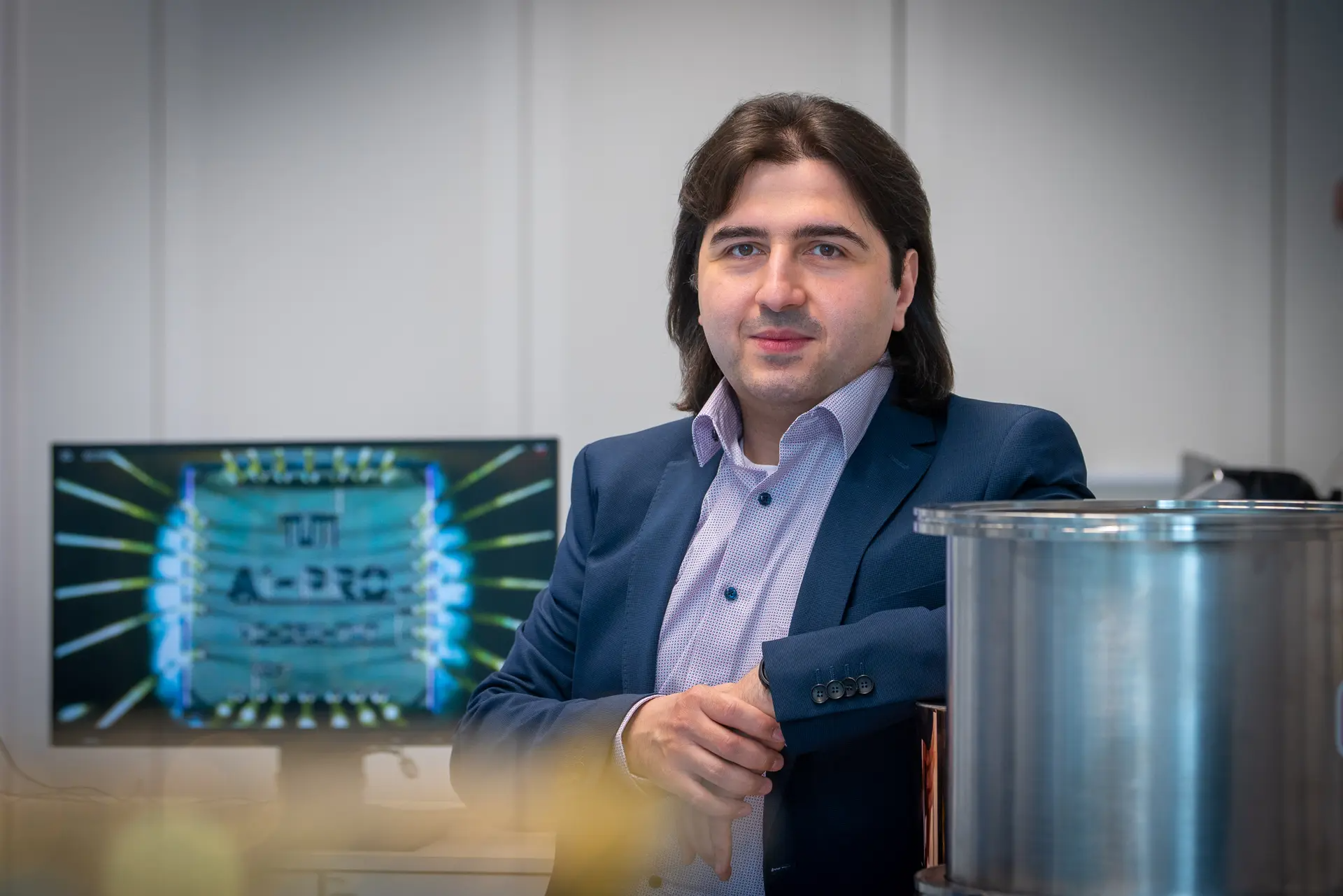
The Technical University of Munich (TUM) has unveiled what it describes as the European Union’s first AI chip developed on 7-nanometre technology, positioning the device as a proof point for advanced node design capability inside Europe’s academic sector.
The chip is based on the open-source RISC-V instruction set architecture and uses a neuromorphic approach intended to support efficient AI processing close to the data source. TUM framed the work as a direct response to the growing appetite for edge inference across applications where latency, bandwidth, and trust boundaries make cloud dependence either impractical or unacceptable.
Rather than pushing data off-device for inference, the architecture is designed around local processing, with the university arguing that this approach improves both privacy and cyber resilience. “This is a fundamental solution for protecting the privacy of our citizens,” Prof. Hussam Amrouch, Chair of AI Processor Design at TUM, said.
That focus has a broad set of industrial echoes. In regulated healthcare environments, local processing can keep biometric signals on-device, reducing exposure to network and cloud risk. In industrial automation, keeping inference inside the control loop helps avoid network jitter and round-trip delays that can undermine deterministic behaviour. TUM also pointed to future relevance in the control electronics for quantum computing, where system stability and noise budgets can be unforgiving, and where the cost of moving data around often becomes the real constraint.
TUM is tying the chip programme to MACHT-AI, a research and training centre established under Amrouch’s leadership. The centre’s stated aim is to train engineers on FinFET technologies and to deliver repeated “silicon tape-outs” on advanced nodes, with a focus on TSMC 16nm and 7nm. The message is less about a single demonstrator, and more about building a repeatable design capability that can feed both research and industrial collaboration.
The university is also looking further down the supply chain. TUM said its group plans to deliver at least three new chip designs per year and, from 2028 onwards, to route manufacturing through the Dresden-based European Semiconductor Manufacturing Company (ESMC). That timeline matters, because the credibility of “sovereignty” claims will increasingly be judged not on design announcements, but on sustained iteration, qualification, and the ability to match silicon to real deployment constraints.
Naturally, the practical question is whether Europe’s edge-AI demand — from medical sensing to industrial control — can be served by architectures that favour specialised, on-device inference over general-purpose acceleration, and whether the surrounding toolchain, verification, and packaging ecosystem can scale with it. TUM’s 7nm chip does not solve that on its own, but it does move one part of the debate out of the policy arena and into silicon.