
IN Brief:
- SK hynix is expanding capacity via M15X and long-cycle investment in the Yongin semiconductor cluster.
- The first Yongin fab is planned for completion in May 2027 and will target next-generation DRAM, including HBM.
- Q3 2025 results underline AI-led demand, with full customer demand secured for next-year DRAM and NAND output.
SK hynix is tightening its capacity posture around AI memory, leaning on both near-term expansion and long-cycle fab investment as high-bandwidth memory demand continues to set the tempo for the wider DRAM market.
In its Q3 2025 financial results, the company tied record performance to strong sales of HBM and high-performance server products, and stated that HBM supply discussions for the following year were completed, with customer demand secured for its entire DRAM and NAND production for next year. Kim Woohyun, Chief Financial Officer at SK hynix, said the market has shifted “to a new paradigm”, with demand spreading across product areas as AI adoption accelerates.
The immediate capacity lever is M15X in Cheongju. SK hynix has previously positioned M15X as a major investment aimed at responding to soaring HBM demand, and in Q3 2025 it stated it plans to expand production capacity through M15X, where equipment installation had begun after the early opening of a new cleanroom, alongside accelerated migration to advanced process technologies. The message is consistent: if demand is higher than expected, the company would rather pull forward readiness than negotiate excuses.
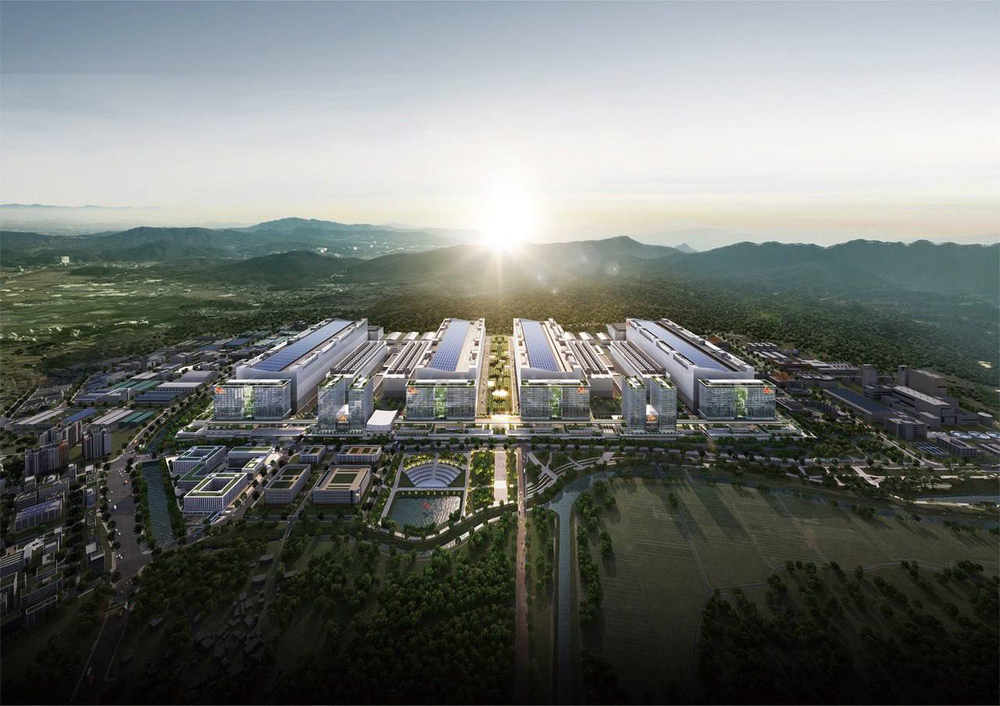
The longer-term bet is Yongin. In July 2024, SK hynix announced a board decision to invest about 9.4 trillion won in building the first fab and business facilities of the Yongin Semiconductor Cluster, a 4.15 million square metre site in Wonsam-myeon, Yongin, Gyeonggi Province. The company said it planned to start construction of the first fab in March 2025 and complete it in May 2027.
Yongin is pitched as more than a single production line. SK hynix has said the cluster will ultimately include four state-of-the-art fabs producing next-generation semiconductors, and a cooperation complex with more than 50 smaller local companies. It has also described a “Mini-fab” within the first phase — a research facility equipped with 300mm wafer processing equipment — intended to help smaller partners develop, demonstrate, and evaluate materials, parts, and equipment in an environment closer to a real production line. Vice President Kim Young-sik, Head of Manufacturing Technology at SK hynix, described Yongin as a foundation for mid- to long-term growth and “a place for innovation and co-prosperity” with partners.
AI infrastructure is still dictating memory mix, and HBM allocation is increasingly treated as a supply chain priority rather than a line item. What is changing is the tempo. The combination of early cleanroom readiness at M15X and continued spend discipline on Yongin suggests SK hynix is treating capacity as a competitive weapon — not because fabs are new, but because the companies that can deliver predictable HBM volumes at the right node and package are the ones that control the conversation with hyperscalers, accelerator vendors, and system builders.
The industry will keep pretending this is a normal cycle until procurement teams start writing contracts that assume it is not.

