
IN Brief:
- QPT has opened customer demonstrations of its updated MicroDyno motor-drive test platform.
- The platform runs field-oriented control natively at 1MHz.
- Sensorless diagnostics, cogging correction, and edge-AI detection target robotics and machine automation.
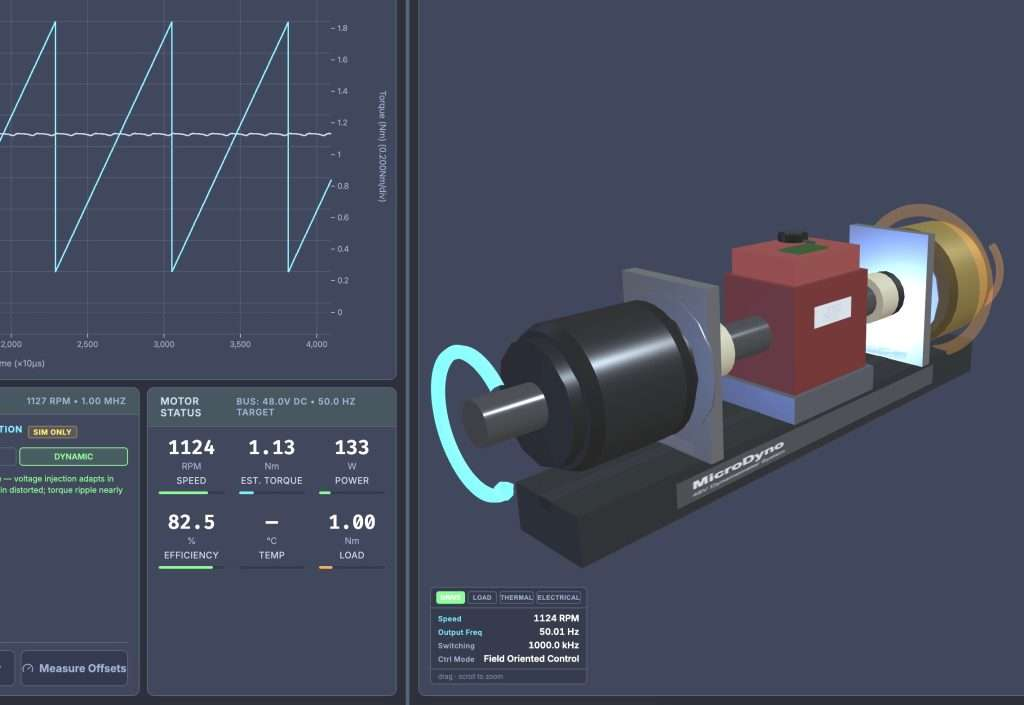
QPT has opened customer demonstrations of its updated MicroDyno motor-drive test platform, adding full field-oriented control and real-time dynamic cogging correction to its 1MHz GaN-based drive architecture.
The Cambridge-headquartered company is offering in-person demonstrations at its new R&D facility in Edinburgh, with remote-access demonstrations available for international customers. QPT is also preparing to show MicroDyno at PCIM Europe 2026 in Nuremberg from 9 to 11 June.
MicroDyno was launched in 2025 as a low-voltage motor-drive test platform using a 1MHz hard-switched sine-wave drive. The switching frequency is around 100 times faster than the approximately 10kHz switching frequencies that have defined many motor-drive architectures for the past two decades.
With the latest update, QPT is connecting high-frequency GaN switching more directly with application-level control. Field-oriented control mathematically decouples torque and flux, enabling more precise torque regulation. Running FOC at conventional 10kHz switching frequencies limits control-loop responsiveness; MicroDyno runs FOC natively at 1MHz, with control-loop updates around 100 times faster than conventional norms.
The additional control bandwidth supports dynamic cogging correction. Torque cogging is measured directly inside the drive, using QPT’s qSense capability, without external sensors or high-resolution encoders. Correction is applied in real time, without look-up tables, reducing drift and setup complexity across different motors.
That approach is intended to extract high-precision control from lower-cost motors that would otherwise need precision servo motors and high-resolution encoders. The platform also generates a digital twin of the system, allowing offline training of an edge-AI model to detect and classify mechanical and electrical faults, with potential for dynamic correction.
GaN power electronics is moving rapidly into industrial and robotics systems. STMicroelectronics’ 700V PowerGaN expansion for AI and robotics power systems reflects the same direction of travel, while industrial connectivity and EMC remain active design concerns as shown by LAPP’s Drives & Controls programme. Faster switching, denser wiring, and smaller drives make power-stage behaviour and system integration increasingly inseparable.
Motor drives are being pushed by robotics, collaborative automation, precision manufacturing, and compact motion systems. These applications need smoother torque, lower acoustic noise, better diagnostics, and reduced mechanical complexity. Traditional servo performance can be expensive because precision feedback, motor quality, cabling, and drive electronics all contribute to cost.
GaN changes part of that equation by enabling much higher switching frequency, but the device technology alone does not define the drive. Control algorithms, filtering, sensing strategy, thermal behaviour, electromagnetic compatibility, and diagnostics all determine whether the higher frequency produces useful machine performance.
MicroDyno demonstrates GaN at the control layer, rather than treating it solely as a switch technology. If a drive can infer more from its own electrical behaviour, correct torque ripple dynamically, and feed edge-AI diagnostic models without additional external sensors, precision motion systems could use simpler motors and fewer external components.
The approach is especially relevant to collaborative robots and compact machine tools, where smooth low-speed motion, repeatability, and cost are tightly linked. It also reflects a broader movement in industrial electronics, with power hardware, embedded intelligence, and system diagnostics converging inside the drive.

