IN Brief:
- Innodisk's DDR5 MRDIMM operates at 12,800MT/s and supports capacities from 32GB to 128GB.
- MRCD and MDB devices multiplex two memory ranks to increase effective data transfer bandwidth.
- Platform support, signal integrity, power, cooling, and workload behaviour will determine realised performance.
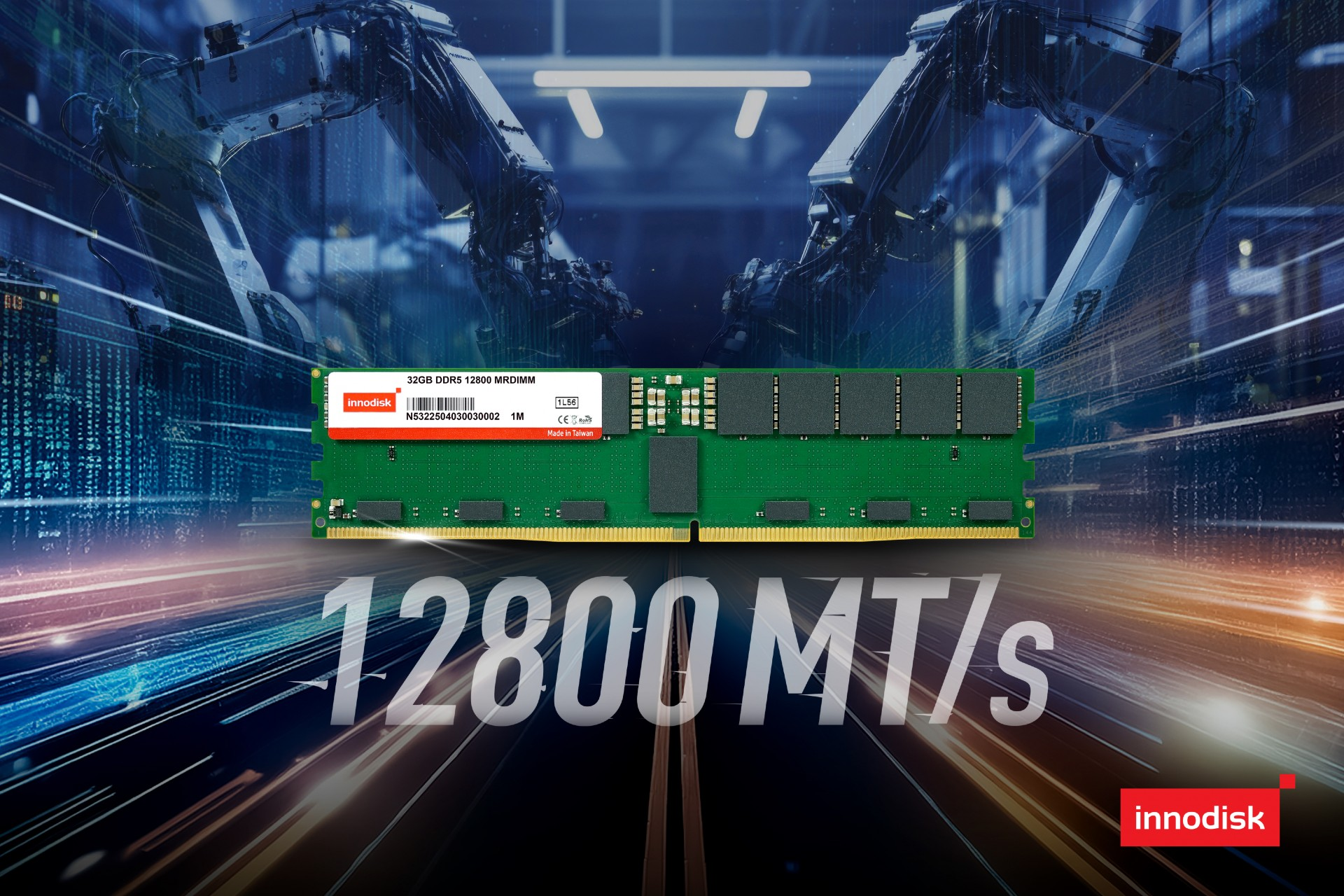
Innodisk has introduced a DDR5 Multiplexed Rank DIMM operating at 12,800MT/s for AI servers, high performance computing, large language models, and data intensive robotics. The module uses a Multiplexed Registering Clock Driver and Multiplexed Data Buffers to access two memory ranks in parallel before presenting the combined data stream to the host.
Innodisk specifies a 60% bandwidth increase over a conventional DDR5-8000 registered DIMM. By reducing the electrical load seen by the host memory controller, the multiplexed architecture raises the external transfer rate without requiring each DRAM device to operate at the full interface speed.
Capacity options will range from 32GB to 128GB, including 48GB, 64GB, and 96GB versions. The modules use a 287 pin DDR5 form factor, an x80 bus with error correction, and a nominal operating voltage of 1.1V.
The MRCD manages command and clock distribution, while the data buffers combine transfers from the two ranks. An electronic fuse and transient voltage suppression are incorporated to protect against abnormal power conditions, and the modules include anti sulfuration measures for environments where airborne contaminants can attack exposed conductors.
Case temperature is specified from 0°C to 95°C, reflecting the thermal conditions around densely populated server memory channels. Availability is scheduled for the fourth quarter of 2026, when compatible processor platforms and firmware will be required to train and operate the multiplexed interface.
Although the module retains the familiar DDR5 slot, mechanical compatibility does not make it a universal replacement for an existing RDIMM. The processor, memory controller, BIOS, board layout, and validation programme must explicitly support MRDIMM technology and the higher channel rate.
Host memory joins the bandwidth race
As AI compute density rises, the memory hierarchy determines how much processing capacity can be sustained. Accelerators may execute vast numbers of operations, yet they still wait when model parameters, activations, database records, or simulation data cannot be delivered at a comparable rate.
High bandwidth memory addresses the fastest transfers close to accelerators, while conventional system memory retains large pools of host data. Training and inference servers use that capacity to prepare datasets, manage model state, feed accelerators, support virtual machines, and execute CPU intensive stages around the principal workload.
MRDIMM provides a route to higher host bandwidth while preserving the general DIMM architecture used in servers. The additional clock and data buffer devices bring latency, heat, power, firmware, and signal integrity considerations of their own, so realised performance will depend on the application’s access pattern.
Bandwidth bound software can gain substantially when data is accessed sequentially or across many concurrent threads. Latency sensitive workloads with irregular access may see less improvement, particularly where cache behaviour, NUMA placement, or software scheduling already limits useful memory parallelism.
Hardware developed to compress AI memory traffic attacks the same constraint from another direction. Compression reduces the amount of information moving through the hierarchy, while MRDIMM raises the rate available to the remaining transfers; both approaches still depend on software and workload characteristics.
The second quarter semiconductor market showed AI demand drawing DRAM, HBM, storage, packaging, and power into the same capacity problem. As channel rates rise, connector performance, board routing, power delivery, cooling, and platform validation all become more demanding around the sockets.
Energy efficiency has to be measured across the completed workload rather than at the module alone. A faster DIMM may draw more instantaneous power but shorten execution or reduce processor stalls; alternatively, bandwidth that software cannot use simply increases cost and heat.
Qualification and serviceability will shape deployment because servers operate with tightly validated combinations of processor, firmware, module type, and capacity. Innodisk’s DDR5-12800 MRDIMM extends the available host memory bandwidth without moving all capacity into specialised accelerator packages, but its advantage will emerge only on platforms able to exploit the interface and workloads capable of keeping it busy.