IN Brief:
- STMicroelectronics has introduced seven 700V PowerGaN devices for high-density power conversion.
- The range targets AI servers, robotics, smart-grid converters, solar inverters, and industrial systems.
- The launch strengthens the role of gallium nitride in compact, efficient power stages for compute and automation loads.
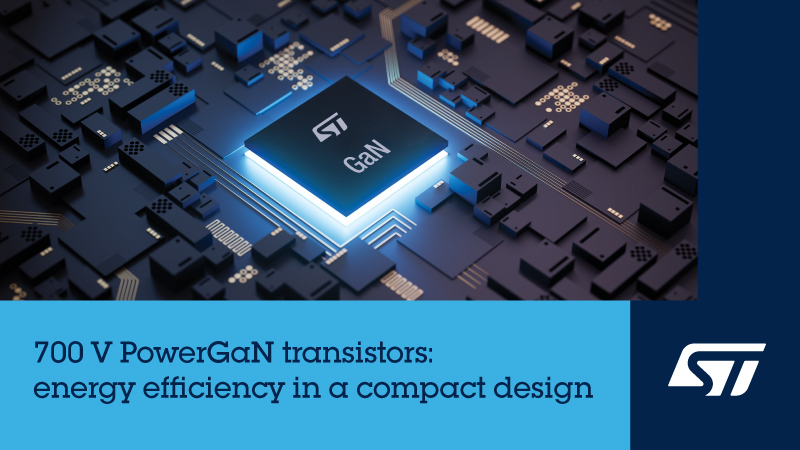
STMicroelectronics has expanded its STPOWER portfolio with seven 700V PowerGaN devices for high-efficiency conversion in AI servers, robotics, smart-grid converters, solar inverters, and industrial power systems.
The new devices use enhancement-mode GaN HEMT technology and cover current ratings from 6A to 29A, with on-resistance values spanning 53mΩ to 270mΩ. Package options include DPAK, TO-Leadless, and PowerFLAT formats, giving designers a broader set of mechanical and thermal integration choices for compact, high-frequency power stages.
Those package and rating options are aimed at converters where switching frequency, efficiency, and board area are tightly linked. AI server power architectures are placing greater pressure on front-end and intermediate conversion stages as rack power density rises, while robotics and automation systems are driving similar demand in drives, chargers, and distributed power supplies.
Selected package variants include Kelvin-source connections, helping reduce parasitic effects in fast-switching circuits. As GaN moves further into production systems, layout discipline, electromagnetic behaviour, and repeatable thermal performance are becoming as important as headline efficiency figures.
The broader industrial power market is already moving in the same direction. Infineon’s PCIM focus on AI data-centre, robotics, and infrastructure power and the European Moore4Power programme both point to wide-bandgap devices becoming central to next-generation industrial electrification.
That shift changes the component selection process. Engineers working with GaN have to balance device performance against gate-drive behaviour, EMI control, package parasitics, thermal dissipation, and qualification over longer operating lifetimes. The device can reduce losses and shrink magnetics, but the surrounding circuit must be designed around faster switching and tighter layout constraints.
AI infrastructure is accelerating that discipline. Higher rack power levels, denser conversion stages, and more aggressive energy-efficiency targets are pushing power electronics closer to the compute architecture itself. Robotics and smart-grid systems are following a parallel path, with compact electrified platforms requiring faster, smaller, and more controllable power conversion.
With seven devices now added to its 700V PowerGaN range, ST is giving engineers more scope to match GaN selection to converter class, switching topology, and thermal envelope. The expansion also underlines how gallium nitride is moving beyond specialist power designs into mainstream industrial conversion, where manufacturability and system behaviour increasingly decide whether a device can be adopted at scale.