
IN Brief:
- Wi-Fi is moving onto the MCU, as designers chase smaller, lower-power IoT nodes.
- RA6W1/RA6W2 combine an Arm Cortex-M33 with dual-band Wi-Fi 6, and optional Bluetooth LE.
- Renesas is backing the platform with long-life supply, tools, and pre-certified modules.
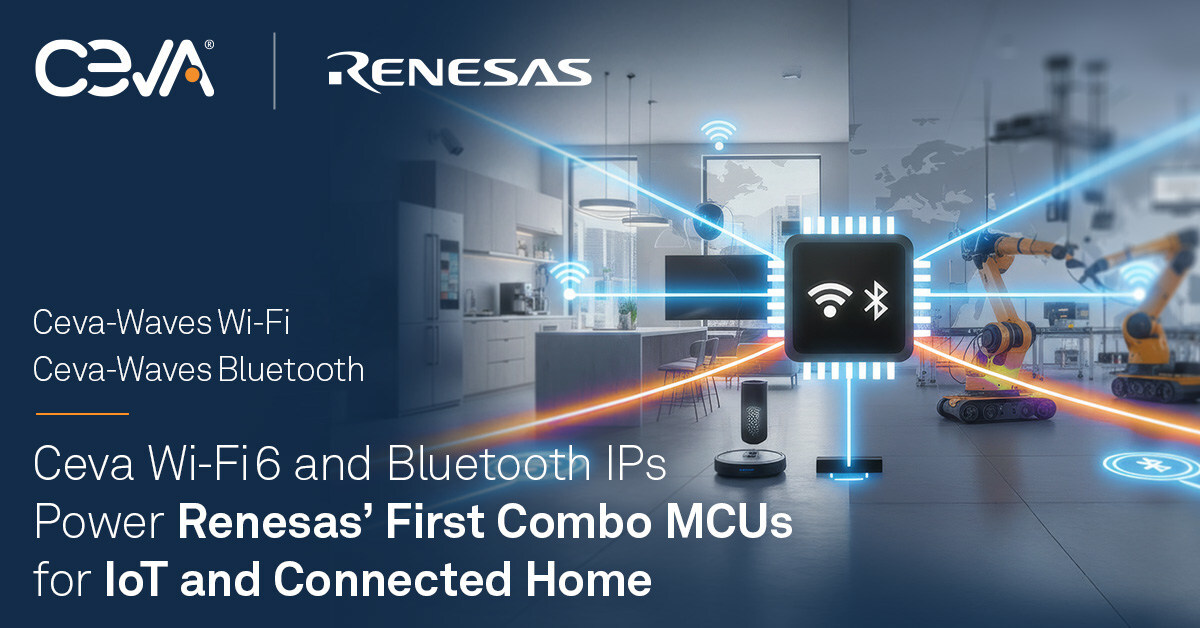
Renesas has integrated Ceva’s Wi-Fi 6 and Bluetooth Low Energy connectivity IP into its RA6W1 and RA6W2 wireless microcontrollers, positioning the devices as single-chip platforms for always-connected IoT endpoints, rather than a conventional MCU plus radio-module pairing.
The RA6W1 is a dual-band Wi-Fi 6 MCU, while the RA6W2 adds Bluetooth LE alongside Wi-Fi 6 for combo designs that need local commissioning, provisioning, and short-range device links. Renesas’ Chandana Pairla, Vice President of the Connectivity Solutions Division, said the company is giving customers “the flexibility to design with a standalone Wi-Fi device, a Wi-Fi/Bluetooth LE combo, or fully integrated modules depending on their needs,” with the aim of saving power, simplifying system design, and lowering bill-of-materials cost.
That flexibility matters in smart home and light industrial devices where the radio is often the dominant layout and certification headache. Renesas is also pushing module options, including Wi-Fi 6 and Wi-Fi/Bluetooth LE variants, designed to bring certified RF components, protocol stacks, and antenna integration into a drop-in footprint, reducing the number of variables that can derail compliance testing across regions.
On the silicon side, the RA6W1 is built around an Arm Cortex-M33 running at up to 160 MHz with 704 KB of SRAM, targeting standalone operation without an external host MCU. The Wi-Fi subsystem supports 2.4 GHz and 5 GHz operation across 802.11a/b/g/n/ac/ax, with features such as OFDMA and Target Wake Time (TWT) intended to improve behaviour on congested networks while extending battery life. Renesas is also leaning into security and lifecycle requirements, with on-chip cryptography, a true random number generator, and secure boot capabilities, aimed at devices expected to take over-the-air updates for years.
Ceva’s role is in the underlying connectivity building blocks and software stacks that let MCU vendors implement standards-compliant radios without building everything in-house. Tal Shalev, Vice President and General Manager of Ceva’s Wireless IoT Business Unit, said the company’s portfolio is focused on “the performance and efficiency needed to bring next-generation wireless features into MCUs,” and framed the Renesas integration as a route to faster IoT development on the edge.
Renesas is already shipping the RA6W1 in FCQFN and WLCSP packages, and is positioning the RA6W2 as the next step for designers who want Wi-Fi 6 throughput alongside Bluetooth LE for device onboarding and local control. The company has also tied the family into its Flexible Software Package (FSP) and e² studio toolchain, and is promoting an evaluation kit with power profiling intended to make low-power tuning less guesswork and more measurement.

