
IN Brief:
- Distribution is catching up with Wi-Fi 6/6E demand in regulated and reliability-driven device categories.
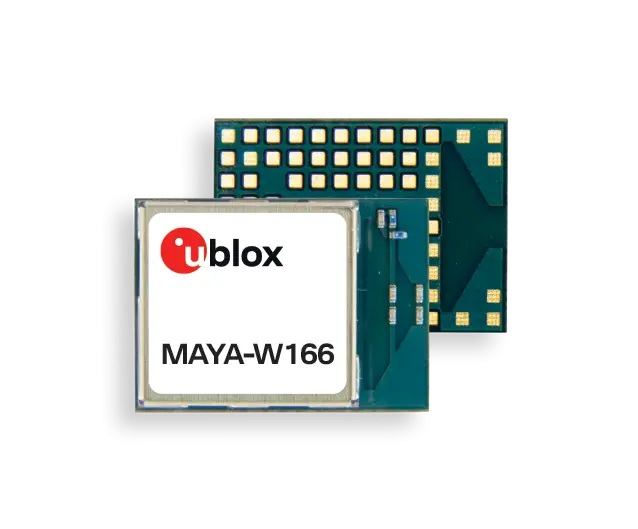
- u-blox’s MAYA-W3 modules combine Wi-Fi 6/6E and Bluetooth LE in a compact, host-based architecture.
- Variant strategy, antenna flexibility, and coexistence tooling are becoming differentiators as wireless density increases.
Mouser has added u-blox’s MAYA-W3 wireless connectivity modules to its stocked portfolio, expanding immediate availability of Wi-Fi 6 and Wi-Fi 6E options aimed at industrial and healthcare deployments.
The MAYA-W3 series is positioned as a host-based module family combining Wi-Fi 6/6E with Bluetooth Low Energy, targeting applications where latency, coexistence behaviour, and security features are increasingly scrutinised alongside raw throughput. Mouser’s listing highlights SISO Wi-Fi 6/6E operation with 20 MHz channel width, with support intended to improve network availability in dense environments, and MU-MIMO capability. Operating modes include access point, station, peer-to-peer connections, or combinations of these, allowing a single hardware choice to cover multiple product architectures.
Bluetooth support is specified as Bluetooth Low Energy 5.4, including isochronous channels used for LE Audio. For product categories that are now routinely expected to stream audio, carry voice control, or run multiple simultaneous sensor links, isochronous support has moved from “feature” to “plumbing,” particularly when devices need predictable timing rather than best-effort traffic.
The module family is offered across single-band, dual-band, and tri-band variants, spanning Wi-Fi 6 and Wi-Fi 6E configurations. Antenna options include embedded PCB antennas, U.FL connectors, and antenna pins, giving design teams flexibility across form factors where enclosure constraints, serviceability, and regulatory test plans can drive the RF architecture. Mouser also notes an LTE filter intended to support coexistence with other radios, reflecting a reality in modern connected products: Wi-Fi rarely operates alone.
On the silicon side, u-blox has previously stated that the MAYA-W3 series is based on Infineon chipsets, aligning the modules with a mainstream wireless platform and driver ecosystem. The compact footprint has been a consistent part of the positioning, with Mouser listing the module size at 10.4 mm × 14.3 mm. For systems where board area is rationed between power, sensing, and compute, that footprint matters, but it is the integration pathway that often determines adoption speed.
To that end, Mouser is also listing evaluation kits for MAYA-W3, positioned as reference designs intended to accelerate hardware development and shorten time-to-market. In practice, the availability of a known-good evaluation platform can reduce early RF and coexistence risk, particularly when products are expected to behave predictably across crowded 2.4 GHz spaces, while also supporting higher bands where required.
The new stocking position reinforces how wireless roadmaps are being pulled into the same procurement logic as core silicon: availability, repeatability, and a clear variant strategy can be as important as peak data rates. With Wi-Fi 6/6E adoption spreading across device classes that are less tolerant of connectivity surprises, module ecosystems are being judged on integration quality as much as the radio.

