
IN Brief:
- Receiver front-end protection is being treated as a retrofit requirement as high-power RF threats diversify.
- Teledyne’s limiter targets always-on protection across 0.1–20 GHz without redesigning existing architectures.
- As wideband receivers spread across platforms, compact protection modules are becoming standard line items.
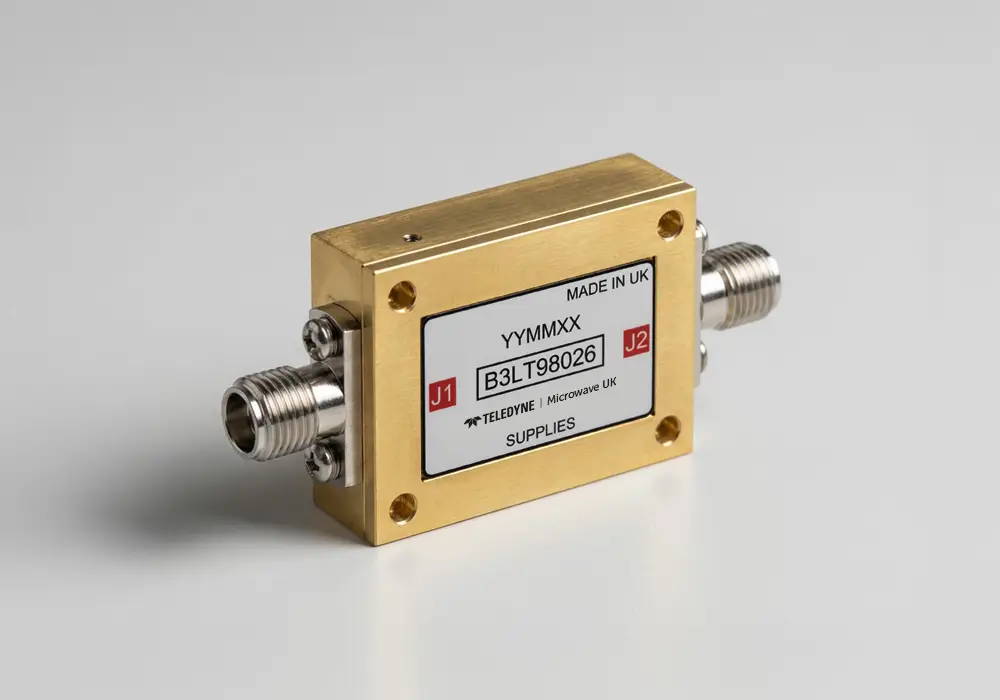
Teledyne Microwave UK has introduced a new Wideband Limiter designed to protect Radar Electronic Support Measures (R-ESM) receivers and broader electronic warfare systems from high-power RF exposure, including scenarios associated with emerging directed-energy threats. The module is positioned as a passive, always-on RF protection stage intended to sit ahead of sensitive receiver electronics and absorb excessive energy before downstream components see damaging power levels.
Teledyne frames the challenge in familiar terms for EW front ends: R-ESM platforms are passive by design, but the receiver chain still faces high-power events that can drive repairs, force replacement of long-lead parts, and translate directly into operational downtime. The limiter is intended to raise resilience without compromising the coverage and sensitivity requirements that keep R-ESM useful in dense RF environments.
The product covers a 0.1 to 20 GHz operating frequency range and is built as a passive wideband design requiring no external power. Teledyne specifies peak input power handling up to 10 W under defined pulse conditions, with a maximum insertion loss of 2.0 dB across the operating band. Recovery time is specified at 40 ns, intended to allow rapid return to nominal sensitivity after a high-power event, rather than leaving the receiver effectively “deaf” for extended periods.
From a mechanical and integration standpoint, the limiter uses SMA female RF connectors for in-line insertion into existing architectures and is supplied as a compact, gold-finished module. Teledyne lists a VSWR of 1.5:1 maximum at input and output, an operating temperature range of −20 °C to +85 °C (storage −40 °C to +85 °C), and weight up to 50 g. The company also notes compatibility with its Phobos MTU (mast top unit) architecture, and the ability to accommodate additional RF elements such as filters when required.
John Toner, Sr. Vice President & General Manager, Teledyne Aerospace & Defence Electronics UK, said: “As threat environments evolve, system survivability depends more than ever on resilient front-end protection. Our new Wideband Limiter delivers the wideband coverage, low insertion impact, and compact form factor our customers need to keep their systems mission-ready in the face of increasingly sophisticated RF and DEW challenges.”
Teledyne says the Wideband Limiter is available now for integration evaluation across defence and electronic warfare applications, with the clear intent that it can be adopted as a protection upgrade rather than an architectural overhaul. In practice, that positioning — wide coverage, passive operation, and a connectorised form factor — matches how many programmes are approaching survivability improvements: bolt-in hardening where it can be justified quickly, rather than redesigning receiver front ends around worst-case events.

