
IN Brief:
- Embedded World 2026 runs from 10 to 12 March at NürnbergMesse, with 1,262 exhibitors from 43 countries across seven halls.
- The official panel programme is zeroing in on RISC-V in automotive, the Cyber Resilience Act, software-defined vehicle cybersecurity, and embedded vision.
- For visitors, the sensible route is simple: pick one regulation session, one compute platform, one tools supplier, and one power story.
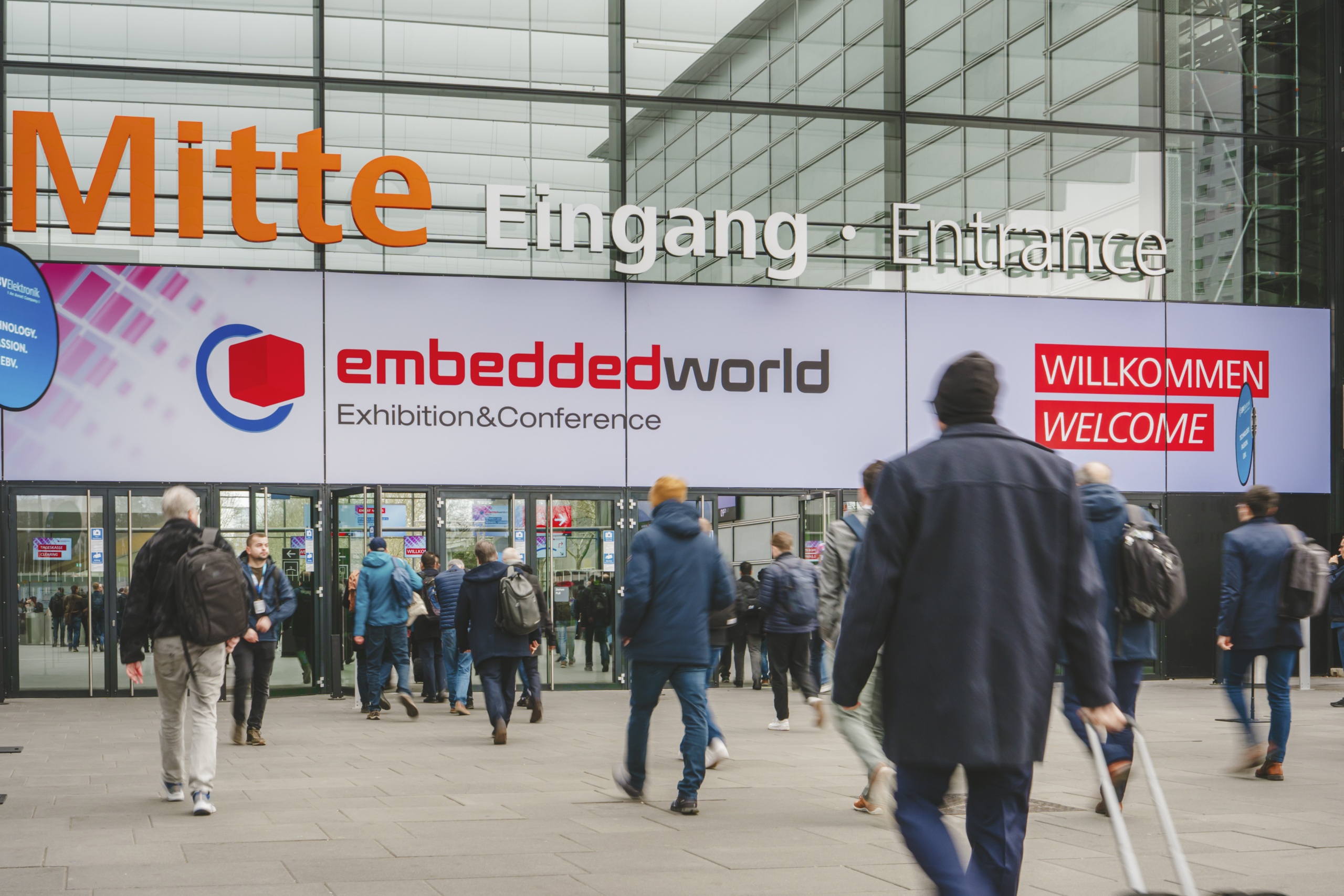
Embedded World 2026 opens with the usual scale and the usual problem: far too much to see in far too little time. The show runs from 10 to 12 March, the doors open from 09:00 to 18:00 on Tuesday and Wednesday, and close at 17:00 on Thursday. This year there are 1,262 exhibitors from 43 countries across seven halls and 34,069 square metres of net exhibition space, which is another way of saying that no one is covering this properly by wandering about and hoping for the best.
The programme tells you where the pressure is landing. One expert panel asks whether RISC-V is ready for automotive. Another deals with the Cyber Resilience Act, including SBOMs, vulnerability handling, and CE conformity. Another looks at cybersecurity for software-defined vehicles, while a separate session on embedded vision and physical AI will pull in the crowd that wants compute, sensors, and deployment in one conversation. Strip away the tradeshow varnish and the shape of the market is plain enough: architecture decisions are shifting, compliance is now part of engineering work, and edge AI is being judged on whether it can survive outside a demo loop.
That gives this year’s guide a clear structure. Start with security and compliance, because the CRA is no longer a policy talking point. Move to compute, because edge AI is now being sold into robotics, industrial automation, vision systems, and vehicles with far less patience for vague claims. Then look at power and lifecycle management, because even the smartest silicon still has to live inside a box with thermal limits, service intervals, and a budget.
Programme picks that will shape corridor conversations
If you only sit in on a handful of sessions, make them these exhibitor-forum panels. They are explicitly framed around strategy, regulation, and what the industry can realistically execute:
- c-level@embedded world — Tue 10 Mar, 13:30–14:30, Hall 3, Booth 3-611 (execs from AMD, Green Hills Software, Lattice Semiconductor, and onsemi).
- RISC-V in the automotive sector: breakthrough or challenge? — Wed 11 Mar, 11:30–12:30, Hall 5, Booth 5-210.
- Cyber Resilience Act panel — Wed 11 Mar, 13:30–14:30, Hall 3, Booth 3-611.
- Cybersecurity strategies for software-defined vehicles — Thu 12 Mar, 11:30–12:30, Hall 5, Booth 5-210.
- Embedded vision and physical AI — Thu 12 Mar, 13:30–14:30, Hall 3, Booth 3-611.
Also worth clocking: the show is using the supporting programme to keep the pipeline full, with Student Day and women4ew, and it is still leaning into keynote theatre — this year led by Microchip COO Richard J. Simoncic.
The stands worth making time for

Where: Hall 4, Booth 4-459, in the IC&IP Design Area. Menta is worth a visit for anyone building long-life silicon into industrial, aerospace, defence, or other qualification-heavy markets. Its pitch is standard-cell embedded FPGA IP that can be integrated into ASIC and SoC designs without proprietary macros or foundry lock-in. The underlying argument is tougher, and more relevant, than the usual FPGA nostalgia: hardware now has to remain useful through changing algorithms, security demands, and standards over a long service life. Menta is framing embedded reconfigurability as part of lifecycle governance rather than a nice extra, which is a much stronger position, and a more realistic one. 
Where: Hall 5, Booth 5-355. Ambarella is using the show to push a full stack story around edge AI, under the banner “From Agentic to Physical AI”. The slogan can stay on the banner. What matters on the stand is the combination of AI SoCs, software tools, developer support, and partner workflows aimed at robotics, industrial automation, automotive, infrastructure, security, and AIoT deployments. The most useful part is likely to be DevZone, which gives developers access to software tools, optimised models, and deployment blueprints. That makes the stand relevant for readers trying to judge not only raw performance, but also how much integration pain sits between evaluation and production. 
Where: Hall 4, Booth 4-410. SYSGO’s stand is worth seeing because it deals with a problem most suppliers would rather leave in the small print: how to combine real-time behaviour, mixed-criticality workloads, and regulatory pressure without producing a platform no one can maintain. The company is showing a real-time edge orchestration demo built on PikeOS virtualisation and Kubernetes, alongside a higher-compute platform that combines certifiable separation with GPU acceleration for AI workloads. It is also pushing its CRA readiness line hard, with the software stack framed around secure-by-design development, lifecycle vulnerability management, and certification support. 
Where: Hall 5, Booths 5-135, 5-136, and 5-138. AMD’s message is straightforward enough: embedded x86 still has a serious place in industrial and edge AI systems, provided it can deliver the right balance of CPU throughput, graphics, and neural processing. The company has timed new Ryzen AI Embedded P100 announcements for the show, expanding the line with up to 80 TOPS, Zen 5 CPU cores, RDNA 3.5 graphics, and ROCm support for deployment at the edge. It is also promising stand demos across industrial automation, robotics, retail, healthcare, and automotive vision. For visitors weighing consolidation against custom heterogeneity, this is a stand worth a proper conversation. 
Where: Hall 4A, Booth 138. Infineon arrives with enough launches to fill half a page on its own, but the story is coherent. One thread is power, led by the EZ-PD PMG1-B2, a single-port USB Type-C Power Delivery microcontroller with an integrated 55 V buck-boost controller for 2S to 12S lithium-ion charging. Another is security, via the TEGRION SLI22 automotive security controller, which brings post-quantum cryptography and Common Criteria EAL6+ certification into the conversation. The third is automotive software and compute, with new DRIVECORE bundles for its future RISC-V automotive roadmap and a 400 MHz option for the AURIX TC3x family. 
Where: Hall 4A, Booth 4A-301. e-peas is one of the cleaner power stories at the show, and that alone makes it worth a stop. The company is using Embedded World to push energy harvesting for Ambient IoT with live demonstrations around its PMIC range, including the AEM15820, which it is pitching as a single-chip hybrid indoor-outdoor photovoltaic harvesting device. The point here is less novelty than practicality. Battery replacement remains a stubborn cost in logistics, building systems, and low-maintenance sensing, and e-peas is targeting that directly with harvesting, cold-start capability, and support for hybrid storage options.
For visitors trying to work the show efficiently, the route is simple enough. Start with one of the panel sessions on RISC-V, the CRA, SDV cybersecurity, or embedded vision, because that gives the rest of the day some shape. Then pick a compute stand, a tools stand, and a power or silicon-lifecycle stand. That will tell you more about the direction of the market than a day spent collecting brochures. Embedded World still does what it has always done well: it puts silicon, software, regulation, and engineering reality in the same building, then lets the uncomfortable questions surface. This year, there should be plenty of them.

