
IN Brief:
- digid is trying to remove the packaging and signal-routing barrier that often blocks nanosensor adoption.
- The company is pairing printed force and temperature sensors with FEM-led integration, deposition, and conventional interconnects.
- That shifts the discussion from sensor novelty to manufacturable assemblies for robotics, machinery, batteries, and medical devices.
digid is packaging nanoscale sensing for easier industrial system integration. That sounds modest until you consider where many ultra-small sensors tend to stall: not in measurement performance, but at the point where somebody has to get a microscopic structure onto a part, route the signal out, and make the assembly manufacturable without turning the whole project into a custom science experiment.
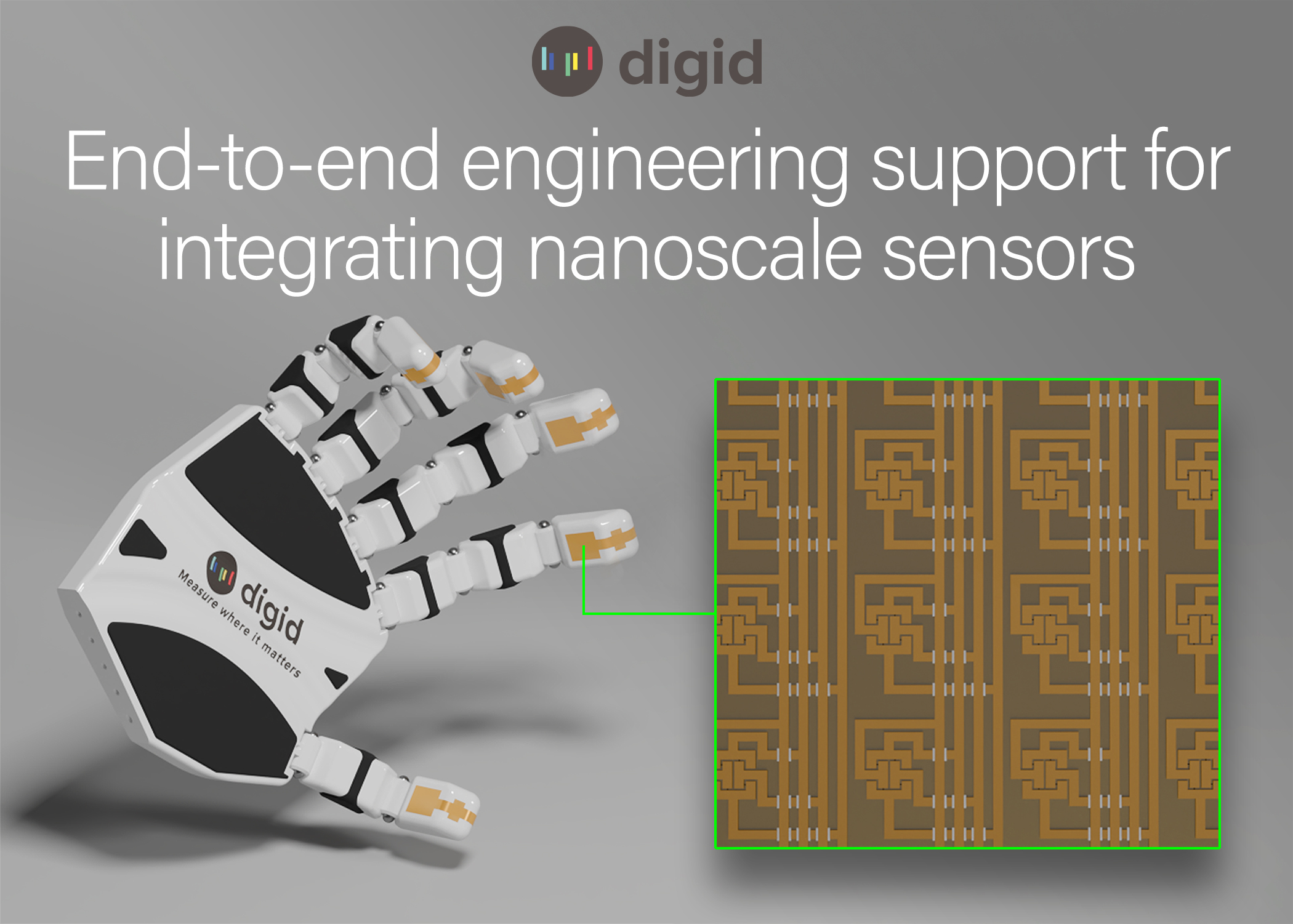
The Mainz-based company has spent the opening months of 2026 telling the market two things. First, its printed temperature and force sensors are ready for mass deployment, with production qualified for devices as small as 1µm. Second, it now wants to take on the integration burden directly, offering end-to-end engineering support that starts with the customer’s part geometry and material parameters and runs through FEM simulation, sensor deposition, signal routing, and finished sub-assemblies.
That second point is the more commercially important one. digid’s own technology material states that the business has already produced more than a million nanosensors and can print them directly onto wafers, metals, ceramics, or polymers. The practical challenge is then turning that sensing element into something an OEM can adopt inside a robot gripper, surgical tool, battery cell, or machine assembly without inventing a connection strategy from scratch.
“When customers approach us, their concern is how to physically connect to the sensor,” said Dr. Konstantin Kloppstech, Chief Technology Officer at digid. “We take that burden off their hands. They provide CAD files and material parameters, and we handle the FEM simulations, sensor deposition, and signal routing. We manage the entire chain so our customers receive a fully plug-and-play solution.”
The application examples are specific and sensible. In precision handling, the company is placing force sensors directly on physical interfaces where conventional parts are too bulky. In automated machinery, it is embedding sensing into mounts and funnels for direct contact or blockage detection. In thermal applications, it is targeting microchips, power components, and battery cells, where surface-mounted sensing can cut lag and improve spatial accuracy.
As with many advanced sensor technologies, packaging, interconnect, and process compatibility are what decide whether the part reaches production. digid appears to understand that, which is why its latest push is less about the abstract promise of nanoscale sensing and more about turning fragile, specialised measurement into something that can be specified, assembled, and shipped.

