IN Brief:
- Battery and energy-harvested IoT designs are still constrained by wake-up overhead, sensor polling, and maintenance intervals.
- Nanopower’s nPZero offloads sensor polling and wake logic so the host MCU can stay asleep for longer.
- Volume production moves the part from evaluation into higher-volume design-ins across long-life sensing nodes.
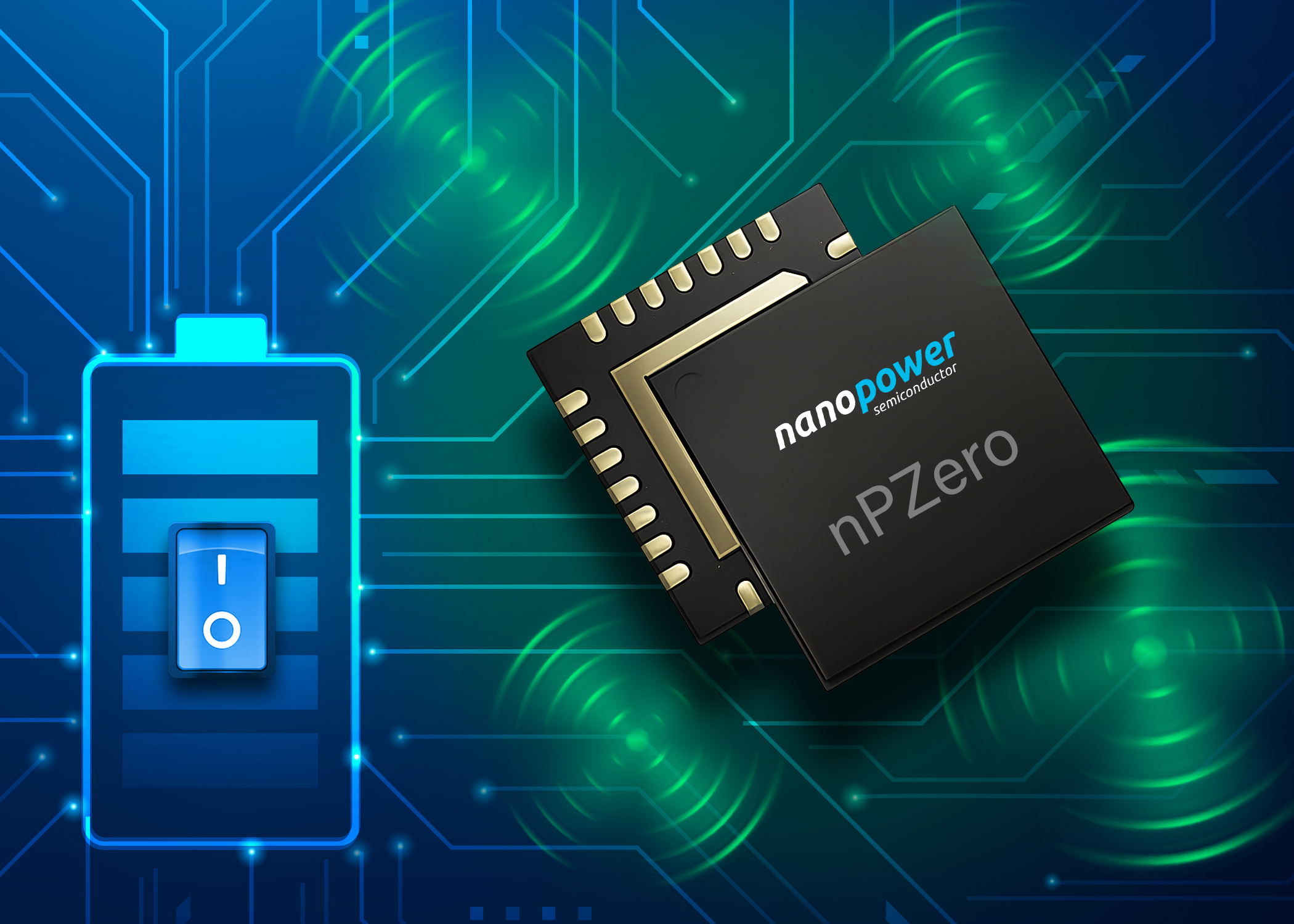
Nanopower has taken its nPZero power-saving IC into volume production. For a market full of devices that spend too much energy waking a host processor just to discover that nothing has changed, that matters more than another low-power headline. It puts an unusual architectural idea into a stage where OEMs can actually design around it at scale.
nPZero is built around a simple shift in control. Instead of letting the MCU shoulder every polling cycle, the companion IC can keep the host powered down, manage sensor power, read up to four peripherals, and wake the main system only when user-defined conditions are met. In practice, the sensing chain remains active while the most power-hungry part of the system stays out of the way.
That approach fits the awkward middle ground where many IoT designs still live. Wireless links have become more efficient, but system life is often dragged down by repetitive sensing, housekeeping, and unnecessary wake events. Nanopower is positioning nPZero for battery-powered and energy-harvested products in smart buildings, agriculture, tracking, logging, and long-life monitoring, where maintenance visits and battery replacement schedules quickly become part of the commercial model.
The company is putting forward reductions in energy consumption of up to 90% in battery-powered applications, and its published product material centres on standalone operation, reconfigurable wake logic, peripheral power cycling, and a full subthreshold design. Samples and development kits are available immediately, with the nPZero Configurator intended to cut bring-up effort by generating the required API code from a graphical setup flow.
The move into volume production also follows a run of industry visibility that has given the device more weight than a niche lab exercise. Nanopower has highlighted Elektra recognition and an EPDT 2025 Products of the Year win, while earlier financing was explicitly tied to commercial scale-up and mass production. That does not guarantee broad adoption, but it does suggest the company has moved past the stage where ultra-low-power architecture is admired more often than it is purchased.
For long-life sensor nodes, the question now is less whether the concept is interesting and more whether it fits an existing system partition. If it does, nPZero offers a route to stretch battery life and harvested-energy budgets without redesigning the whole platform around a larger battery, a more aggressive duty cycle, or a service plan nobody really wanted in the first place.