IN Brief:
- Samsung and AMD have signed an MoU covering HBM4 supply for AMD’s next-generation Instinct MI455X AI accelerators.
- The agreement also extends to DDR5 for future EPYC platforms and opens discussions around foundry collaboration.
- The move ties memory design more tightly to rack-scale AI system architecture, where bandwidth, power, and packaging now sit at the centre of performance planning.
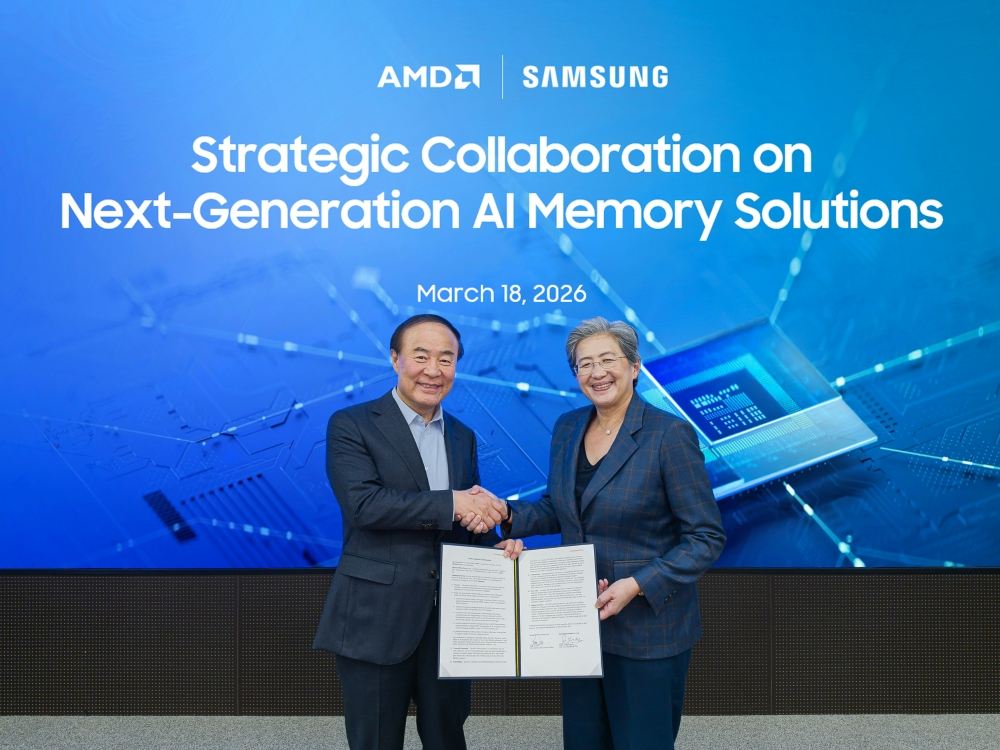
Samsung Electronics and AMD have expanded their partnership around next-generation AI memory, signing a memorandum of understanding that positions Samsung as the primary HBM4 supplier for AMD’s forthcoming Instinct MI455X accelerator. The agreement also covers high-performance DDR5 solutions for future EPYC processors and points to a broader alignment around AMD’s Helios rack-scale AI platform.
The technical headline is bandwidth. Samsung says its HBM4 is built on a sixth-generation 10 nm-class DRAM process with a 4 nm logic base die, reaching transfer speeds of up to 13 Gbps and peak bandwidth of 3.3 TB/s. That places the memory package not as a supporting component but as a central determinant of how the accelerator, CPU, and rack-level interconnect stack can be balanced in training and inference systems.
AMD is framing the MI455X as a building block for Helios, which makes the agreement significant beyond a single device win. Rack-scale AI architecture is increasingly defined by how tightly compute, memory, packaging, and power delivery can be co-optimised, and that is pushing memory suppliers into a much earlier role in platform planning. The deal also stretches beyond HBM, with both companies working on DDR5 for 6th Gen EPYC CPUs, codenamed Venice.
The two companies have already worked together for nearly two decades across graphics, mobile, and computing, with Samsung previously supplying HBM3E for AMD’s latest Instinct accelerators. This new step pushes the relationship further upstream into roadmap alignment, and potentially into foundry services as well, with both sides also discussing a future manufacturing partnership for next-generation AMD products.