IN Brief:
- Delta is using LogiMAT 2026 to show a combined charging, motion, vision, and robotics architecture for automated material flow.
- The electronics layer spans 1 kW to 30 kW vehicle charging, RGB-D time-of-flight sensing, motion control, industrial PCs, and collaborative robotics.
- The pitch is less about standalone boxes and more about a common control stack for higher uptime, easier scaling, and lower energy waste in intralogistics.
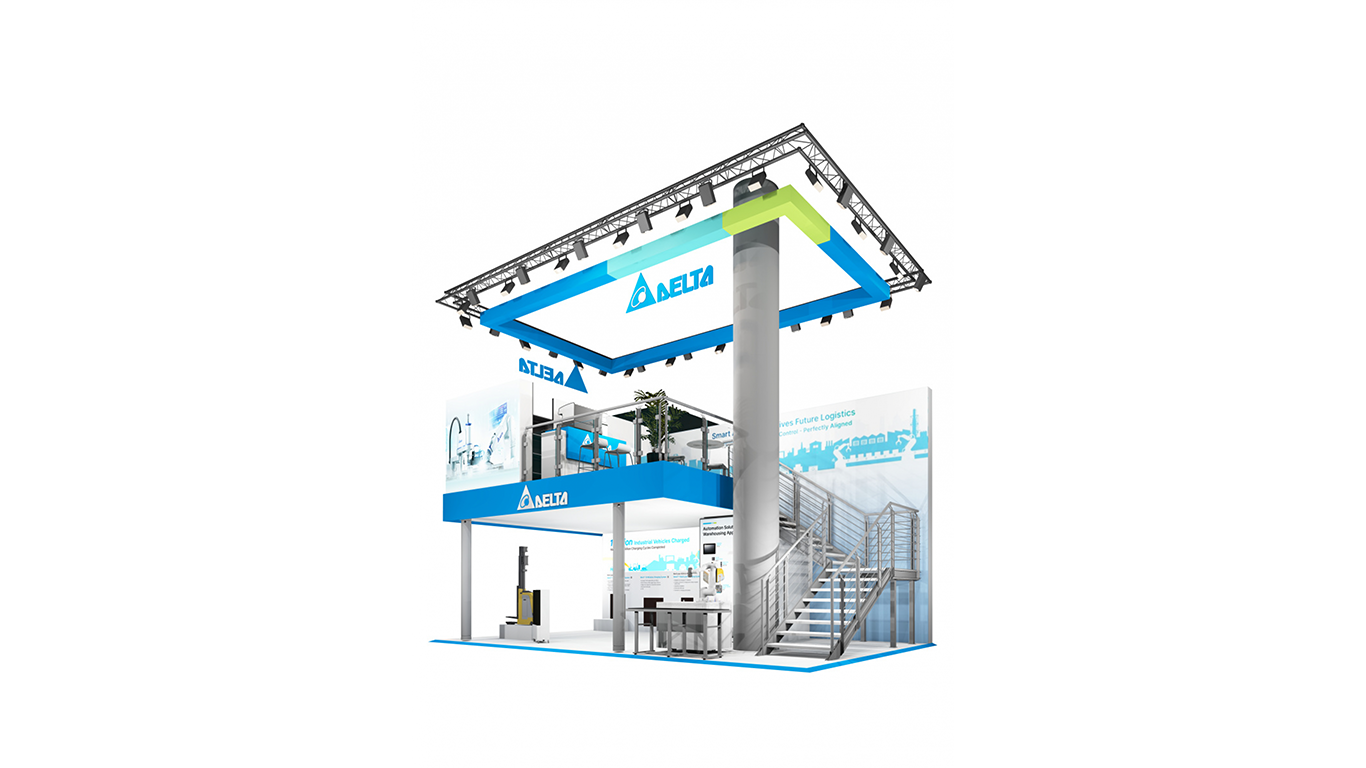
Delta is using LogiMAT 2026 to make a wider point about industrial electronics in logistics: the competitive edge is shifting from individual subsystems toward tightly coordinated control of charging, motion, sensing, and robotics. Its Stuttgart exhibit brings those layers together as a single intralogistics architecture rather than a loose collection of drives, cameras, chargers, and robot arms.
At the charging layer, Delta is centring the MOOV portfolio, which now spans conductive and wireless systems across a 1 kW to 30 kW range. The company says its charging hardware has now powered more than one million industrial electric vehicles globally, from AGVs and AMRs to forklifts and tow tractors. In warehouse automation, that matters because charging is no longer a background utility; it is part of fleet availability, route planning, and duty-cycle management.
Delta is pairing that energy layer with CP2000 sensorless vector controllers for conveyor systems, lifts, fans, and pumps, then pushing upward into perception and orchestration. The machine-vision element is built around the DMV-T family of 3D time-of-flight cameras, including the newly released RGB-D ToF Camera DMV-TM, which is aimed at object recognition, environmental sensing, and navigation in space-constrained mobile platforms. At control level, AX5 motion controllers and industrial PCs are positioned as the synchronisation layer for coordinated movement and precise positioning across the warehouse flow.
The live demonstration at the booth puts those pieces into a more legible format. Delta’s DC08 collaborative robot, rated for an 8 kg payload and 1,300 mm reach, is being shown in palletising and depalletising tasks within a conveyor-based system. That kind of demo is standard trade-show territory, but the more relevant detail is the common architecture behind it: charging state, vehicle movement, perception, control, and robotic handling are all being framed as part of the same electronics problem.
That is an important shift for intralogistics integrators. As warehouses become denser, more automated, and more power-aware, interoperability between subsystems matters more than the specification sheet of any one component. Charging hardware that can schedule around operational pauses, vision systems that stay reliable under changing lighting, and motion platforms that can be tuned without rebuilding the whole cell all reduce friction in deployment.
Delta is turning that argument into a live event pitch at LogiMAT, where visitors can view the full exhibit details and register for the show. The broader takeaway is straightforward: in warehouse automation, system availability is now being designed in at electronics level, long before it appears as a throughput number on an operations dashboard.