
IN Brief:
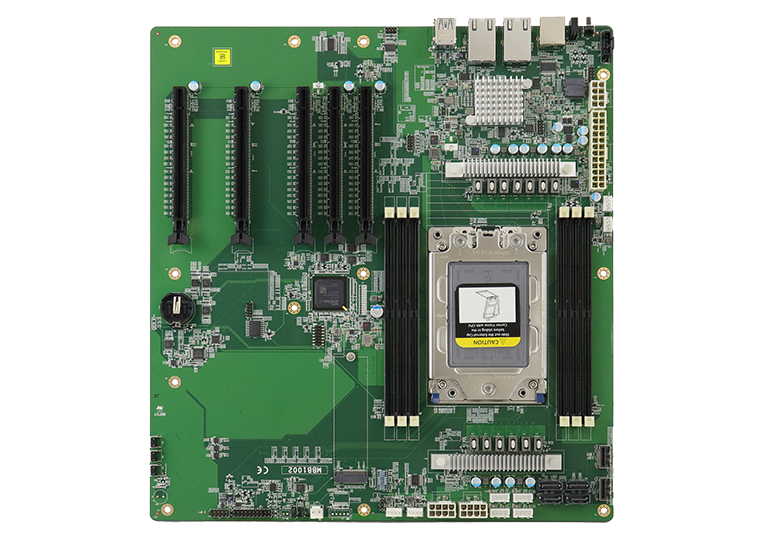
- The MBB1002 combines AMD EPYC Embedded 8004 compute with up to 576GB of DDR5-4800 ECC memory in a single-socket eATX format.
- Five PCIe Gen5 x16 slots, dual 10GbE, and NVMe support position the board for GPU-assisted inference, machine vision, and data-heavy edge workloads.
- The launch reflects a wider shift towards server-class processing at the industrial edge, where local AI, deterministic response, and system consolidation are becoming design priorities.
IBASE Technology has launched the MBB1002, an AI-ready eATX motherboard built around AMD EPYC Embedded 8004 series processors and aimed at data-intensive edge systems in manufacturing, transportation, AIoT, and related industrial deployments. The board brings a distinctly server-class specification into an embedded form factor, with support for up to 576GB of DDR5-4800 ECC memory, five PCIe Gen5 x16 slots, dual 10GbE, SATA, and PCIe Gen5 NVMe storage.
The specification tells its own story. Rather than positioning the MBB1002 as a general-purpose industrial motherboard, IBASE is aiming at installations where local compute density is becoming a constraint in its own right. A platform with that much memory headroom and expansion is less about simple control or gateway duties than about consolidating workloads such as machine vision, sensor fusion, AI inference, local analytics, and fast data movement without pushing everything back to a central server or cloud stack.
At the processor level, the choice of AMD EPYC Embedded 8004 is notable. The family is designed for single-socket systems and can scale up to 64 cores in a relatively compact footprint, which makes it well suited to space- and power-constrained deployments that still need heavy parallel throughput. In the MBB1002, that compute envelope is matched with the kind of I/O budget increasingly expected in edge AI systems, where the limiting factor is often not raw CPU throughput alone but the ability to attach GPUs, AI accelerators, high-speed networking, and fast storage without forcing awkward compromises elsewhere in the design.
The five PCIe Gen5 x16 slots are the clearest marker of where IBASE sees the market moving. In many industrial systems, the edge node is no longer a modest controller with a little extra processing on the side. It is becoming a consolidation point for vision capture, inferencing, local model updates, historian functions, and data pre-processing before anything is passed upstream. In that setting, expansion bandwidth is not a luxury. It determines whether designers can add discrete acceleration, frame grabbers, specialist NICs, or future cards without redesigning the underlying platform.
That shift is being driven by application changes across the factory and beyond it. In machine vision, higher-resolution cameras and more complex inspection algorithms have pushed compute demand steadily upwards. In transport and roadside infrastructure, analytics is increasingly expected to run close to the point of data capture rather than in a remote server room. In AIoT, engineers are also trying to reduce latency, bandwidth overhead, and exposure to intermittent connectivity by keeping more decision-making local. Boards such as the MBB1002 are a response to that pressure, offering a way to deploy server-derived silicon in installations that still need embedded-style longevity, manageable integration, and a predictable hardware bill of materials.
Memory and networking choices reinforce the same point. Support for ECC memory remains central in systems that have to stay up, recover cleanly, and operate for long service intervals, while dual 10GbE reflects the fact that industrial edge nodes increasingly sit inside data-rich architectures rather than isolated machine islands. Once vision, telemetry, control, and AI outputs converge on the same platform, internal data traffic rises quickly, and the old assumption that an industrial box can get by on modest I/O starts to look dated.
There are limits to that model, of course. A highly expandable eATX board is not the right answer for every deployment, and many edge systems still need smaller thermally constrained platforms, lower power draw, or sealed fanless construction. Even where the compute case is strong, engineers still have to resolve thermal design, power budgeting, software orchestration, and field serviceability. Dense hardware can reduce system count, but it can also concentrate failure points and complicate certification, especially in regulated or safety-related environments.
Even so, the direction of travel is hard to miss. Industrial edge computing is borrowing more heavily from server and data-centre design, not because the sectors are converging culturally, but because the workload mix is changing. Local AI execution, larger data pipelines, and tighter response requirements are pushing embedded platforms towards more memory, more lanes, and more expansion. The MBB1002 lands squarely in that transition, giving system designers another option when conventional industrial motherboards no longer offer enough headroom.
For OEMs and integrators, that makes this launch less about one board and more about platform shape. The question is no longer whether heavy compute will reach the edge, but how much of it can be packaged, cooled, and maintained economically. IBASE is betting that, for a growing class of industrial systems, the answer will look increasingly like this.

