
IN Brief:
- Sunny Smartlead is introducing ADAS camera modules built on Microchip’s VS700 family and VS775S ASA-ML devices.
- The collaboration adds security, deterministic timing, and a standards-based path for camera architectures in software-defined vehicles.
- Open SerDes ecosystems still need ecosystem depth and qualification discipline, but the case against proprietary lock-in is becoming harder to ignore.
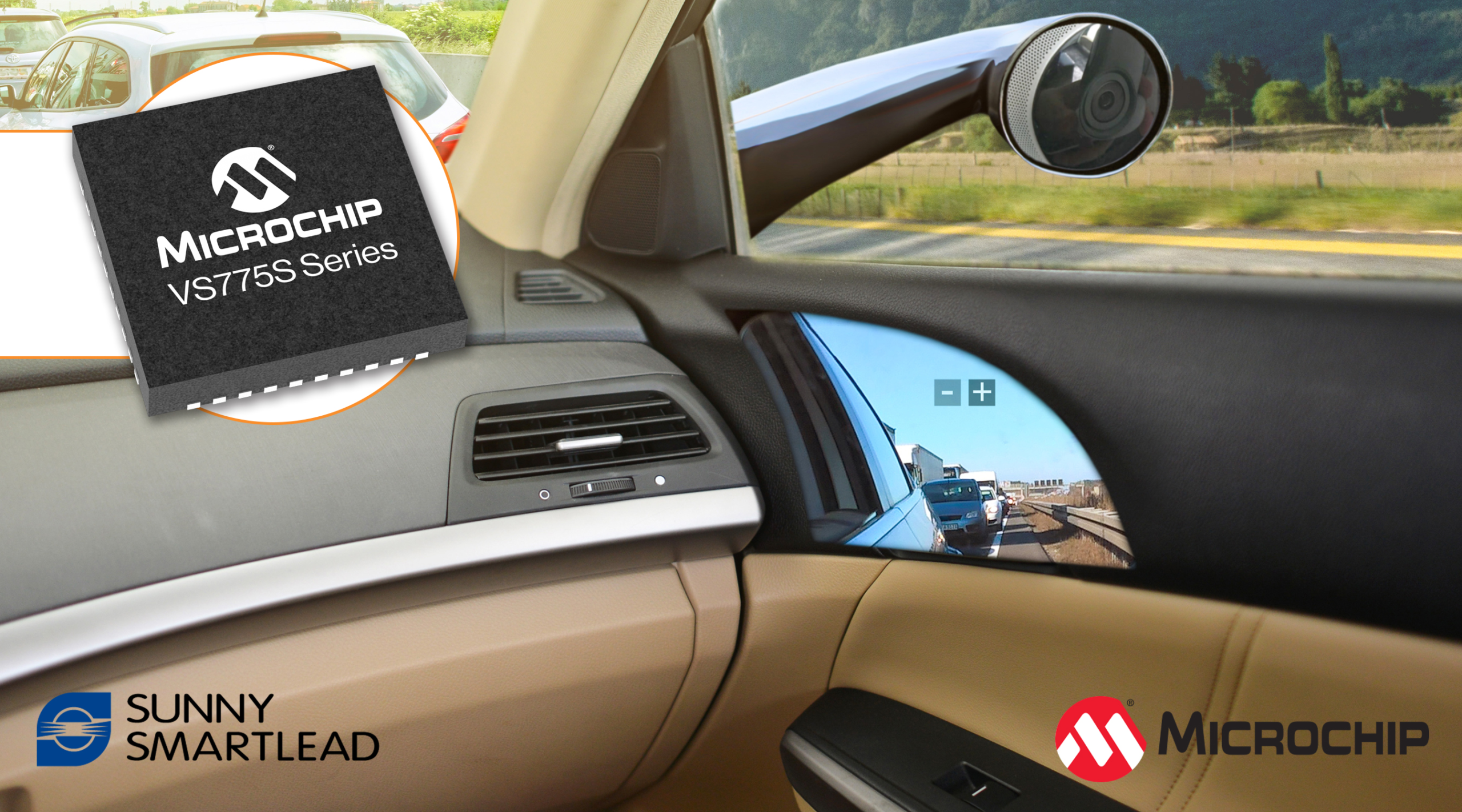
Microchip Technology and Sunny Smartlead have announced a strategic collaboration to expand the Automotive SerDes Alliance Motion Link ecosystem, with Sunny Smartlead bringing out ADAS camera modules based on Microchip’s VS700 family of ASA-ML devices. The new camera modules are intended to give automotive OEMs and Tier 1 suppliers a more standardised route to secure, high-speed camera connectivity as software-defined vehicle programmes move from architecture slides into platform execution.
At the centre of the collaboration is Microchip’s VS775S serializer, which Sunny Smartlead is integrating into camera modules for prototyping, evaluation, and eventual deployment within the broader ASA-ML environment. Microchip says the move is designed to simplify development of interoperable ADAS camera solutions while reducing dependence on proprietary serializer-deserializer stacks or single-vendor ecosystems. That is a meaningful point in automotive electronics, where camera links have become foundational to ADAS performance but the surrounding connectivity layer has often remained fragmented and vendor-specific.
The technical argument for ASA-ML rests on more than just openness. Microchip’s implementation brings standards-based link-layer security through ASAsec, providing authentication and encryption without pushing the burden onto the host processor. The platform also includes Precision Time Base support for deterministic time synchronisation across sensors, a requirement that becomes more important as multi-camera systems, radar, LiDAR, and centralised compute are asked to operate as a coherent sensing architecture rather than a set of loosely connected devices. In ADAS, timing drift is not a housekeeping issue. It directly affects alignment, fusion quality, and the confidence that can be placed in the downstream software stack.
Microchip’s VS700 family is already aimed squarely at that problem set. The product line spans single-port, dual-port, and quad-port devices compliant with the ASA 2.1 standard, with serializer devices for camera and sensor endpoints and deserializers for zonal aggregation, ECUs, and high-performance computing platforms. The VS775S also carries features intended to ease practical implementation, including support for EEPROM-less camera designs and automotive qualification aligned with ISO 26262 ASIL-B and AEC-Q100 Grade 2 requirements.
The significance of the Sunny Smartlead link-up lies in ecosystem depth. Standards do not gain traction simply because the specification is elegant. They gain traction when module suppliers, semiconductor vendors, OEMs, and system integrators can all build against them with enough confidence that supply, validation, and long-term support will hold up. Camera modules are one of the most visible proving grounds for that because they sit right at the interface between image sensing, optics, data transport, security, timing, and vehicle compute architecture.
China is an important theatre for that development. Vehicle manufacturers there have moved quickly on ADAS feature deployment, camera count is climbing, and platform teams are under pressure to scale architectures across vehicle lines without multiplying complexity at every sensor node. A standards-based SerDes approach offers one route to that scalability, especially if OEMs want more freedom to qualify multiple partners rather than remain tied to a closed ecosystem. That does not automatically settle the matter. Automotive design cycles still reward proven supply relationships, and the qualification burden for high-volume camera systems remains demanding.
Even so, the direction of travel is clear. As vehicles add more cameras and shift towards zonal and centralised compute architectures, proprietary point solutions begin to look increasingly expensive to maintain. Engineering teams need security, synchronisation, bandwidth, and interoperability together, not as separate layer-by-layer negotiations between suppliers. That is where alliances like ASA-ML either prove their worth or fade into committee history.
The Microchip-Sunny Smartlead collaboration suggests the standard is moving into a more practical phase. It is no longer only about promoting an alternative to proprietary SerDes. It is about building real modules, with real ecosystem partners, that OEMs can evaluate against production timelines. In automotive electronics, that is the stage where standards begin to matter — when they stop being ideology and start becoming purchasable design options.

