
IN Brief:
- Microchip has added dsPIC33AK256MPS306 devices to its dsPIC33A family, targeting AI data-centre power, motor control, and intelligent sensing.
- The parts combine 200 MHz control, fast analog, 78 ps PWM resolution, multiple 40 MSPS ADCs, and hardware support for secure boot, firmware update, and PQC-related functions.
- Control silicon is being asked to do more than close loops: it now has to carry safety, telemetry, firmware resilience, and security into dense power and automation designs.
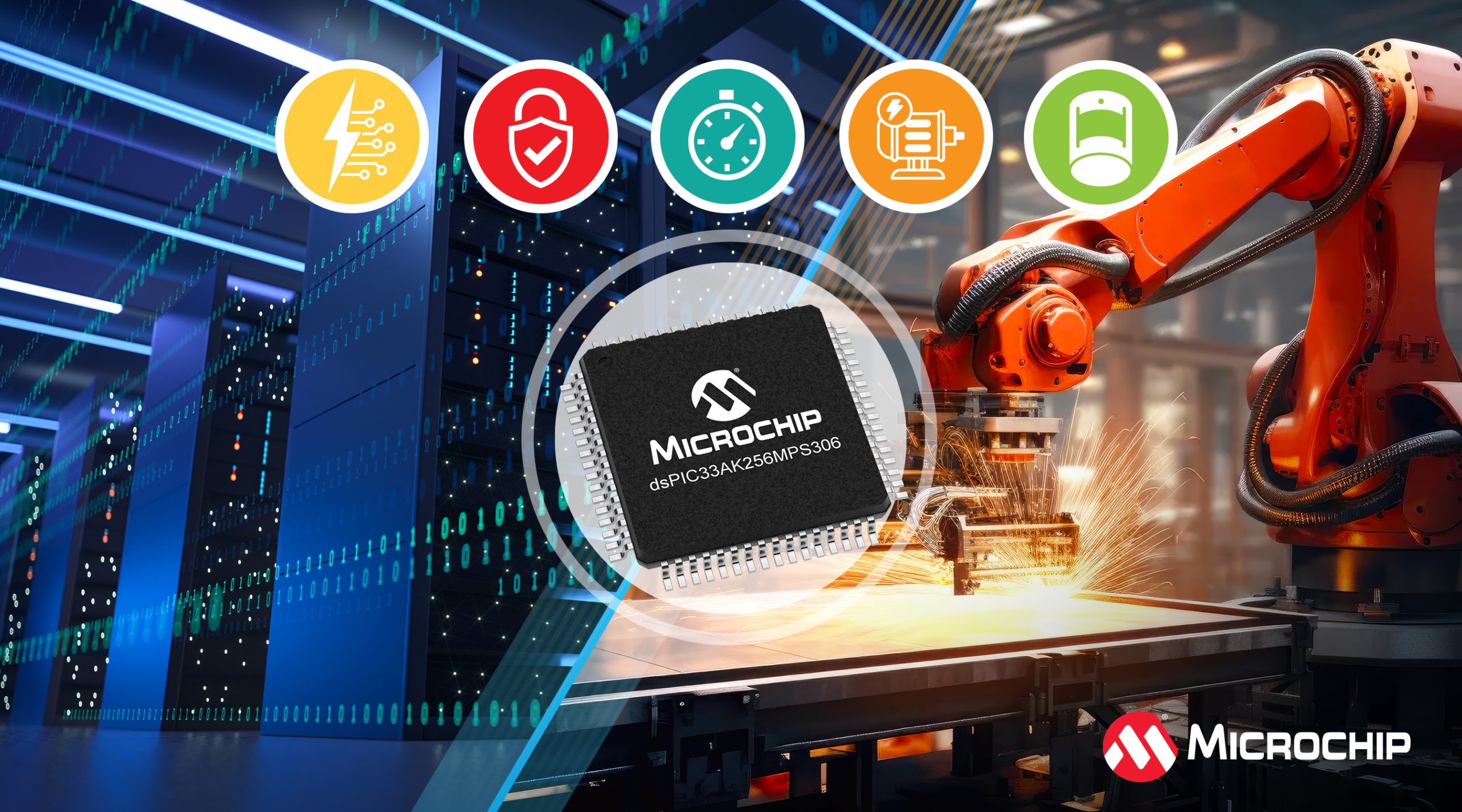
Microchip has extended its dsPIC33A digital signal controller line with the dsPIC33AK256MPS306 family, aiming the new parts at three areas that are increasingly overlapping in embedded design: AI data-centre power conversion, complex motor control, and intelligent sensing. The devices bring together a 200 MHz 32-bit core, high-speed analog resources, fine PWM resolution, and hardware security features in a package intended to cut external component count while tightening control performance.
At the heart of the new family is a 200 MHz architecture with a double-precision floating-point unit, backed by 78 ps pulse-width modulation, multiple 40 MSPS 12-bit ADCs, 5 ns comparators, and DACs with slope compensation. On paper, that gives the device the kind of mixed control-and-measurement profile now demanded by fast-switching digital power designs and more exacting motor-control systems, especially where silicon carbide or gallium nitride devices are pushing switching frequencies higher and collapsing the margin for sloppy timing or slow feedback paths.
Microchip is also placing unusual emphasis on cybersecurity and lifecycle management for a control-class device. The family supports secure boot, secure firmware update, secure debug, and cryptographic acceleration, with library support aimed at post-quantum algorithms aligned to CNSA Suite 2.0 recommendations. It also adds live update support and I3C connectivity alongside CAN FD, LIN, SPI, I2C, and SENT, making the part relevant not only for actuation and conversion, but for telemetry-heavy and connected systems that need to remain updateable in service.
That combination is what makes the launch more interesting than a straightforward controller refresh. In high-density AI server power, the control problem is no longer confined to efficiency alone. Power stages must respond quickly, report accurately, support supervisory functions, and increasingly satisfy harder security expectations around firmware integrity and system trust. The same pattern is visible in industrial drives and sensing platforms, where the controller is expected to manage real-time behaviour, local analytics, communications, and safety without pushing the design into a larger processor class than the application really needs.
The dsPIC33AK256MPS306 is positioned to sit in that widening space between traditional microcontrollers and more specialised digital-power or motor-control controllers with fragmented support ecosystems. Its support for Zephyr, FreeRTOS, SafeRTOS, model-based development, and established debug environments suggests Microchip is trying to make software portability and ecosystem depth part of the value proposition rather than an afterthought. That matters because many real-world control designs now fail to meet schedule not through a lack of raw silicon capability, but because integration across firmware, safety, communications, and tooling takes longer than expected.
There is also a clear industry backdrop to the AI data-centre angle. Server power has become a first-order semiconductor opportunity as rack densities climb and power conversion stages become more numerous, more closely monitored, and more dynamic under load. Better magnetics, wide-bandgap switches, and thermal design all matter, but none of them deliver much value unless the control loop is quick and stable enough to exploit them. The controller therefore becomes a bottleneck or an enabler, depending on how much analog visibility and compute headroom it offers.
In motor control, meanwhile, the market has not become simpler. Designers still want field-oriented control, fast position feedback, efficient current sensing, and smaller bills of material, yet they also want certification pathways and longer software life. Adding resolver, encoder, and functional-safety-friendly support to a single family is a response to that pressure. The same applies in advanced sensing, where higher integration increasingly determines whether a design stays compact enough for the application it is meant to serve.
Microchip’s latest dsPIC33A addition is therefore best read as a control-platform move rather than a single-device announcement. The embedded controller is being asked to take responsibility for more of the system than before, particularly where power, security, and real-time behaviour intersect. Devices that can carry those demands without dragging a design into unnecessary complexity should find a receptive market over the next phase of industrial and infrastructure build-out.

