IN Brief:
- EPC has launched new GaN-based inverter platforms for three-phase BLDC motor drives up to 5kW.
- The boards support up to 150Arms, 120kHz PWM switching, and both sensorless and encoder-based control.
- GaN is moving further into practical motion-control hardware, not just point demonstrations and component-level comparisons.
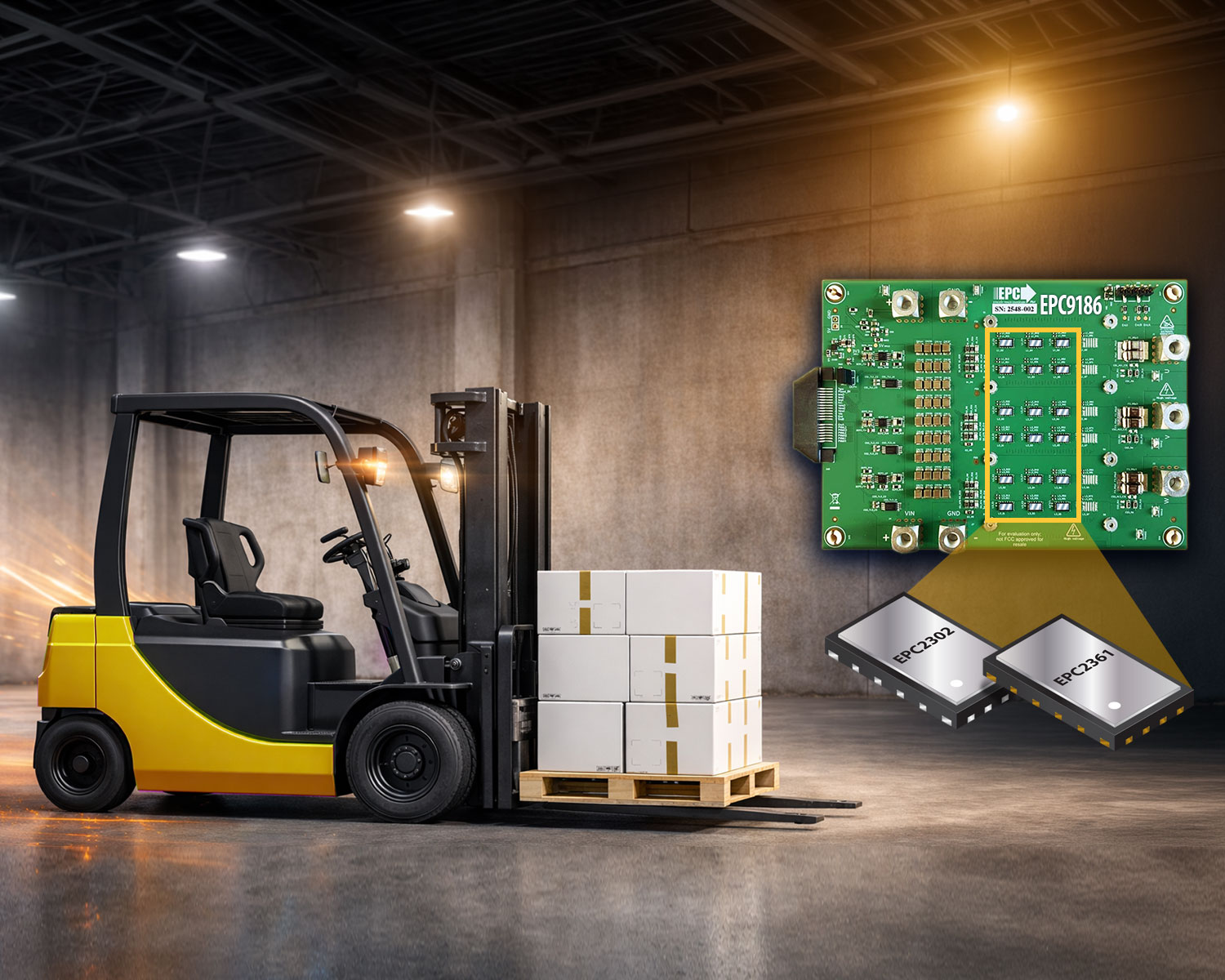
Efficient Power Conversion has introduced two 5kW three-phase inverter platforms built around its 100V EPC2361 eGaN FETs, pushing gallium nitride a little further from component promise and a little closer to everyday motion-control engineering. The new EPC9186HC2 and EPC9186HC3 boards are intended for BLDC motor-drive development across robotics, industrial automation, forklifts, agricultural equipment, battery-powered mobility systems, scooters, and high-power drones.
Both platforms are based on the earlier EPC9186 hardware architecture, but the updated power stage uses EPC2361 devices to improve conduction performance and support higher current operation at lower cost. The HC2 version places two EPC2361 devices in parallel at each switch position, while the HC3 uses three. EPC says the boards support phase currents up to 150Arms, depending on current-sensing configuration, and PWM switching frequencies up to 120kHz. They also operate with DC inputs up to 76V and are designed around dv/dt of roughly 6V/ns to help limit torque ripple and acoustic noise in precision motion systems.
That gives engineers a more realistic evaluation platform than the sort of stripped-down demo boards that often accompany wide-bandgap launches. The boards integrate gate drivers, high-bandwidth current sensing, voltage monitoring, housekeeping supplies, overcurrent protection, and undervoltage lockout. They support both sensorless and encoder-based control and can be used with controller platforms from Microchip, Texas Instruments, and STMicroelectronics. In other words, these are not just reference designs meant to showcase transistor physics. They are meant to be dropped into actual motor-control development flows.
The timing makes sense. GaN has already proved its value in fast-switching converters and compact power stages, but motion control has been a harder commercial bridge. The gains are attractive — lower gate charge, lower output capacitance, faster switching, smaller passives, and potentially better system efficiency — yet designers still have to manage layout discipline, EMI behaviour, sensing fidelity, and software control in applications where acoustics, smooth torque delivery, and thermal stability matter as much as peak efficiency figures. Evaluation boards that present a more complete system view help shorten that gap between device interest and design commitment.
There is a broader industrial context as well. Motor-driven systems are being redesigned under pressure from electrification, warehouse automation, mobile robotics, and tighter energy targets. The result is a market that wants more torque density, better battery use, quieter operation, and smaller power stages in increasingly diverse form factors. Silicon MOSFETs remain deeply competitive, particularly on cost and familiarity, but GaN keeps finding openings where switching speed and compactness translate into whole-system benefits rather than just nicer datasheet numbers.
EPC’s new boards do not guarantee that every motor-drive engineer will suddenly pivot to GaN. Power-stage design is conservative for good reason, and many teams will stay with mature silicon where the trade-offs still work. Even so, launches like this matter because they move the conversation from device-level evangelism to application-level engineering. A 5kW class inverter platform with integrated sensing, mainstream controller compatibility, and a credible list of target applications is a stronger signal than another comparison chart. It suggests GaN is settling into the more difficult phase of market adoption — the phase where it has to prove it can fit into the messy realities of industrial motion control and do so without demanding heroics from the design team.