
IN Brief:
- Microchip has added dsPIC33AK256MPS306 devices to the dsPIC33A DSC family.
- The parts combine 78ps PWM, 40MSPS ADCs, fast comparators, DACs, and security features.
- Power conversion, intelligent sensing, and motor-control platforms are increasingly being designed around tighter control loops, richer telemetry, and stronger security baselines.
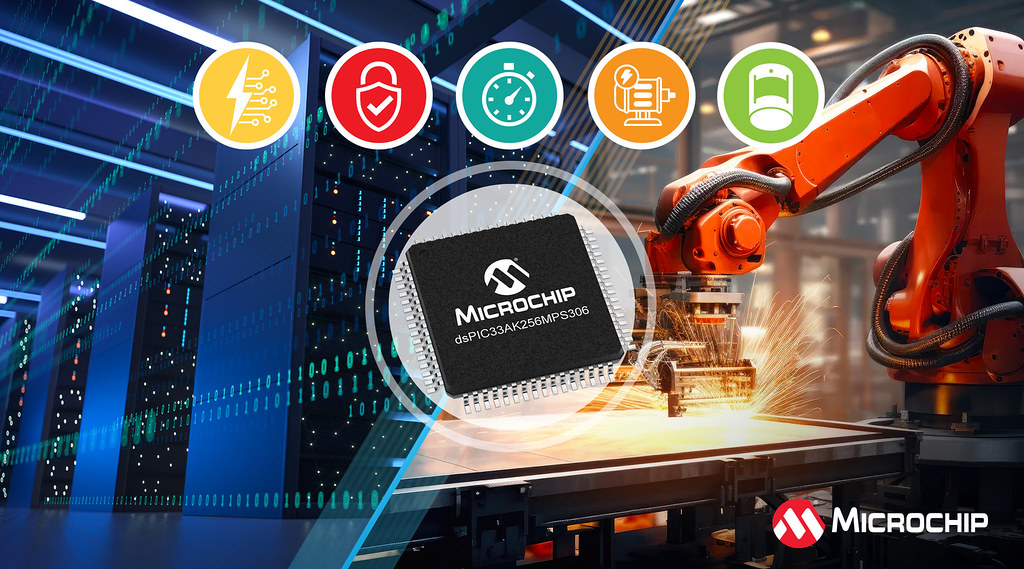
Microchip has expanded its dsPIC33A digital signal controller portfolio with the dsPIC33AK256MPS306 family, targeting high-density AI data-centre power, complex motor control, and intelligent sensing applications that need fast real-time control and dense analogue integration on the same device.
The new parts are built around a 200MHz 32-bit core with double-precision floating-point support and combine 78ps pulse-width modulators with multiple 40MSPS 12-bit ADCs, 5ns high-speed comparators, and DACs with slope compensation. The family also adds hardware security features for secure boot, authenticated firmware updates, secure debug, and support for post-quantum cryptographic libraries aligned with CNSA Suite 2.0 recommendations.
Microchip is also targeting the devices at high-frequency power designs built around silicon carbide and gallium nitride switching devices, where faster control loops and cleaner analogue visibility are needed to push efficiency without eroding stability margins. The parts support I3C for low-latency telemetry and sensor networks, alongside CAN FD, LIN, SPI, I2C, and SENT interfaces for use across server power, industrial drives, automotive control, and sensing-heavy embedded platforms.
For motor-control designs, the family includes hardware intended to support field-oriented control and position feedback through interfaces such as BiSS-C, EnDat, and encoder or resolver inputs. For sensing and HMI work, the devices add an integrated touch controller and oversampling support for up to 16-bit ADC resolution, reducing the need for external support devices in more complex mixed-signal designs.
Control devices are being asked to do more in less space. Power conversion, motor drive systems, and sensor-rich embedded nodes now need tighter loop timing, more telemetry, and stronger security while still meeting cost, size, and power targets. That is pushing demand toward controllers that can combine fast control, high-speed analogue, and communications support without forcing a step up to a larger processor-plus-analogue architecture.
Security is moving further down the stack as well. Connected power shelves, industrial control nodes, and embedded infrastructure once treated as closed subsystems are now expected to support authenticated updates, secure startup, and greater resistance to tampering. That is particularly visible in data-centre power, where telemetry-rich power supplies and rack-level electronics are becoming networked assets rather than sealed hardware blocks.
The addition of post-quantum support underlines that shift. Most designs will not move immediately to quantum-safe cryptography, but the inclusion of those capabilities shows how cybersecurity requirements are extending into control silicon that would once have been treated as functionally narrow. The same pattern is visible across industrial electronics, where power and control devices are expected to carry more communications, more diagnostics, and more assurance over their operating state.
The controller market is also tilting back toward workload-specific integration. General-purpose MCUs and MPUs remain important, but there is renewed interest in device families that bundle timing, analogue, security, and software support around defined application classes. That reduces design overhead and cuts the number of interface problems a team has to solve separately.
Digital signal controllers sit neatly in that space. In applications where deterministic control, high-speed analogue acquisition, and systems-level security need to coexist, they remain a practical fit. With AI infrastructure and industrial control both placing heavier demands on surrounding electronics, that part of the market is gaining weight again.

