IN Brief:
- ispace and the University of Leicester will fly a Raman spectrometer payload on a future lunar mission.
- The payload adapts laser spectroscopy heritage from ExoMars for lunar regolith analysis.
- Compact analytical instruments are becoming increasingly important as commercial lunar transport services mature.
ispace and the University of Leicester have signed a Payload Service Agreement to deliver a Raman analytical spectroscopy instrument to the lunar surface on a future mission.
The payload is adapted from a laser-based spectrometer originally developed for the ExoMars mission. It will be delivered by the University of Leicester in collaboration with INTA in Madrid, the University of Aberdeen, RAL Space, and the University of Valladolid.
Once deployed, the instrument will analyse the lunar surface and determine the molecular composition of regolith. The resulting data can help identify materials and potential resources relevant to future human exploration, including work linked to in-situ resource utilisation on the Moon.
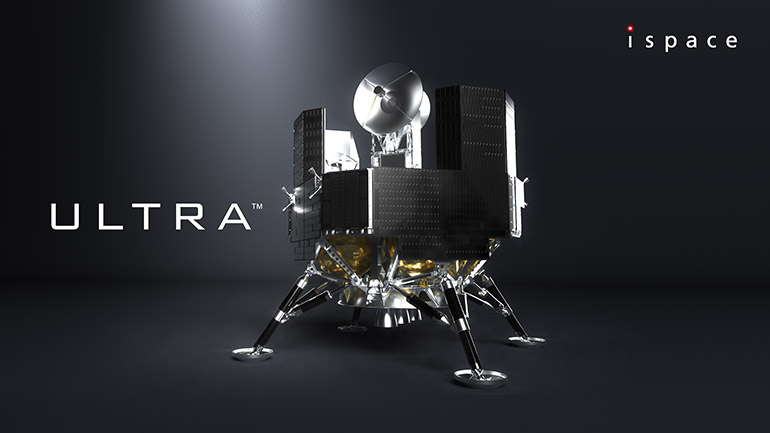
The project is funded under the UK Space Agency Science and Exploration Bilateral Fund. Under the agreement, ispace will provide payload transportation services through its Japanese entity aboard a future mission using the company’s ULTRA lunar lander. The specific mission assignment has not yet been determined.
Raman spectroscopy uses laser interaction with a material sample and analysis of scattered light to identify molecular composition. On the Moon, the instrument must be placed close enough to the regolith to collect useful data, making the deployment mechanism as important as the optical payload. The spectrometer is expected to operate in very close proximity to, or in direct contact with, the lunar surface.
ispace and the University of Leicester are jointly developing a deployment mechanism to position the instrument on the surface with the required precision. The mechanism is being developed for both lander-based and rover-based operation, giving the payload a route into smaller commercial lunar platforms as well as more traditional exploration architectures.
The collaboration has developed over several years. A Letter of Support was signed in 2022, followed by an Initial Payload Service Agreement in 2024, and now a full Payload Service Agreement. That progression gives the UK-led instrument a defined commercial delivery path while retaining the scientific and engineering heritage of earlier planetary exploration work.
For the electronics and instrumentation sector, the project brings together optical sensing, embedded control, thermal design, precision deployment, and harsh-environment reliability. Lunar payloads have to survive launch and landing loads, operate within strict mass and power limits, tolerate severe temperature swings, and return useful data without maintenance access or laboratory-style handling.
The renewed push towards lunar exploration is increasing demand for compact analytical instruments that can do more than image the surface. Future missions will need to characterise material composition, map resource availability, and validate technologies that support longer-duration operations. Instruments with Mars-mission heritage offer a useful starting point, although lunar deployment brings its own requirements around dust, mechanical contact, landing dynamics, and payload integration.
Raman spectroscopy is attractive for early surface analysis because it can provide molecular information without extensive sample preparation. That allows a relatively compact instrument to add chemical context to imaging and environmental measurements, particularly when payload mass and mechanical complexity are tightly constrained.
Commercial lunar access is beginning to change how such instruments are designed. Payload developers must still meet scientific objectives, but they also have to fit into repeatable transport services, standardised integration processes, and lander or rover platforms with limited accommodation. In that environment, the most successful instruments will be those that combine measurement performance with practical deployability.