IN Brief:
- SiLC Eyeonic Vista uses FMCW LiDAR, silicon photonics, velocity sensing, and dynamic region-of-interest scaling.
- The system is designed to identify and track small targets beyond 1km.
- Long-range 4D sensing is moving into perimeter security as small autonomous threats become harder to classify with single-mode sensors.
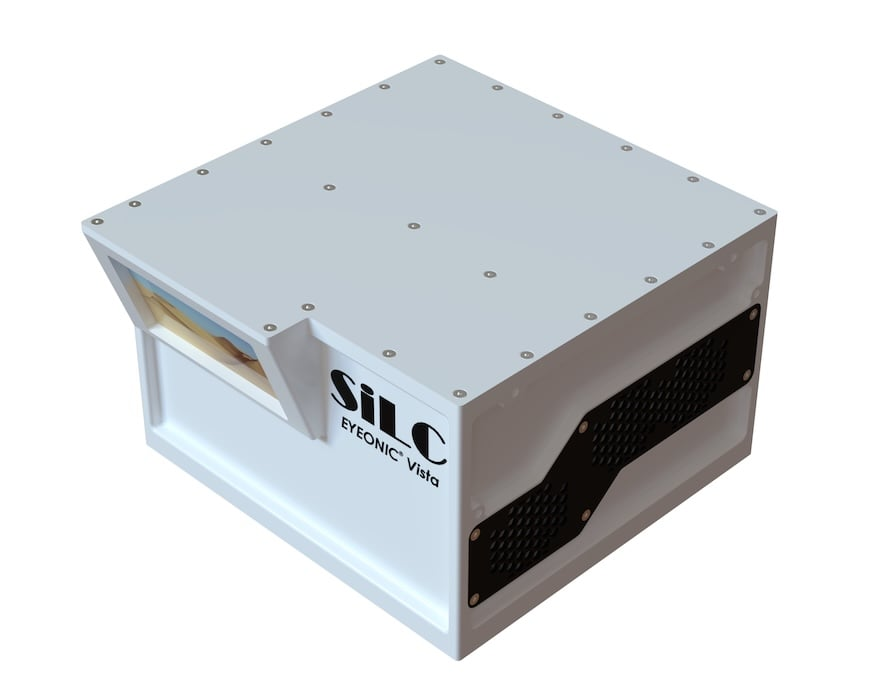
SiLC Technologies has launched Eyeonic Vista, an ultra-long-range 4D vision system for perimeter security, counter-UAS, maritime monitoring, and critical infrastructure applications.
The system combines silicon photonics, FMCW LiDAR, velocity sensing, and dynamic region-of-interest scaling to identify and track small targets at distances beyond 1km. Target classes include drones, animals, humans, vehicles, and unauthorised vessels, placing the platform in a growing category of sensors designed to improve classification at the edge of secured environments.
Eyeonic Vista uses an eight-channel architecture to collect spatial and velocity data from distant targets. Dynamic region-of-interest scaling enhances resolution around objects of interest, allowing the system to focus sensing resources where more detail is needed. The platform is housed for exposed deployment and carries an IP65 rating for all-weather operation across changing lighting conditions.
The system provides an instrumented range beyond 1km and angular resolution as fine as 8 millidegrees. Micro-Doppler velocity measurement is used to detect speed and direction in real time, while dual-polarisation sensing supports material classification. Coherent detection is included to reduce susceptibility to jamming and crosstalk where multiple sensors may be operating in the same environment.
SiLC is targeting perimeter security, counter-unmanned aerial system operations, airports, power stations, military assets, borders, prisons, maritime ports, public venues, and historical landmarks. Those applications share a difficult detection profile: small or irregularly moving targets, cluttered backgrounds, weather exposure, and the need to distinguish genuine threats from benign activity.
Radar remains a strong technology for broad surveillance, especially over wide areas and in poor visibility, but fine classification of small targets can be difficult. Camera and thermal systems provide visual detail, though their performance depends heavily on lighting, weather, obscurants, and line of sight. FMCW LiDAR adds direct velocity and depth information, giving security systems another data layer for target confirmation.
The use of 1550nm-class LiDAR technology is relevant for outdoor systems because longer-wavelength operation can support higher optical power within eye-safety constraints than some shorter-wavelength approaches. Combined with coherent detection, that gives the system a route to longer-range operation and stronger discrimination in environments where background light, reflective surfaces, and other active sensors can complicate measurement.
Perimeter security has become a multi-sensor discipline as small drones, autonomous ground systems, and low-signature vehicles change the behaviour of intrusion events. Detection systems that were originally built around humans, large vehicles, or fixed crossing points are being asked to identify moving objects across three dimensions and classify them quickly enough for an operational response.
Critical infrastructure operators are increasingly combining radar, electro-optical cameras, thermal imaging, acoustic sensors, RF detection, and LiDAR within layered security systems. The engineering difficulty sits in classification confidence, latency, false alarm reduction, sensor fusion, and rugged operation, rather than simple detection alone.
Eyeonic Vista adds a long-range 4D sensing option to that mix, with spatial, velocity, and material-related information gathered in a single platform. Its practical value will depend on how well it integrates into wider command, control, and automation systems, but the direction is clear: high-security perimeter monitoring is moving towards richer edge sensing and more sophisticated target discrimination.