IN Brief:
- Molex has introduced multi-channel liquid-cooled busbars for AI data-centre racks.
- The architecture supports 15,000A today, with a roadmap toward 25,000A.
- AI rack power is pushing electrical distribution and thermal management into a single design problem.
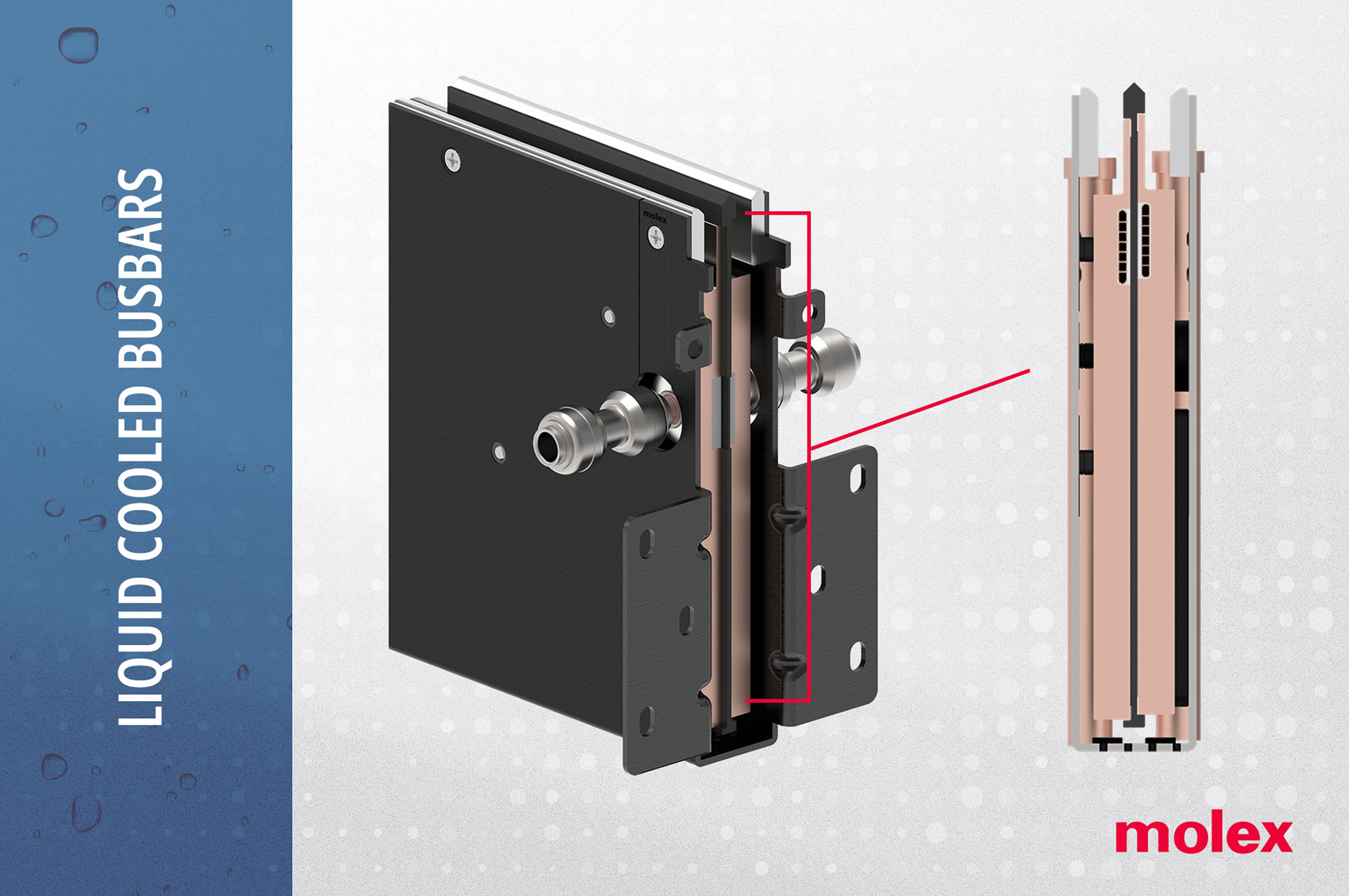
Molex has introduced multi-channel liquid-cooled busbars for AI data-centre racks, extending liquid cooling from compute hardware into the power-distribution backbone.
The company is showing the technology at Computex 2026 in Taipei, where it will demonstrate thermal mapping of the busbar architecture under simulated high-density AI workloads. The busbars are designed to support currents up to 15,000A today, with a development roadmap toward 25,000A as rack power moves closer to the 1MW level.
Instead of using a single fluid path, the architecture uses as many as seven discrete coolant channels. Molex’s simulation data puts the cooling-efficiency improvement at up to 20% compared with a single-channel design, while the busbars deliver a 15°C temperature rise at 15,000A. The multi-channel structure is intended to reduce hot spots, improve heat extraction, and maintain more stable electrical performance at high current.
Kevin Alberts, vice president and general manager of the Power and Signal Business Unit at Molex, said: “Direct-to-chip cooling is now standard for compute, but for AI to truly scale, we must also address the thermal challenges of the power path.”
The busbars can be configured by length, depth, and fluid inlet and outlet positions, allowing them to fit different rack layouts. Molex has also designed the products for footprint compatibility with ORV3 and HPR mechanical standards, supporting integration into rack architectures that are already moving toward higher current and higher thermal density. Compatibility with dielectric and non-dielectric liquids broadens the range of facility cooling loops into which the technology can be integrated.
AI infrastructure is changing the role of power distribution hardware. Accelerators and high-bandwidth memory are pushing rack density higher, while direct-to-chip cooling has already moved into mainstream high-performance systems. The conductors, connectors, and busbars carrying power through the rack are now exposed to the same thermal and mechanical pressure as the compute layer they supply.
Higher-voltage distribution offers one route to reducing copper burden and limiting conversion losses. Infineon’s work with NVIDIA’s 800V rack ecosystem shows how rack-level architectures are moving away from incremental power-supply changes toward broader electrical redesign. Molex’s busbar development addresses the same rack-scale problem from the conductor and cooling side.
Power components, sensing, switching, and thermal management are also converging around AI data-centre requirements. TDK’s PCIM programme for AI data-centre power covered DC/DC conversion, passives, contactors, capacitors, sensors, and protection devices in the same technical field. Rack power can no longer be treated as a chain of separate components.
Liquid-cooled busbars will not remove the need for efficient conversion stages or robust protection, although they address a physical limit in high-current racks. As current levels rise, the power backbone becomes both an electrical path and a thermal structure, with its design increasingly shaping rack density, reliability, serviceability, and upgrade cycles.