IN Brief:
- Microchip and Marelli have demonstrated ASA Motion Link connectivity between central vehicle compute and automotive displays.
- The implementation supports data rates up to 16Gbps, with link-layer authentication and encryption.
- Marelli's display-side integration extends open ASA-ML SerDes beyond camera and sensor connections into cockpit systems.
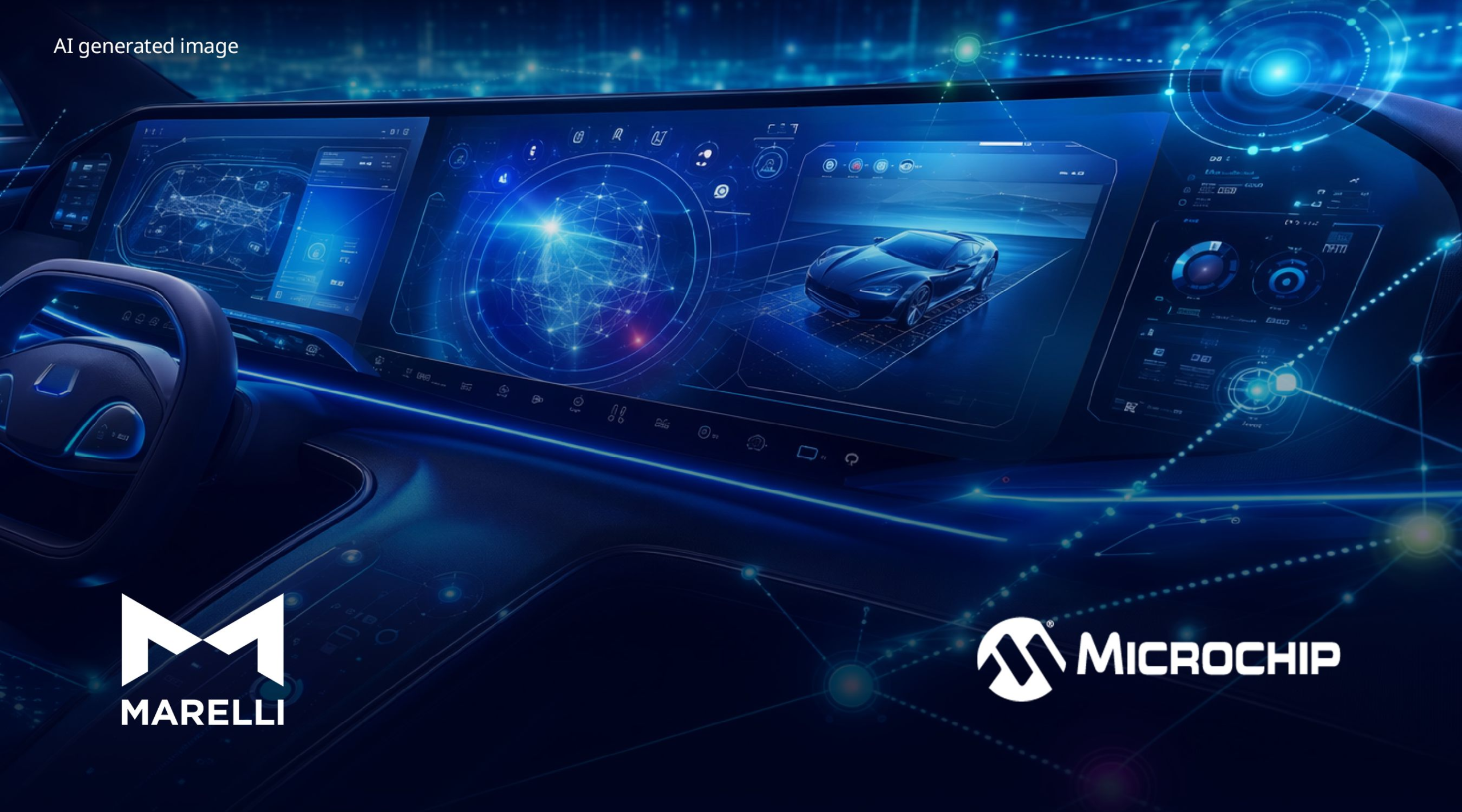
Microchip Technology and Marelli have demonstrated an automotive display link built around the open ASA Motion Link standard, carrying centrally generated graphics and video from a vehicle computer to remote displays.
The demonstrator uses Microchip’s VS7000 ASA-ML chipset to transport content generated by a central compute system, while Marelli handles display-side integration and configuration of the deserialiser. The arrangement can deliver camera feeds, navigation maps, infotainment graphics, and vehicle-control interfaces over the standardised high-speed connection.
ASA Motion Link was developed by the Automotive SerDes Alliance as an open serializer-deserializer standard for automotive video connectivity. The approach is aimed at the growing number of cameras, sensors, and displays attached to central or zonal computing platforms as vehicle architectures become less dependent on separate function-specific electronic control units.
That consolidation changes the role of the display link. A cockpit screen is no longer necessarily paired with a local processor generating its content; instead, graphics may be rendered centrally and transmitted across the vehicle, making bandwidth, latency, electromagnetic compatibility, error handling, and security characteristics part of the display architecture itself.
Microchip specifies data rates up to 16Gbps for the demonstrator and includes link-layer authentication and encryption. Time Division Duplex operation and simplified Forward Error Correction are intended to reduce protocol overhead and power consumption, while the link is designed to operate within the electrically demanding automotive environment.
Marelli’s contribution is concentrated at the display endpoint. Its integration configures the ASA-ML deserialiser to receive and synchronise the standardised stream before presenting the resulting video or graphics to the display electronics. That makes the demonstrator more than a serializer-to-deserializer bench link, showing how an automotive Tier 1 can incorporate the standard into a cockpit subsystem.
The open specification also changes the component-sourcing calculation. Proprietary automotive SerDes technologies can bind both ends of a connection to one vendor or a tightly controlled product family, whereas ASA-ML is intended to allow devices from different suppliers to operate within the same architecture.
Multi-vendor sourcing remains subject to qualification. Electrical behaviour, protocol timing, security functions, diagnostics, error recovery, and electromagnetic performance all need validation across the actual combination of serializer, deserialiser, cable, connector, display electronics, and central compute platform used in a vehicle.
Microchip has previously demonstrated ASA-ML interoperability in camera applications, and the Marelli work extends that activity into display connectivity. Cameras and displays share a requirement for high-rate asymmetric data transfer, but their endpoint behaviour, synchronisation, visual-output, and fault-handling requirements are not identical.
ASA-ML is also being positioned alongside automotive Ethernet rather than as a substitute for every in-vehicle network. Ethernet remains well suited to packet-based communication between controllers and high-performance compute nodes, while an asymmetric SerDes link can move video between an endpoint and its processing platform without forcing the traffic into the same network model.
That division may become more common as software-defined vehicle architectures consolidate computing functions. Ethernet can provide the broader backbone, while ASA-ML handles high-bandwidth sensor and display connections that would otherwise rely on proprietary interfaces or additional conversion stages.
The demonstrator does not represent a disclosed vehicle programme, production award, or start-of-production date. Its scope is narrower: an open-standard link has been integrated through a central compute-to-display path by a semiconductor supplier and an established automotive Tier 1.
The production test will be interoperability across qualified components rather than a single demonstration system. An open specification only improves sourcing flexibility if manufacturers can introduce another compliant implementation without redesigning the surrounding electronics or repeating an uneconomic proportion of the original validation programme.
Centralised compute can reduce duplicated processing and simplify software management, but it places more responsibility on the networks carrying time-sensitive visual information around the vehicle. A remote display still has to behave predictably when a camera feed or driver interface is being generated elsewhere in the architecture.
Microchip and Marelli have shown that ASA-ML can be taken into that display subsystem. Production adoption will depend on whether its interoperability, security, and signal-integrity characteristics remain intact when an OEM qualification programme replaces the demonstrator with multiple suppliers, production harnesses, and the rather less forgiving electrical conditions of a vehicle.