IN Brief:
- AI is becoming embedded in practical medical electronics, supporting diagnostics, monitoring, and clinical decision-making across connected healthcare environments.
- Edge processing, cloud infrastructure, and interoperability standards are giving medical devices faster, more reliable ways to handle clinical data.
- Design engineers must now account for performance, connectivity, cybersecurity, explainability, and governance as healthcare systems become more intelligent.
By Roy Wills, VP, Head of Healthcare Business and Partnerships at Intellias
Artificial intelligence (AI) is rapidly becoming embedded within medical electronics, moving beyond experimental projects to support real-world diagnostics, monitoring, and clinical decision-making. From imaging systems and wearable health devices to connected monitoring platforms, AI is helping healthcare providers process growing volumes of data while improving efficiency and patient outcomes.
The engineering value of AI solutions in healthcare can be traced to measurable improvements in how systems process and act on data. This is increasingly reflected in financial outcomes, with healthcare organisations reporting positive returns from generative AI deployments. Research from McKinsey shows a growing proportion of healthcare systems implementing generative AI solutions are already achieving a positive return on investment (ROI) — highlighting the technology’s transition from innovation initiative to operational necessity.
Several technological advances are driving this shift. Improvements in cloud computing and edge processing allow AI models to analyse data closer to where it’s generated, reducing latency while maintaining central oversight. At the same time, interoperability standards such as Fast Healthcare Interoperability Resources (FHIR) and Health Level Seven (HL7) enable AI-enabled devices to exchange data with electronic health records (EHRs), imaging systems, and laboratory platforms.
The result is a new generation of intelligent medical devices capable of delivering insights in near real time.
AI in diagnostic systems
Medical imaging remains one of the most established applications of AI in healthcare electronics. Modern computer vision algorithms can analyse CT, MRI, and X-ray images to identify abnormalities, prioritise urgent cases, and support clinical decision-making. In acute stroke pathways, for example, AI-assisted radiology triage systems are helping clinicians reduce scan review times by automatically flagging suspected haemorrhages or large vessel occlusions for urgent assessment.
Rather than replacing clinicians, these systems act as decision-support tools that help radiologists and specialists manage increasing workloads. By automating routine image analysis and highlighting potential concerns, AI can reduce diagnostic delays and improve workflow efficiency.
Beyond imaging, AI is increasingly being used alongside genomic sequencing and laboratory diagnostics. Machine learning models can identify patterns across large datasets, helping clinicians personalise treatment plans and support earlier disease detection.
Intelligent patient monitoring
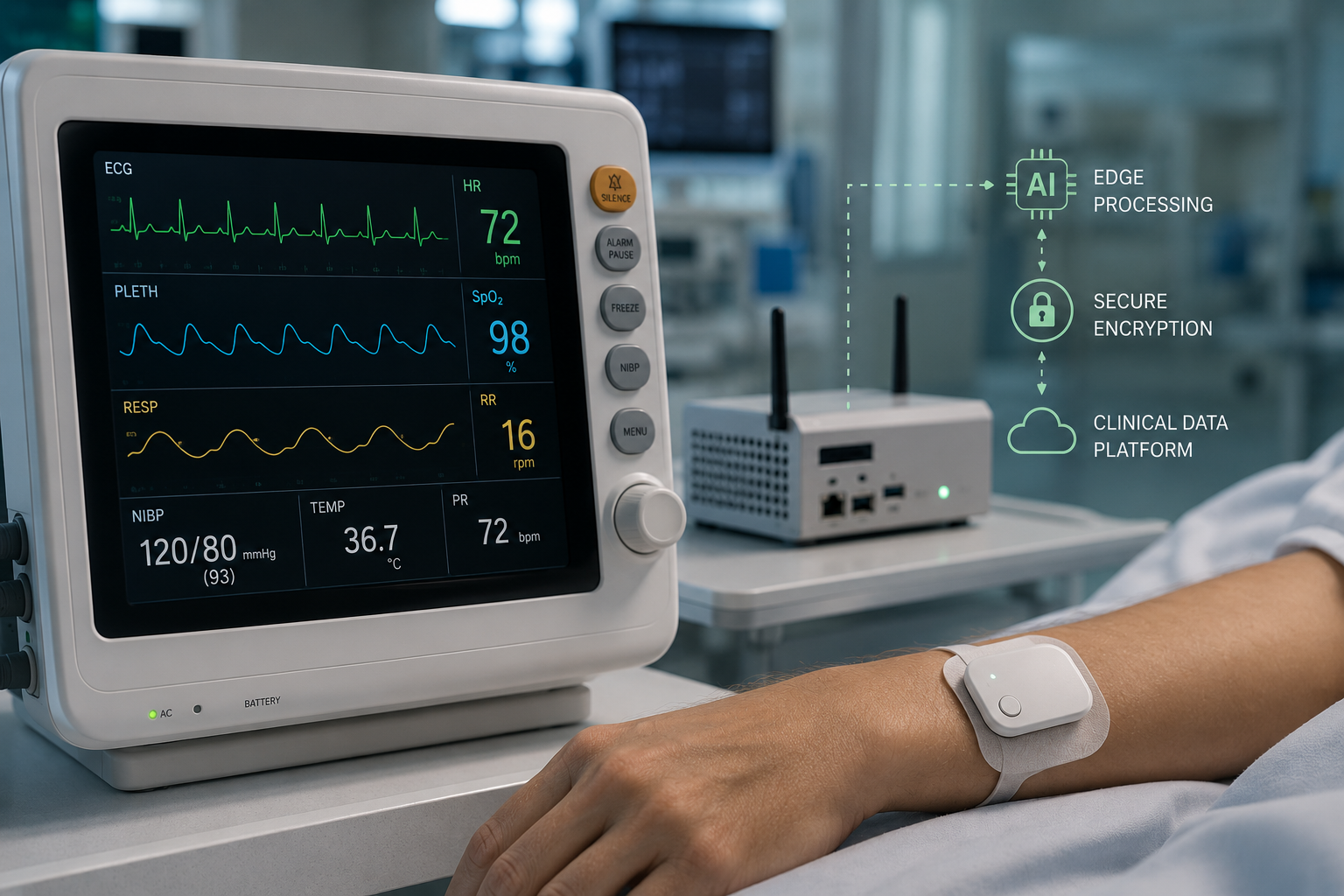
Continuous monitoring technologies are generating unprecedented amounts of patient data. Wearable devices, remote sensors, and connected medical equipment can track vital signs, activity levels, and physiological changes around the clock. AI-enabled cardiac monitoring wearables are already demonstrating how continuous analysis can support earlier detection of arrhythmias that might otherwise go unnoticed during periodic clinical assessments.
AI plays a critical role in transforming this data into actionable insights. Predictive models can identify early warning signs of patient deterioration, helping clinicians intervene before symptoms become clinically apparent. In intensive care environments, predictive deterioration systems are being used to identify subtle physiological changes associated with sepsis, respiratory failure, or cardiac instability, helping clinical teams reduce adverse events through earlier intervention.
For healthcare providers, these capabilities support the shift towards more proactive and preventative models of care.
The rise of connected healthcare devices
As healthcare becomes increasingly connected, medical electronics must operate within larger digital ecosystems. Connected healthcare platforms combine data from monitoring devices, diagnostic equipment, and clinical systems to create a more complete view of patient health.
Achieving this level of integration requires robust interoperability, cybersecurity, and data governance. Medical device manufacturers must ensure that systems can securely exchange information while complying with regulations such as GDPR and HIPAA.
Design engineers also face the challenge of managing diverse data streams generated by imaging systems, monitoring devices, and consumer wearables. Building scalable architectures that maintain data integrity and reliability is becoming a core requirement for modern medical electronics.
Edge AI and real-time decision support
One of the most significant developments in healthcare technology is the adoption of edge AI.
Instead of transmitting all data to the cloud for analysis, edge-enabled devices process information locally. This approach reduces latency, lowers bandwidth requirements, and enables faster clinical decision-making. This is particularly valuable in portable ultrasound systems used in rural or remote settings, where edge AI can assist with image interpretation and clinical guidance even when reliable connectivity is unavailable.
In critical care environments, operating theatres, and remote monitoring applications, edge AI allows systems to respond to changing conditions in real time. Local processing can also support resilience when connectivity is limited, while sensitive patient data remains closer to its source.
For medical device designers, balancing edge performance with cloud-based analytics is becoming an increasingly important engineering consideration.
Looking ahead at agentic AI in healthcare
The next stage of AI development is likely to involve more autonomous, goal-oriented systems. Known as agentic AI, these technologies can coordinate actions across multiple healthcare systems while maintaining human oversight.
For example, an AI agent could identify an abnormal test result, retrieve relevant patient information, recommend follow-up investigations, and notify the appropriate clinical team. Similar approaches are being explored in patient monitoring, scheduling, and hospital operations.
While these systems offer opportunities to streamline workflows, clinical decisions will continue to require human review and accountability.
Engineering for trust and reliability
As AI becomes more deeply embedded within medical electronics, success will depend on more than model accuracy alone. Reliable deployment requires strong data governance, cybersecurity, transparency, and ongoing monitoring.
Healthcare organisations and device manufacturers must ensure that AI systems remain explainable, auditable, and compliant throughout their lifecycle. Human oversight, rigorous testing, and continuous performance monitoring are essential to maintaining trust in clinical environments.
AI is becoming a foundational technology in medical electronics, enabling smarter diagnostics, continuous patient monitoring, and more connected healthcare systems. As edge computing, interoperability, and intelligent devices continue to evolve, design engineers will play a central role in developing the next generation of healthcare technologies.
This article originally appeared in the May/June 2026 edition of IN Electronics. Read the full issue here.