
IN Brief:
- Anritsu’s Tensor VNA adds AI-assisted setup and optimisation for complex RF and microwave measurement workflows.
- The platform uses a dedicated signal source per measurement port, enabling multi-source measurements from compact two- and four-port systems.
- Frequency coverage extends to 54GHz natively, 220GHz with Anritsu millimetre-wave modules, and above 1THz using third-party banded extensions.
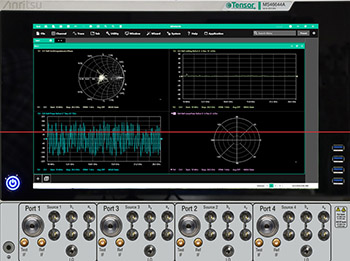
Anritsu has introduced Tensor, a vector network analyser platform built for RF, microwave, millimetre-wave, and sub-THz component characterisation, combining AI-assisted setup, faster data handling, and a dedicated signal source for each measurement port.
Available in two- and four-port configurations, the platform uses a source-per-port architecture to reduce the amount of external instrumentation needed for complex measurements. A four-port Tensor VNA can operate with up to four independent sources, while a two-port chassis can support two-tone stimulus measurements without requiring a larger system configuration. The architecture also supports mixer, converter, and multi-source device testing where independent stimuli are part of the measurement plan.
Frequency coverage extends to 54GHz in the base instrument and to 220GHz when used with Anritsu compact millimetre-wave modules. With third-party banded extensions, the platform can be configured for operation above 1THz, bringing it into the measurement range required for sub-THz device evaluation, high-frequency interconnect work, advanced radar research, and early-stage communications development.
Independent control of multiple sources and receivers gives the instrument true bi-static measurement capability. The platform is designed to characterise passive devices, active devices, and frequency-translating components, including amplifiers, filters, phase shifters, mixers, converters, interconnect structures, and high-speed signal paths. A second local oscillator option supports vector characterisation of converters, including phase and group-delay measurements.
Tensor’s AI engine is intended to help configure and optimise complex test benches, reducing the amount of manual setup required for multi-step measurements. The software can interpret text queries and assist with measurement configuration, while application wizards support amplifier and mixer workflows covering S-parameters, stability, gain compression, AM/AM, AM/PM, intermodulation distortion, intercept points, harmonics, conversion gain, isolation, and LO sensitivity.
Performance improvements extend beyond the user interface. Source powers exceed 15dBm across the instrument’s frequency range, while source spectral purity is improved by around 20dB compared with the previous generation. Power handling is rated above 5W, and port match remains linear for incident powers above 20dBm. Depending on configuration, dynamic range can be around 15dB greater than earlier instruments.
Measurement throughput has also been lifted, with operation around five times faster at 1MHz IF bandwidth. Continuous-wave and few-frequency sweeps can run 10 to 20 times faster, while remote data transfer is around five times quicker than before. Those gains are especially relevant where instruments sit inside automated characterisation, production, or validation systems rather than being used only as standalone laboratory equipment.
As high-speed digital systems move to denser server fabrics, faster backplanes, and lower-loss interconnect structures, multiport measurement is becoming harder to separate from mainstream signal-integrity work. Tensor’s scalable architecture can extend from eight to 128 ports through switch matrices, allowing larger interconnect assemblies to be characterised without turning every test into a heavily manual setup exercise.
The same pressure is visible in RF design automation, where executable RF workflow capture is being pulled into AI-driven design environments. Measurement data remains the anchor point for that shift, since simulation only carries weight when models are tied back to calibrated hardware behaviour. Instruments such as Tensor generate the validated results that keep high-frequency design automation from drifting into abstraction.
Test infrastructure is also becoming a strategic asset in aerospace and defence electronics. The Leonardo UK test-services extension with Keysight underlined the scale of calibration, repair, lifecycle management, and asset control required around radar, avionics, electronic-warfare, and mission systems. Advanced VNAs occupy the same ecosystem, where instrument capability and repeatability influence programme risk as well as laboratory productivity.
Multi-source testing is likely to become more routine as front ends become more integrated and nonlinear behaviour becomes harder to isolate. Power amplifiers, frequency converters, phased-array elements, and optoelectronic components increasingly require measurements that combine phase awareness, wide bandwidth, high dynamic range, and flexible stimulus conditions. A single clean stimulus no longer represents enough of the operating environment.
Tensor’s combination of source-per-port hardware, AI-assisted configuration, faster sweep handling, and extended frequency coverage gives Anritsu a platform shaped around that complexity. High-frequency validation is becoming less sequential, less manual, and more dependent on instruments that can operate as controlled nodes in a broader design and test flow.

