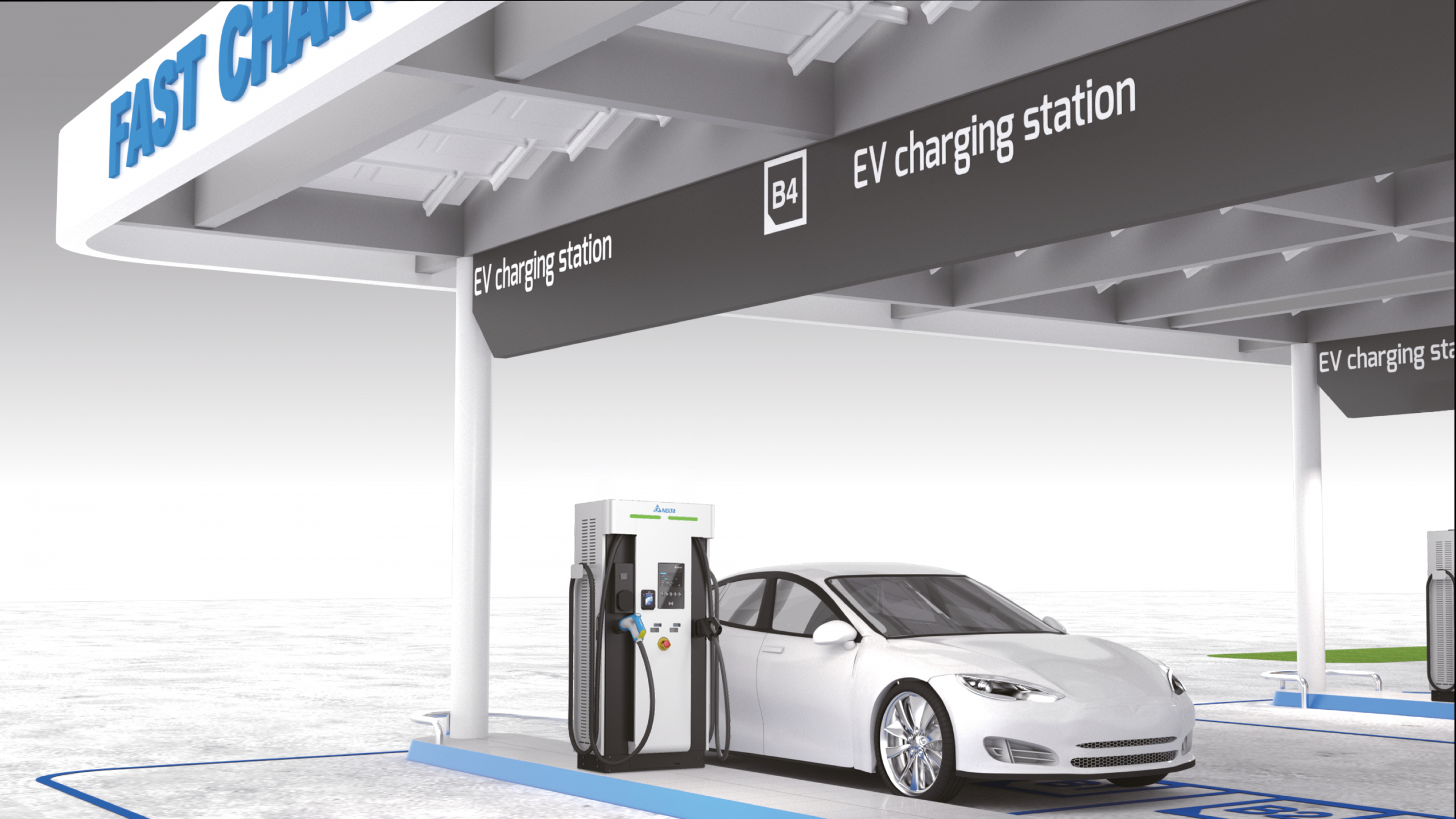
IN Brief:
- Delta’s 100kW SLIM 100 DC charger is now available with German Eichrecht certification.
- The certification enables transparent, tamper-proof energy billing for public charging deployments.
- Calibration-law compliance is becoming a design requirement for DC charging hardware across European infrastructure markets.
Delta has extended its Eichrecht-certified DC charging portfolio with a compliant version of the SLIM 100, a compact 100kW DC charger for public charging sites, commercial fleets, and city-edge depot installations.
The certification allows the SLIM 100 to support transparent and tamper-proof energy billing under Germany’s calibration law. Eichrecht compliance is required for public EV charging infrastructure in Germany and is also relevant in markets such as Austria, along with other European countries examining comparable requirements for metered charging systems.
The SLIM 100 now joins Delta’s previously certified DC Wallbox 50kW and UFC 500 products, giving the company Eichrecht-compliant DC charging options across several power classes. The three chargers use the same technology platform and can be configured for different installation requirements, including product features and exterior designs aligned with operator branding.
Under German calibration law, operators selling energy to consumers must use certified charging stations that function as calibrated metering systems. That requirement reaches beyond the charger’s power stage into measurement accuracy, data integrity, secure billing records, user transparency, and protection against tampering.
EV charging hardware is becoming more complex as infrastructure moves from early roll-out into regulated public operation. Fast DC chargers must combine power conversion, metering, thermal control, communications, safety systems, payment interfaces, and remote monitoring in equipment expected to operate reliably outdoors under high utilisation. Certification adds a further engineering layer because the charger must prove not only that it can deliver power, but that it can measure and bill delivered energy correctly.
Power-electronics components are advancing to support that shift. TDK’s DC-link capacitors for SiC converters and ROHM’s top-side cooling SiC MOSFETs both point to the continuing push for higher efficiency, improved thermal paths, and more compact converter design. Charging infrastructure depends on those component gains as operators seek smaller footprints, lower losses, and better reliability.
Eichrecht brings metrology into the centre of charger design. Accurate billing requires secure measurement chains, data traceability, protected user information, and interfaces that can withstand regulatory scrutiny. Weaknesses in that chain can create customer disputes, operator risk, and procurement delays, particularly in public networks where charging sessions are billed directly to drivers.
Germany’s rules often influence wider European procurement because operators deploying across several markets prefer platforms that can meet stricter requirements rather than managing fragmented charger variants. A certified 100kW unit gives Delta a mid-power option between compact wallbox systems and ultra-fast chargers, with enough capacity for fleets, retail locations, municipal infrastructure, and depot-adjacent public charging.
The 100kW class is commercially attractive because it offers meaningful fast charging while avoiding some of the site constraints associated with the highest-power systems. Grid connection capacity, cable routing, parking layout, charger footprint, service access, and visual impact all affect deployment cost. A compact certified unit can fit locations where ultra-fast charging is either unnecessary or too expensive to install.
As charging networks mature, power level will remain important but will no longer be the sole differentiator. Operators need chargers that satisfy regulation, integrate with back-office systems, maintain metering integrity, and remain serviceable throughout long operating lives. Delta’s Eichrecht-certified SLIM 100 reflects that shift, with compliant power electronics becoming part of a regulated energy infrastructure market rather than a standalone hardware sale.