
IN Brief:
- Westermo, Eviden, and Blu Wireless won DB InfraGO’s Rail Data Transfer Challenge.
- The system used mmWave links to transfer inspection-train data at up to 2.4Gbit/s.
- Rail maintenance is becoming a high-bandwidth electronics problem as sensor and imaging payloads generate terabytes of data.
Westermo, Eviden, and UK-based Blu Wireless have won DB InfraGO’s Rail Data Transfer Challenge after demonstrating high-performance mmWave data transfer under real railway conditions.
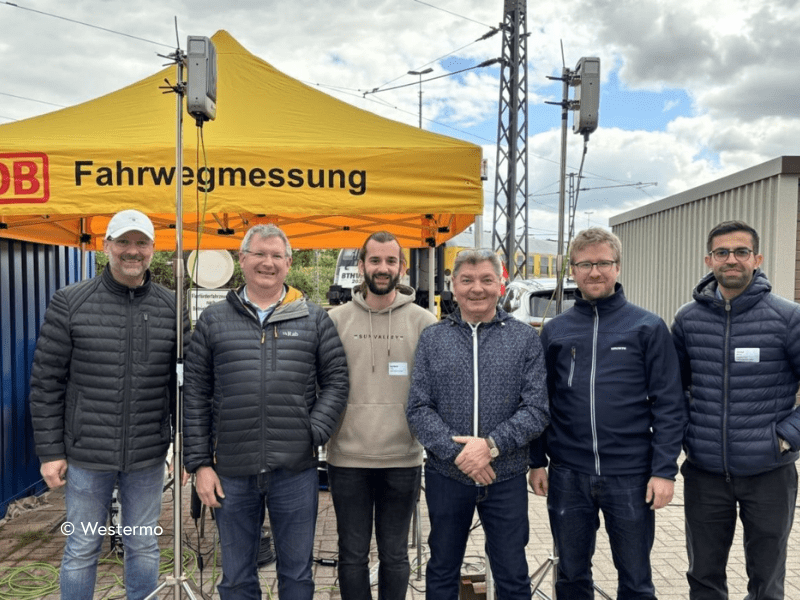
The consortium achieved transfer rates of up to 2.4Gbit/s in a single data stream during a live demonstration in Minden, Germany. The challenge was organised through DB mindbox, Deutsche Bahn’s start-up hub, and focused on moving large volumes of train inspection data from rolling stock to ground infrastructure without manual handling.
Inspection trains can generate up to 10TB of data each day as high-resolution images, video, and sensor streams are collected for track inspection, asset monitoring, maintenance planning, and safety-related infrastructure assessment. Moving that volume of data during the limited dwell time available in depots has become a constraint on digital rail maintenance.
The winning system combined Blu Wireless mmWave communications, Westermo’s railway networking experience, and Eviden’s data pre-processing and post-processing capability. It was developed for automated operation, reduced manual intervention, and scalable deployment across depot and maintenance environments.
Rail depots are difficult RF environments, with metallic structures, moving vehicles, safety restrictions, legacy assets, and tight operating schedules. A train-to-ground system has to combine high bandwidth with link reliability, predictable installation, cybersecurity, maintainability, and integration with onboard storage and data-processing systems.
Blu Wireless gives the project a UK engineering link. The Bristol company has developed mmWave systems for transport and infrastructure applications, and Westermo has previously invested in the business to strengthen its rail connectivity portfolio. Deutsche Bahn’s challenge gives the technology a live operational reference in one of Europe’s largest rail markets.
The wider engineering context is the insertion of advanced connectivity into long-life transport platforms. Discussions around solid-state power amplifiers replacing travelling wave tube amplifiers in aerospace and satellite systems show a similar pattern: high-frequency electronics must often be introduced into assets that were not originally designed around today’s bandwidth demands.
Rail maintenance is moving towards heavier sensor coverage and more automated condition assessment. Track geometry, overhead-line condition, surface defects, vegetation, thermal behaviour, and equipment status can all be measured more frequently, but additional sensing only improves operations when the data reaches analysis systems quickly enough to inform decisions.
That makes communications architecture part of the maintenance chain. If inspection data remains locked on a vehicle until it is manually removed, the cadence of analysis is constrained by depot process rather than sensor capability. High-capacity wireless offload reduces the gap between measurement and action, particularly where operators want to increase inspection frequency without adding proportional manual workload.
mmWave has often been discussed through consumer and telecom deployment, yet controlled industrial transport settings can offer a more suitable operating environment. Short-range, high-capacity links in depots or fixed transfer zones can exploit the available bandwidth while keeping the radio geometry more predictable than wide-area mobile service.
Operational deployment will still require ruggedisation, installation procedures, fleet-system integration, certification, cybersecurity assurance, and long-term support. The Minden demonstration nevertheless gives rail operators a practical route for removing one of the quieter bottlenecks in digital infrastructure maintenance: getting inspection data off the train fast enough for it to be useful.

