IN Brief:
- Rocket Lab has agreed to acquire Iridium in a cash-and-stock transaction valuing the business at around $8bn.
- The deal combines launch, spacecraft manufacturing, satellite operations, L-band connectivity, IoT, and PNT services.
- The transaction would create a vertically integrated space systems and services company, subject to approvals and closing conditions.
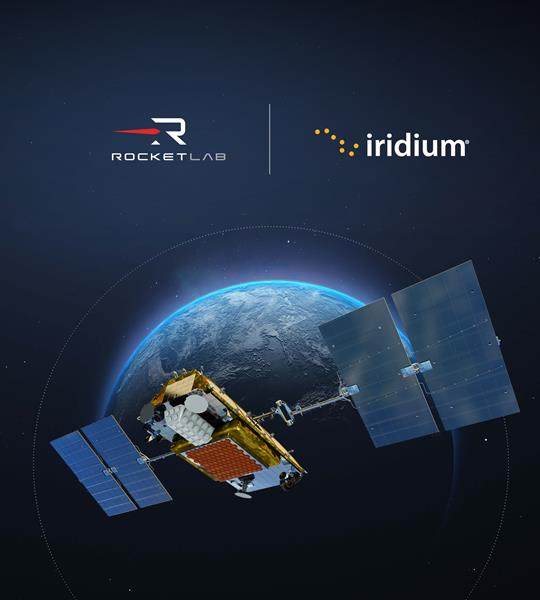
Rocket Lab has agreed to acquire Iridium Communications in a cash-and-stock transaction valued at around $8bn, bringing together launch services, spacecraft manufacturing, satellite operations, L-band communications, IoT, direct-to-device capability, and positioning, navigation, and timing services.
Under the agreement, Iridium shareholders will receive $54 per share, made up of $27 in cash and Rocket Lab common stock calculated under an exchange ratio. The transaction is expected to complete in mid-2027, subject to Iridium shareholder approval, regulatory clearance, and customary closing conditions.
The deal would give Rocket Lab ownership of Iridium’s low Earth orbit satellite network, globally harmonised L-band spectrum, and more than 500 partner relationships. Iridium’s services support government, defence, maritime, aviation, commercial, and industrial users, with more than 2.55 million active subscribers worldwide. Its network also provides an alternative PNT architecture where GPS and other GNSS signals are degraded or unavailable.
Rocket Lab gains a recurring satellite-services business alongside its launch and spacecraft manufacturing operations. Iridium generated $871.7m in revenue in 2025, giving the combined company a more balanced profile across hardware production, orbital access, and communications services.
Space electronics is becoming more vertically integrated as satellite communications, orbital manufacturing, and service operation converge. Sivers’ Ka-band beamforming IC order for ALL.SPACE terminals shows the continuing demand for specialist RF front-end hardware in satellite communications, while BAE Systems’ Vantor imaging satellite work shows how spacecraft-bus manufacturing is also moving toward repeatable constellation production.
The electronics stack behind satellite communications is broad. Terminals, payloads, spacecraft buses, ground systems, timing hardware, RF front ends, phased arrays, power systems, thermal design, secure communications, and onboard processing all influence the reliability and economics of a network. A vertically integrated operator can align spacecraft replenishment, payload development, launch planning, and service evolution more closely than a business split across separate providers.
L-band capability gives the transaction additional weight. Lower-frequency satellite links offer resilience and global reach in remote or degraded environments where terrestrial infrastructure is unavailable, damaged, or unsuitable. That is valuable in maritime safety, aviation tracking, defence communications, emergency response, industrial IoT, and remote asset monitoring.
The acquisition also comes as non-terrestrial networks move closer to mainstream device architectures. Standards-based satellite IoT and direct-to-device services place new demands on modules, antennas, RF filtering, power management, software stacks, and certification. Devices that once relied exclusively on terrestrial networks are increasingly being designed with satellite fallback, resilient positioning, or global low-data-rate coverage in mind.
Component suppliers may see a more disciplined qualification environment as satellite operators consolidate. Integrated space businesses can offer clearer long-term roadmaps, but they may also centralise procurement, impose stricter lifecycle requirements, and expect hardware suppliers to support longer service continuity. RF, timing, processing, memory, power, and radiation-tolerant component strategies will all need to align with constellation refresh cycles and network-service commitments.
Rocket Lab’s proposed acquisition of Iridium therefore marks a significant shift in the commercial structure around space electronics. The market is moving beyond launch cadence and spacecraft build rates into integrated orbital infrastructure, where spectrum rights, satellite hardware, manufacturing repeatability, and service continuity are part of the same engineering equation.