IN Brief:
- IDS cameras are supporting synchronised multi-camera imaging of atmospheric-pressure plasma jets.
- The Leibniz INP setup captures discharge structures changing at microsecond scale and sub-millimetre dimensions.
- The work highlights the role of industrial imaging in scientific instrumentation, plasma medicine, and high-speed measurement.
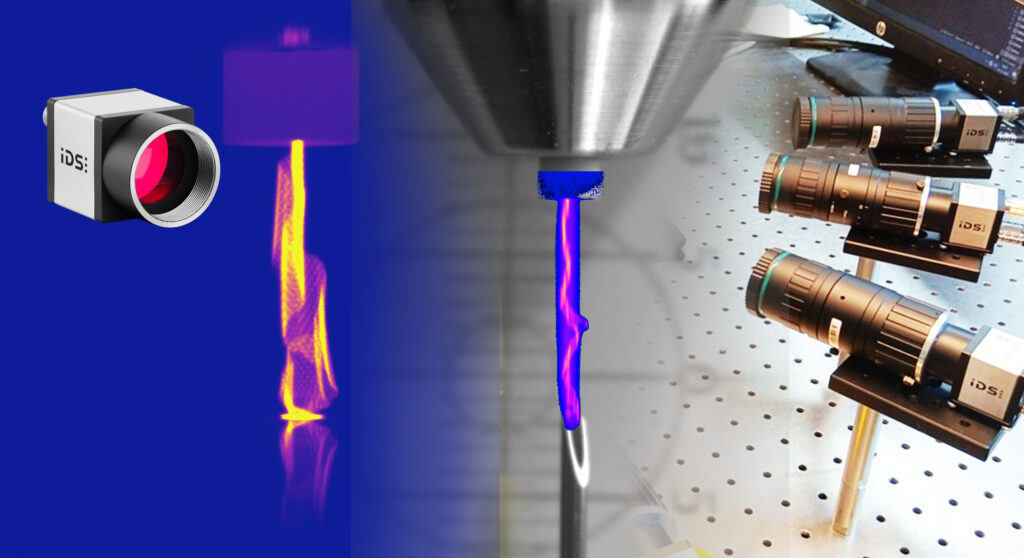
IDS Imaging Development Systems industrial cameras are being used by researchers at the Leibniz Institute for Plasma Science and Technology to reconstruct plasma jet discharges in three dimensions.
The work centres on the kINPen plasma jet, an atmospheric-pressure cold plasma source developed at the Greifswald-based institute. The plasma leaves the device as a small, highly dynamic, light-emitting filament, with discharge behaviour changing at microsecond scale inside a very small spatial volume.
Conventional measurement struggles with that combination of speed and size. The discharge structure has a period of about 1µs, with a diameter of around 0.1mm and a length of approximately 10mm. A synchronised multi-camera setup built around IDS industrial cameras allows the research team to capture the discharge from multiple viewing angles and reconstruct its three-dimensional structure.
The reconstructed data gives researchers a clearer view of how individual plasma jet discharges form, propagate, and change over time. That experimental foundation is relevant to surface treatment, materials processing, sterilisation, and plasma medicine, where cold atmospheric plasma sources are being developed for technical and biomedical use.
Industrial cameras are commonly associated with factory inspection, automation, and machine vision, yet the same attributes are valuable in research instrumentation. Exposure timing, trigger repeatability, synchronisation, sensor sensitivity, optical calibration, and data handling become decisive when the subject is small, fast, bright, and physically unstable.
High-speed sensor data is also becoming more tightly linked with embedded processing and interface design. Sony’s expanded role in MIPI interface development sits on the same technical path, where sensors, camera modules, processors, and embedded platforms require predictable high-speed links before the data can be useful.
Plasma medicine adds a demanding control environment. Medical plasma systems depend on the behaviour of reactive species, thermal load, electrical conditions, exposure time, and tissue interaction. Before devices can be engineered for repeatable use, the discharge must be characterised with enough confidence to support process control and safety assessment.
Multi-camera reconstruction gives researchers a spatial view that a single camera cannot provide. Asymmetry, filament shape, propagation path, and discharge evolution can be studied in three dimensions, rather than inferred from a flattened image. Small geometric errors still matter, which places heavy demands on calibration and synchronisation across the imaging system.
The electronics behind the measurement are as important as the camera body. Sensors must be triggered with sufficient precision, lenses must provide the required spatial resolution, exposure must match the discharge behaviour, and the acquisition system must avoid timing artefacts. The reconstruction software then depends on consistent and well-calibrated input from each camera view.
Such systems also put pressure on storage, processing, and experiment control, because high-speed image sequences can quickly become the largest data source in the laboratory. Camera selection therefore has to be matched to triggering hardware, host interfaces, memory bandwidth, and analysis software, rather than treated as a standalone optical choice.
The project reflects a broader convergence between scientific instrumentation and industrial imaging. Cameras designed for robust industrial use are increasingly capable of research-grade measurement, while scientific applications continue to push timing, synchronisation, and processing techniques that later influence inspection, automation, and medical-device engineering.
Plasma jet reconstruction is a specialised application, but the underlying requirement is becoming common: electronic systems must capture fast physical behaviour accurately enough for measurement, control, and validation. As machines and medical systems interact more directly with dynamic physical processes, synchronised imaging is moving from a specialist research tool toward a practical engineering capability.