
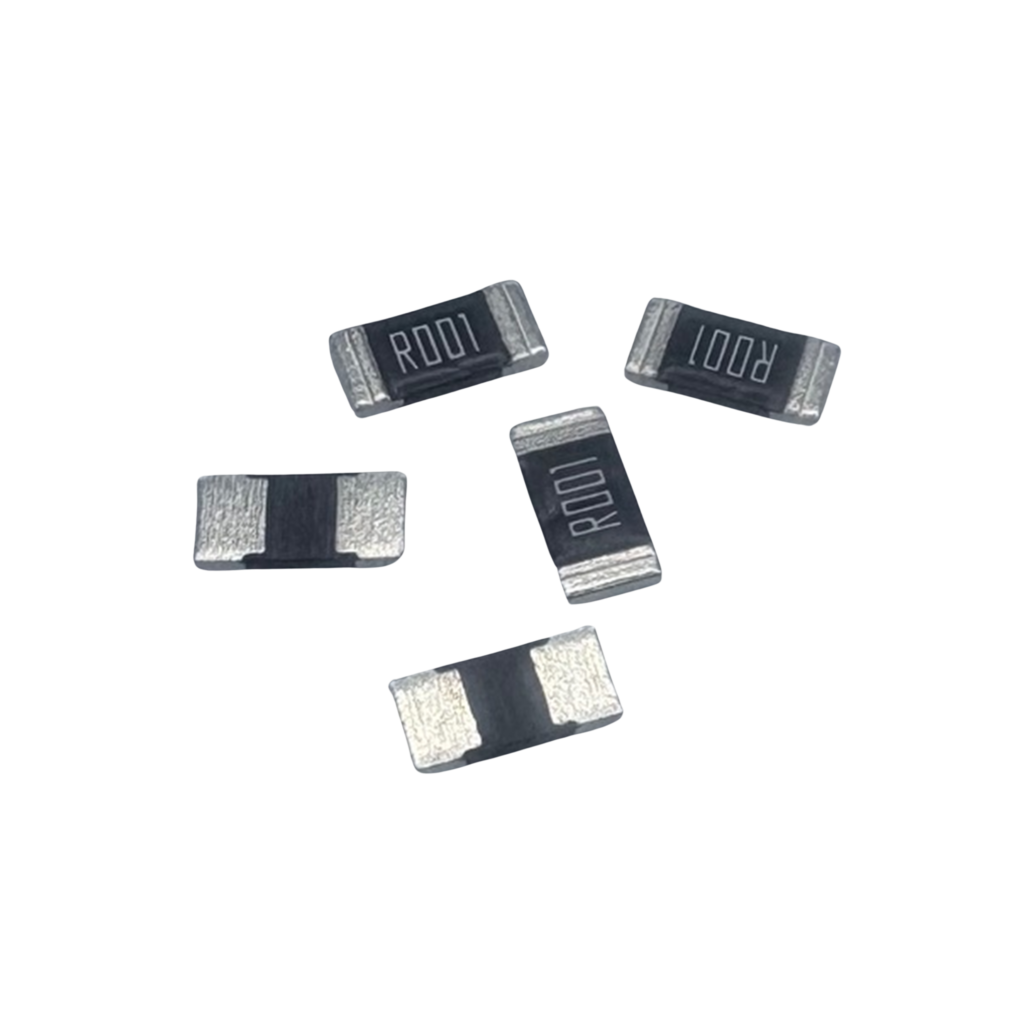
IN Brief:
- Stackpole has added 0.5mΩ and 20mΩ values to its CSSU current-sense resistor series.
- The devices maintain a 5W rating in a 2512 package.
- Applications include battery management, automotive electronics, motor drives, industrial power supplies, DC-DC converters, and renewable energy equipment.
Stackpole Electronics has expanded its CSSU series of high-power metal-alloy current-sense resistors with 0.5mΩ and 20mΩ resistance values.
The new additions extend the family’s usable range while maintaining a 5W power rating in a 2512 package. The 0.5mΩ value is intended for high-current circuits where lower resistance reduces dissipation and measurement loss, while the 20mΩ option provides a larger sense voltage for lower-current designs or applications that need greater measurement headroom.
The CSSU series is designed for demanding power electronics environments, combining low resistance, low temperature coefficient of resistance, long-term stability, and AEC-Q200 qualification. Battery management systems, automotive electronics, motor drives, industrial power supplies, DC-DC converters, renewable energy equipment, and other high-current control systems are among the target applications.
Current sensing is a small but decisive part of the power architecture. A shunt resistor helps determine how accurately a system measures load current, detects faults, balances cells, regulates conversion stages, controls motor torque, and protects semiconductor switches. Measurement errors can quickly become control errors, particularly in fast-switching or thermally constrained designs.
The 0.5mΩ value serves circuits where losses are highly visible. At high current, even a small increase in resistance can raise I²R loss and local temperature. Reducing shunt resistance improves efficiency and eases thermal design, but it also reduces the voltage available to the measurement circuit, placing more pressure on amplifier offset, ADC resolution, noise performance, and PCB layout.
The 20mΩ value addresses the opposite design condition. A higher sense voltage can simplify the measurement chain and improve signal-to-noise performance in lower-current designs, although voltage drop and dissipation still need to be controlled. The wider resistance spread gives engineers more flexibility without changing package class or series qualification strategy.
Power conversion is being pushed toward higher density and lower loss across several component categories. Fifth-generation SiC MOSFET development from ROHM shows the pressure on active devices, while current sensing sets the measurement quality behind the control loop. Fast switches, compact layouts, and high current density leave less margin for drift, parasitics, or thermal mismatch.
Thermal modelling also becomes harder as low-value shunts are placed near power switches, inductors, connectors, or busbars. Local copper area, airflow, enclosure temperature, solder-joint design, and board material can all alter the apparent stability of a current measurement path under sustained load.
Passive components often set practical reliability limits in these systems. Current-sense resistors must tolerate heat, pulse energy, solder-joint stress, vibration, humidity, and long operating lifetimes. Their resistance must remain predictable because protection thresholds and regulation loops are built around it.
Battery systems make those constraints particularly visible. Current measurement feeds state-of-charge estimation, charge and discharge control, overcurrent detection, and diagnostics. Motor drives use current feedback for torque control, phase balancing, and fault detection. Industrial power supplies and DC-DC converters depend on current sensing for loop stability, overload behaviour, and efficiency optimisation.
PCB implementation remains central to performance. Kelvin connections, copper geometry, thermal spreading, amplifier placement, common-mode voltage, and transient currents all affect measurement accuracy. A current-sense resistor cannot be treated as a generic passive part once the system moves into high-current, high-speed, or safety-related operation.
The CSSU expansion gives designers more choice within a compact high-power footprint. As power electronics spreads from AI infrastructure and automotive systems into industrial drives, renewable equipment, battery platforms, and compact converters, small measurement components are becoming more influential in the overall behaviour of the power stage.

