IN Brief:
- SEMI has warned that direct intervention in memory markets could intensify supply pressure.
- AI demand is pulling wafer capacity and packaging resources toward high-bandwidth memory.
- Embedded, industrial, and infrastructure designs face tighter planning around DRAM, HBM, and lifecycle availability.
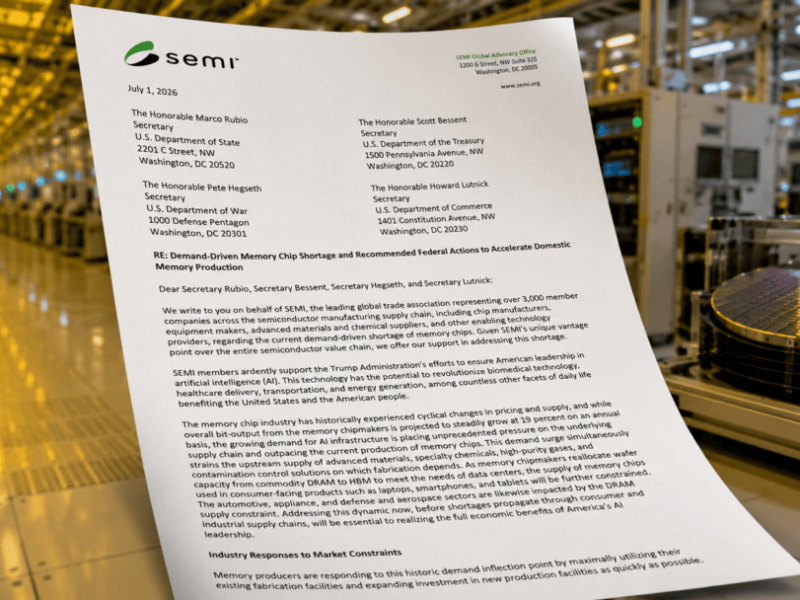
SEMI has warned that direct intervention in memory markets could worsen supply pressure while AI infrastructure demand reshapes DRAM and high-bandwidth memory allocation.
The warning centres on the risk that attempts to force short-term supply outcomes could disrupt an already constrained market. AI accelerators are driving strong demand for HBM, a stacked memory category that depends on advanced DRAM manufacturing, packaging capability, and close alignment with processor roadmaps. As suppliers prioritise high-growth AI platforms, conventional DRAM availability can be affected by capacity allocation, wafer starts, and investment timing.
Memory is now a system-level constraint across electronics. HBM sits at the centre of AI accelerator performance, while the same manufacturing base also supports DDR5, LPDDR, conventional DRAM families, and embedded memory routes used by industrial, telecoms, medical, automotive, and computing platforms. A market shift toward one product family can alter pricing, lead times, and sourcing assumptions elsewhere.
Micron’s Hiroshima HBM expansion underlined the scale of investment now moving into advanced DRAM and HBM production, with equipment installation expected from the second half of 2028. Memory demand can move in quarters, while qualified wafer and packaging capacity arrives over years.
The pressure also runs through the wider electronics market analysis in the latest quarterly sector review, where memory sits beside packaging, optics, edge AI, power delivery, and EDA automation as a linked design constraint. Memory selection is no longer a procurement line that can be finalised late without consequence.
HBM is especially exposed because it combines high-end DRAM die, stacking, through-silicon via processing, advanced packaging, thermal management, and close qualification with accelerator vendors. Capacity pressure does not stop at wafer fabrication. Assembly, test, substrate availability, and customer-specific validation all affect usable supply. When demand accelerates from AI clusters, the impact spreads through more than one layer of the memory chain.
Industrial electronics feels that pressure in a less visible but persistent way. Products with long service lives require stable memory availability, firmware compatibility, environmental qualification, and controlled change management. A shift from one DRAM family or package to another can trigger hardware redesign, software work, EMC retesting, safety analysis, or renewed customer approval.
Embedded systems are also becoming more memory-hungry. Local AI inference, machine vision, robotics, industrial gateways, software-defined equipment, and higher-resolution sensor processing all increase pressure on bandwidth, capacity, and endurance. These systems may not use HBM, but they sit in a market influenced by the same capital spending decisions and production priorities.
Governments increasingly view memory as strategic because AI, defence, cloud infrastructure, automotive electronics, and critical systems depend on predictable supply. Memory markets, however, remain cyclical, capital-intensive, and technically specialised. Intervention that ignores manufacturing lead times, product qualification, and capacity trade-offs may shift shortages rather than solve them.
Design teams have few simple options beyond earlier planning. Approved vendor lists, second-source strategy, lifecycle monitoring, software abstraction, disciplined memory down-selection, and long-term supply agreements are becoming more important. The cheapest suitable memory part at prototype stage may carry more production risk than a device with stronger lifecycle support.
SEMI’s warning places AI demand and conventional electronics supply in the same frame. HBM may be the visible pressure point, but the consequences reach into products where reliability, availability, and qualification stability still decide whether systems can be built and maintained.