IN Brief:
- Panasonic Industry Europe has expanded its passive infrared sensor portfolio with PaPIRs+.
- The sensor technology targets building automation, lighting control, HVAC, and smart infrastructure.
- Higher spatial detection performance supports lower-power, more responsive presence and motion sensing.
Panasonic Industry Europe has expanded its passive infrared motion sensor portfolio with PaPIRs+, targeting building automation, lighting control, HVAC, and smart infrastructure applications.
The new sensor technology extends Panasonic’s established PaPIRs line with upgraded spatial detection performance for systems that need reliable motion or presence sensing while maintaining compact dimensions and low power consumption. The portfolio is aimed at designs where the sensing layer has to operate unobtrusively, efficiently, and predictably across commercial, industrial, and infrastructure environments.
Passive infrared sensors detect temperature changes caused by moving people or objects. In building automation, they are widely used to trigger lighting, ventilation, security, access, and energy-management functions. The engineering challenge is not simply detecting motion, but detecting it accurately enough to avoid false triggers, missed occupancy, unnecessary energy use, and poor user experience.
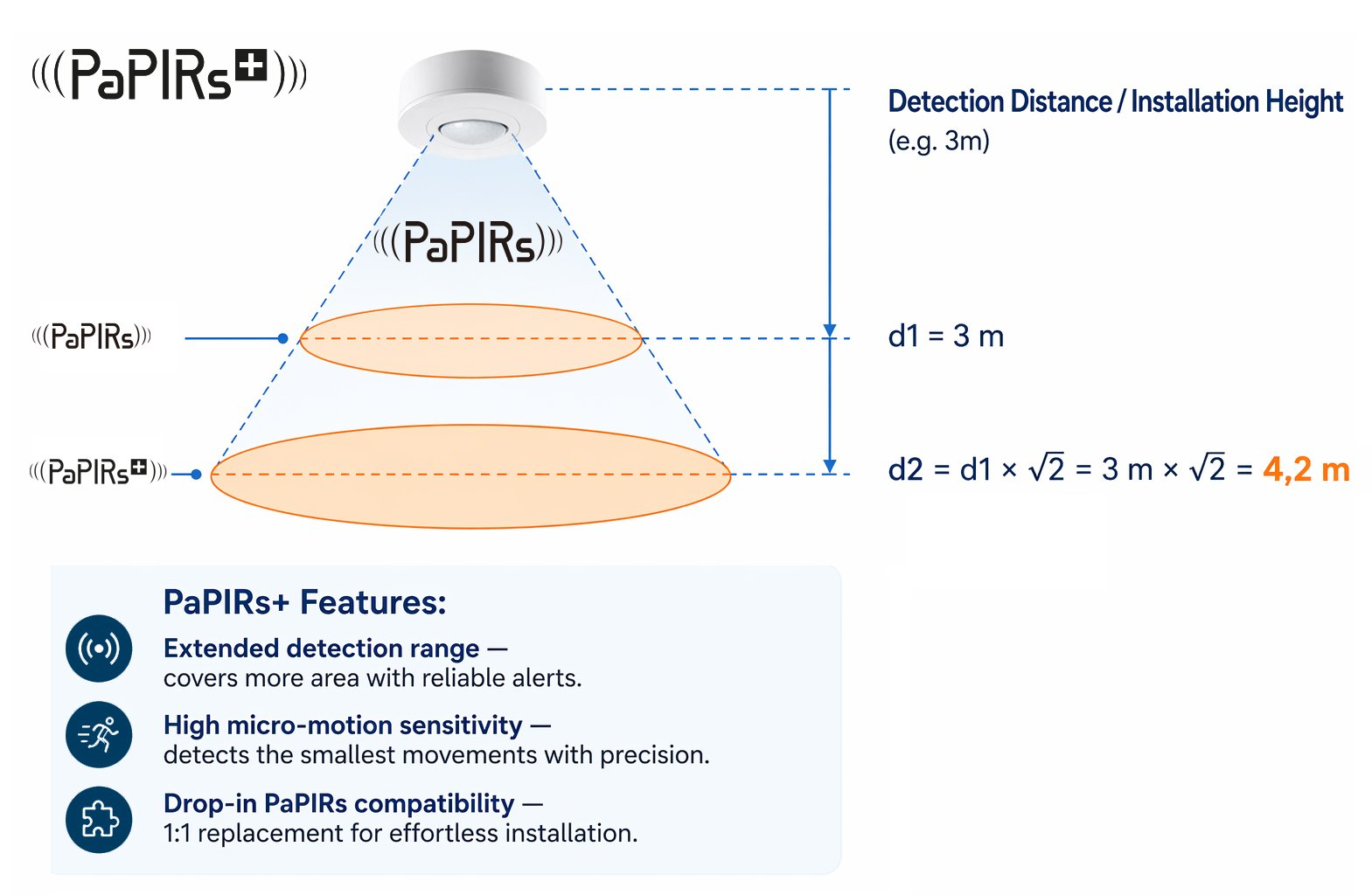
Panasonic’s published PaPIRs+ details have included a flat wide-detection type with coverage of around 15m diameter at a 3m ceiling mounting height, 416 detection zones, a 32.6mm lens diameter, current-consumption variants from 1µA to 170µA, digital open-drain and analogue op-amp output options, and an operating-temperature range of -20°C to +60°C. The combination gives designers scope to balance detection range, power budget, output architecture, and application requirements.
The LED-lighting connection is increasingly important. Modern lighting systems depend on sensors, controllers, wireless links, daylight harvesting, scheduling, and building-management integration. A luminaire or lighting-control node is often a distributed sensing and control point inside a larger automation network rather than a simple switched load.
Component-level sensing is becoming more integrated across several electronics markets. Melexis’ digital current-sensing device for EV inverters shows the same movement from raw detection toward devices that absorb more of the accuracy, conditioning, diagnostics, and integration burden around the component.
Energy use and operating cost are pushing this change through building systems. Lighting, HVAC, and ventilation are among the largest controllable loads in commercial buildings. Occupancy sensing allows systems to reduce waste, although weak sensing quickly undermines the saving. If lights turn off while a space is occupied, users override the automation. If HVAC runs when rooms are empty, efficiency gains disappear.
Sensor placement continues to shape system performance. Ceiling height, detection angle, lens pattern, room geometry, obstructions, temperature gradients, air movement, and the thermal contrast between people and background surfaces can all influence PIR behaviour. A wider detection field and denser sensing zones give product designers more flexibility, although the final system still depends on mechanical design, firmware logic, and installation guidance.
Low current consumption gives developers another design lever. Battery-powered nodes, energy-harvesting devices, wireless lighting controls, and retrofit building sensors all benefit from lower standby load. Reduced maintenance frequency improves viability in locations where cabling is expensive, disruptive, or impossible.
The smart infrastructure use case extends the opportunity beyond office lighting. Public buildings, transport hubs, education estates, healthcare sites, logistics facilities, and industrial plants all need more granular visibility of occupancy and movement. Sensing can support safety, utilisation analysis, energy management, and predictive maintenance when integrated into wider control systems.
PaPIRs+ strengthens Panasonic’s position in the sensing layer of building electronics. The component is small, but it sits at a decisive point in the control chain: the moment a system decides whether a person, machine, or space requires action.