
IN Brief:
- The Axelera AI Mini PC combines a Metis M.2 MAX accelerator with an Intel Core Ultra 125H processor.
- The system can process more than 25 simultaneous 1080p video streams at 20 frames per second.
- Local inference reduces dependence on discrete GPUs and central servers in multi-camera industrial systems.
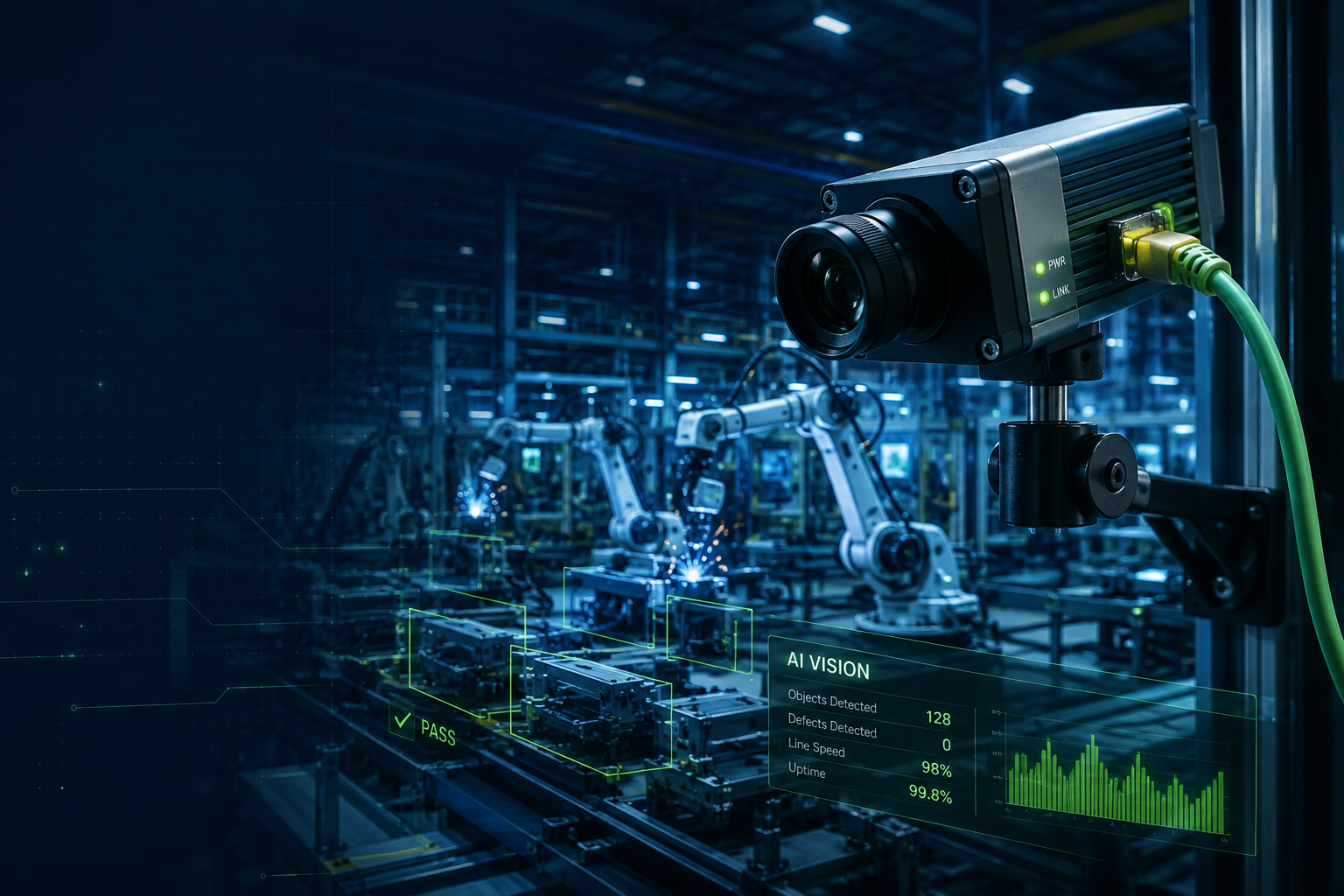
Axelera AI has introduced a compact edge computer capable of processing more than 25 simultaneous 1080p computer-vision streams without using a discrete graphics processor.
The Axelera AI Mini PC combines the company’s Metis M.2 MAX accelerator with an Intel Core Ultra 125H processor, 32GB of DDR5 memory operating at up to 5,600MT/s, and 256GB of NVMe storage. An actively cooled 8GB accelerator provides the dedicated inference hardware.
Typical accelerator consumption is specified between 3.5W and 11W, with energy efficiency of up to 15 tera operations per second per watt. The complete system has an operating-temperature range of 0°C to 40°C, which suits controlled indoor environments or installations using a separate industrial enclosure.
Multi-camera performance extends beyond 25 concurrent 1080p streams at 20 frames per second. Production inspection, traffic monitoring, security, logistics, retail analytics, and other continuous-video applications can therefore be consolidated onto one node rather than distributed across several smaller systems.
Pre-processing, post-processing, display rendering, and system management are handled by the Intel processor, while the Metis device executes the neural-network workload. Removing a conventional GPU reduces the required power-supply capacity and cooling load, although the CPU, memory, storage, voltage regulation, and active fan still contribute to the thermal design.
Axelera’s Voyager software development kit covers model optimisation, quantisation, conversion, deployment, and runtime monitoring. More than 100 pre-trained models are available for tasks including object detection, classification, semantic and instance segmentation, pose estimation, face processing, and licence-plate recognition.
Published model support can shorten initial development, but deployment still requires validation against the camera, optics, lighting, scene geometry, and production conditions. A network trained on general images may need substantial retraining before it can identify small surface defects, variable assemblies, or events occurring under difficult illumination.
Data movement competes with inference performance
Once several cameras are connected, the accelerator is only one part of the throughput calculation. Camera interfaces, Ethernet bandwidth, image decoding, pre-processing, memory movement, storage, triggering, and control-system integration may become restrictive before the available inference capacity has been exhausted.
Twenty-five video streams also create extensive data-governance requirements. Even where raw footage remains local, selected images may be retained for quality records, incident investigation, model retraining, or regulatory evidence, requiring defined storage periods, metadata, timestamps, and access controls.
Processing beside the camera reduces the amount of raw video transmitted to a central server and can shorten response time where decisions must be made near a production line or controlled access point. Local inference also allows the application to continue during a network interruption, although fleet management and remote maintenance still depend on reliable connectivity.
Edge AI has already been moving down through the embedded stack, with dedicated accelerators appearing in industrial computers, modules, cameras, and lower-power controllers. The correct level of compute depends on workload density: one modest classification task may fit inside a smart sensor, while segmentation and tracking across several cameras can justify a shared edge node.
Long service lives create a different pressure. Industrial equipment may remain deployed beyond the commercial lifespan of a particular AI framework, operating system, or model format, so conversion tools, security patches, driver support, and a migration path become part of the hardware decision.
Software reproducibility is equally significant when many systems run the same model. Accelerator firmware, runtime version, operating-system image, neural-network weights, and pre-processing parameters must be controlled together, since an apparently minor software change can alter latency or detection behaviour across an installed fleet.
Thermal performance deserves particular scrutiny near production equipment. Dust accumulation, fan wear, restricted airflow, and elevated enclosure temperatures can reduce sustained processing speed even when short benchmark runs remain within specification. An active cooling system must therefore be accessible for maintenance or protected from the surrounding environment.
Local AI also widens the cybersecurity boundary because each edge computer stores models, application logic, credentials, and potentially sensitive images. Secure boot, encrypted communications, controlled updates, and device identity are required if a compromised node could alter an inspection decision or provide access to a wider operational network.
By supplying the accelerator, host processor, memory, storage, cooling, and software as a complete platform, Axelera has reduced the integration work involved in evaluating its architecture. Developers can measure model latency, camera density, and total system power against a defined reference rather than assembling a host and accelerator independently.
The Mini PC occupies the space between small embedded vision controllers and high-power GPU servers. Sustained software support, environmental integration, and predictable behaviour across real models will determine its industrial lifespan, but the hardware demonstrates how much multi-camera inference can now be concentrated into a conventional compact computer.

